
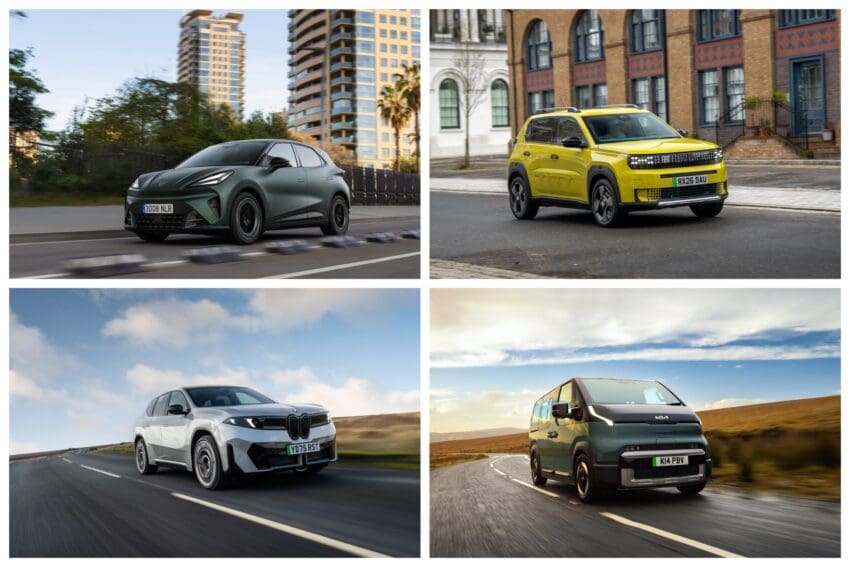
The EV Powered team run down their favourite models from the first six months of the year
Somewhat astonishingly, it’s the middle of 2026 already. We’re not entirely sure how that’s happened – it seems like only yesterday we were issuing advice on how to maximise range in the dead of winter.
Anyway, here we are, and the midpoint of the year seems like an ideal time to reflect on all the new EVs we’ve driven this year and begin to sort the wheat from the chaff. We’ve tested everything from high-performance hot hatches to super-cheap superminis and an awful lot of C-segment SUVs.
But what has caught our attention and might be among our cars of the year come December? Read on to find out.
BMW iX3

Remember when all those EV skeptics said they’d only ever drive one once they could do 500 miles? Well their time is here. The BMW iX3 is the UK’s first EV with an official 500-mile range. That in itself (and the engineering that allows it) is an achievement to be celebrated, but it’s also just a brilliant all-round car. It’s a big, comfortable SUV with space for the entire family. The interior is high-quality and high-tech but smart and user-friendly. It’s also a pleasure to drive and packs a punchy 463bhp for typical BMW performance. And with peak charging of 400kW, it’s one of the fastest charging cars in the country, adding 231 miles in just 10 minutes.
Fiat Grande Panda

The Fiat Grande Panda is part of the new wave of affordable, fun small EVs alongside the likes of the Renault 5 and Hyundai Inster, and continues Fiat’s long history of building cheap and cheerful little cars that owners will fall in love with. Its design alone is almost enough to win a place on this list thanks to its loving homage to the original Panda. However, there’s more to it than just looks which brilliantly blend retro and modern. Its 111bhp motor and 44kWh battery aren’t massive, but provide all that most city drivers need, and the interior is stylish, simple and surprisingly spacious.
Volvo ES90

Volvo’s first attempt at an all-electric saloon earns its place on this list with one caveat. As we’ve talked about with other Volvo cars, every function is controlled via the touchscreen and it’s neither clear or intuitive enough. Putting that aside, however, the ES90 is a delightful executive saloon that deserves to be considered against the best from Audi, BMW or Mercedes. It delivers on all the usual Volvo qualities, being hugely spacious and comfortable, and refined and effortless to drive. It’s also loaded with the latest high-tech equipment and offers some of the longest range and fastest charging out there, with almost 440 miles per charge and the ability to top-up at 350kW.
Cupra Raval

Cupra has quietly evolved from Seat’s sporty sub-brand to the head of the family and the Raval is the latest and probably best example of that. Its new MEB+ platform was developed from the ground up by Cupra’s engineers for the entire VW Group, and it’s a compact hot hatch that delivers on Cupra’s ambitions with razor-sharp looks and performance. There are “sensible” powertrain options and a starting price of £23,785 for those seeking a regular small car, but the VZ spec brings 223bhp and bespoke chassis hardware/software that deliver a thoroughly lively and engaging driving experience. Amid overpowered all-wheel-drive monsters, it embodies the timeless joy of a well set up front-driven hot hatch.
Rolls-Royce Black Badge Spectre

Yes, we’re bending the rules slightly here since this car launched in 2025. But we only drove it this year, and it made such an impression it’s impossible not to include. How do you make the best electric car in the world even better? Give it more power, obviously. But the 650bhp Black Badge Spectre does more than that. It also tweaks the chassis and motor management for a more dynamic feel. This is still a Rolls-Royce, so refinement and comfort are still the primary concern, but the Black Badge brings a sharper edge and can swallow up tough cross-country routes with remarkable aplomb for a 5.5-metre, 2.7-tonne private lounge on wheels.
Hyundai Inster

The Inster is another car we’ve cheated with. It launched in the UK in summer 2025 but both Matt and George drove it for the first time in 2026 and were immediately charmed by this unusual little machine. Its Fisher Price look and feel will definitely divide opinion, but amid so much bland automotive design, this quirky little pseudo-SUV exudes charm and character. It also packs remarkable practicality into its tiny 3.8-metre footprint and there’s genuinely space for four average adults on board. On top of (or beneath) that, Hyundai’s EV expertise shines through in a range of 224 miles and a city-friendly setup that makes urban motoring a breeze.
Toyota C-HR+

Toyota’s EV game got off to a wobbly start with the original bZ4X, and it’s still not as far along as some other “legacy” brands, but this year’s C-HR+ shows that the Japanese giant is getting its act together. Not only is this family-focused C-segment SUV Toyota’s best EV to date, it’s also a serious contender in a field of strong options. Starting at under £33,000, it’s competitively priced, well equipped, good to drive and offers up to 376 miles of range. It also comes with Toyota’s unrivalled 10-year warranty on car and battery, plus its traditional bombproof construction.
Renault 4 Plein Sud

The Renault 4 just missed out on a place in the list of best cars of 2025, nudged out by its smaller sibling, the R5. However, it remains a brilliant car thanks to its well-balanced powertrain offering 148bhp and up to 249 miles, competitive £23,500 starting price, and charmingly retro design. To add to its appeal this year, Renault has gone back to its heritage again and fitted a fabulous canvas fabric sunroof. This 80x97cm panel means the 2026 R4 Plein Sud is the only car in its class to have a full-length opening roof, which floods the stylish, spacious cabin with sunlight. If only we had more of the weather to go with it…
Kia PV5

Technically, the PV5 is an electric van, not a car, but we’re not going to split hairs. In PV5 Passenger configuration, it’s a realistic everyday choice for families seeking more space and flexibility than your average SUV. The enormous van-based platform means acres of space for passengers and luggage (up to 1,300 litres), plus lots of practical storage spaces around the cab. Kia has just added a seven-seat option to boost practicality and appeal further. Under the surface, Kia’s EV expertise means this people carrier drives relatively well and can cover more than 250 miles on a charge. Best of all, starting at under £32,000 after the ECG, it’s almost half the price of its closest rival, the VW ID Buzz.
MG4 Urban

MG’s launch of two cars bearing the MG4 name earlier this year has caused some confusion. To be clear, the updated “regular” MG4 is a much improved car, but the car on our list is the MG4 Urban – an entirely new model built on a different platform, which offers more space for less money. It’s that level of value that has earned the MG4 Urban its place. While it’s not the most attractive or high-tech car on offer, it delivers Renault Megane or VW ID.3 practicality for Renault 5 or VW Polo costs. It’s also far better built and easier to use than old MGs, come well equipped and offers up to 250 miles of range.
