
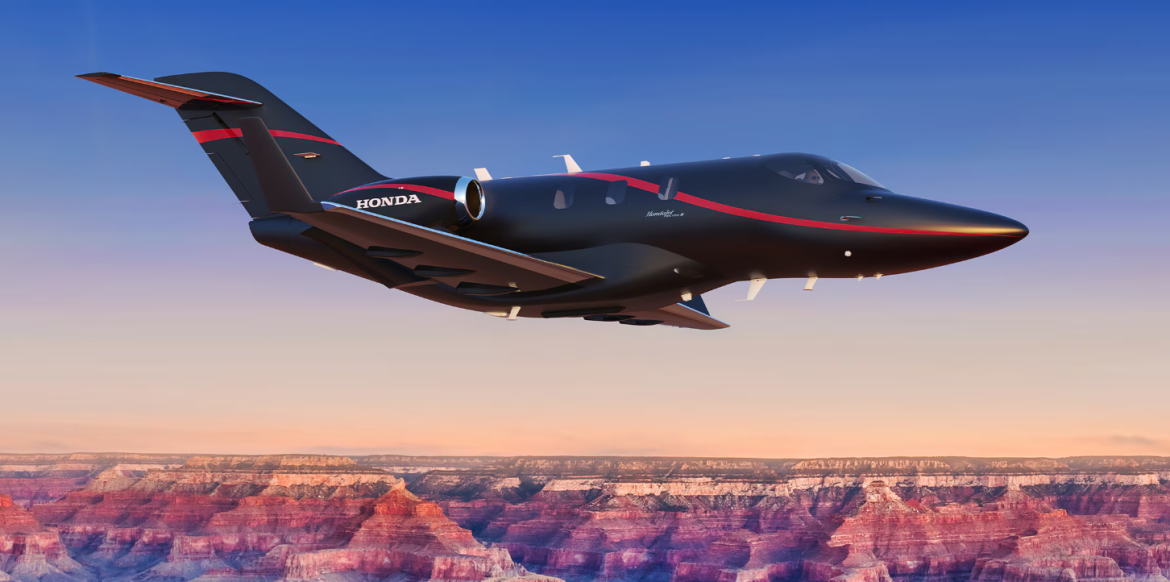

Honda Aircraft Company delivered the first HondaJet Elite II to Brazil this week following official ANAC type validation from the country’s National Civil Aviation Agency, confirming a decade-in-the-making engineering concept now backed by nine aircraft on Brazilian soil. The milestone matters not just as a market-entry story but as a demonstration of why the Elite II’s over-the-wing engine mounting — a configuration that defied conventional aerodynamic wisdom and took Honda engineers three years of computational fluid dynamics work to validate — produces results its rear-engine competitors cannot replicate: a cabin that is simultaneously larger, quieter, and more fuel-efficient than anything else in the very light jet class.
The delivery, handled through Lider Aviação — Honda’s exclusive authorized sales representative in Brazil and Latin America’s largest private aviation company — was timed to coincide with LABACE 2026, Latin America’s biggest business aviation show, which ran August 4–6 at Campo de Marte Airport in São Paulo. The newly certified aircraft, carrying serial number msn 42000276 with Brazilian registration PS-MTO reserved, made the ferry journey from Honda Aircraft’s production facility in Greensboro, North Carolina on July 22, arriving at Sorocaba, Brazil on July 29 via stops at Fort Lauderdale, Aguadilla, Bridgetown, Boa Vista, Paraíso do Tocantins, Goiânia, and Vitória — a route documented by flight tracking service ch-aviation.
How Putting Engines Above the Wing Changes the Physics
The HondaJet Elite II’s most technically significant attribute is not its avionics suite or its cabin materials — it is where Honda placed the engines. On every competing very light jet, the twin turbofans sit on brackets bolted to the rear fuselage. Honda attached the Elite II’s engines to pylons above the wing surface, at a position equivalent to 75% of the wing chord. That placement sounds like a niche engineering choice. The aerodynamic consequences are fundamental.
At the transonic cruise speeds where the Elite II operates — around Mach 0.75, or 422 knots (486 mph) at FL300 (30,000 feet) — the airflow accelerating over the upper wing surface generates shockwaves. Shockwaves create wave drag, a form of resistance that rises steeply as aircraft approach the speed of sound and is a primary limiter of VLJ cruise performance. Conventional aviation engineering held that placing engine nacelles over the wing would compound this problem, adding their own interference drag on top of the wing-surface shockwaves. The VFW-Fokker 614 tried an over-wing engine layout in the 1970s and confirmed the concern: the configuration generated unacceptable drag at speed, contributing to the aircraft’s commercial failure and making over-wing engines an engineering taboo for decades.
Honda designer Michimasa Fujino returned to the problem in 1997. His computational analysis, validated in Boeing wind tunnels, found that at the specific chord position Honda now patents, something counterintuitive happens: the accelerated airflow over the upper wing surface and the airflow wrapping around the engine nacelle superimpose constructively, canceling rather than amplifying the shockwave. Honda calls this “favorable interference.” The result is that the Elite II’s over-the-wing engine mount configuration achieves lower wave drag at transonic cruise than a conventional rear-fuselage mounted configuration — not equivalent, lower. The engineering reversal is why the aircraft is both faster and more fuel-efficient than rear-mounted peers despite the seemingly counterintuitive placement.
The OTWEM configuration has two further consequences that directly affect what Brazilian operators experience in the cabin. First, because the engine pylons attach to the wing structure — not the fuselage — there is no structural framework penetrating the aft fuselage to accommodate engine mounting. That freed space translates directly into cabin volume. Honda claims the largest cabin in the VLJ class, with interior dimensions of 17.80 feet (5.43 m) long, 5.00 feet (1.52 m) wide, and 4.83 feet (1.47 m) high. Second, rear-fuselage engines transmit turbomachinery vibration through the fuselage skin into the cabin; over-wing engines transmit their structural path through the rigid wing, decoupling the primary noise source from the fuselage. The Elite II’s interior acoustic treatment, combined with OTWEM, produces measurably lower in-cabin noise than rear-engine alternatives.
The OTWEM configuration also preserves what Honda calls a natural laminar flow (NLF) wing. The wing’s upper surface, machined from a single piece of aluminum to minimize joints and surface discontinuities, maintains smooth laminar airflow longer than conventional multi-piece wing structures. Because the OTWEM pylons attach below and aft of the critical upper surface rather than penetrating it, the laminar flow region remains intact — a design advantage that would be compromised by conventional under-wing engine pylon placement. The combined effect of OTWEM wave-drag reduction and NLF skin-friction reduction is what Honda credits for the Elite II being the most fuel-efficient aircraft in its class.
What ANAC Certification Actually Means for Brazilian Operators
ANAC type validation is not a rubber stamp. Brazil’s civil aviation regulator conducts its own technical review of foreign-certified aircraft before permitting registration and commercial operation in Brazil, examining whether the original certification process satisfies Brazilian safety and airworthiness standards. The Elite II received its FAA type certificate on November 2, 2022; ANAC’s own validation, announced August 3, 2026, came after that review concluded the aircraft meets Brazilian requirements.
The practical implications extend beyond a permission-to-fly stamp. With ANAC validation in place, Brazilian operators can now register the Elite II on the Brazilian civil aircraft registry (giving it a PS- prefix registration), operate it commercially under Brazilian operator certificates, have it serviced at ANAC-certified maintenance organizations, and obtain Brazilian aviation insurance coverage. That last point matters: insurance underwriters in Brazil typically require local ANAC certification before issuing coverage for revenue-generating operations.
Critically, ANAC validation opens two distinct addressable markets simultaneously: the owner-operator market (companies and high-net-worth individuals buying aircraft for direct use) and the commercial charter market. Brazilian air charter operators, who require locally registered and ANAC-validated aircraft to offer charter services to paying passengers, were previously excluded from the Elite II’s capability set. That door is now open.
Lider Aviação’s infrastructure makes that opening commercially viable. The company, headquartered in Belo Horizonte, operates 22 fixed-base operations (FBOs) spread across Brazil, providing maintenance, customer care, and ground handling from Belém to Porto Alegre. Including this latest delivery, Lider has facilitated nine HondaJet deliveries in Brazil since 2017 — a nine-year track record that matters for resale values, parts availability, and technician expertise.
“This delivery underscores Honda Aircraft Company’s commitment to building a global fleet presence while delivering meaningful value to customers worldwide,” said Amod Kelkar, Senior Vice President and Chief Commercial Officer of Honda Aircraft Company. “The enhanced features of the Elite II will enable customers in Brazil and across South America to travel farther, more efficiently, and with an elevated level of comfort.”
Range Is an Argument in Brazil’s Geography
The Elite II’s maximum NBAA IFR range of 1,547 nautical miles (approximately 1,780 statute miles) is not a performance vanity metric in Brazilian operations — it is a direct response to the country’s geography. Brazil is the fifth-largest country in the world by land area, and the distances between its major economic centers are substantial. São Paulo to Manaus covers roughly 1,700 miles (2,736 km) as the crow flies, a route that crosses the Amazon basin with minimal commercial jet frequency. São Paulo to Recife is about 1,520 miles (2,446 km). A VLJ with a 1,547-nautical-mile range — combined with OTWEM fuel efficiency — makes these city pairs practical in a single flight with IFR reserves, reducing the layover stops that shorter-range competitors require on the same routes.
The Elite II’s autothrottle system, which automatically manages engine power to maintain a selected airspeed, is particularly relevant on these longer missions. It reduces pilot workload during cruise, maintaining optimal power settings through altitude and temperature variations without constant manual input — a meaningful workload reduction for single-pilot operations on extended overwater or overland legs.
The Brazilian Market HondaJet Is Entering
Brazil’s business aviation sector is expanding fast enough that the timing of ANAC validation gave Honda Aircraft something rare: market entry into a genuinely receptive environment. According to Brazil’s General Aviation Association (ABAG), the country’s business aviation fleet approaches 11,400 aircraft, keeping Brazil in second place worldwide behind only the United States. Business jets in active operation reached 1,193 in May 2026, a 12.5% year-on-year increase. Total business aviation takeoffs and landings in April 2026 reached 94,800 — up 12.18% from 84,500 movements in April 2025.
LABACE 2026, the 21st edition of Latin America’s premier business aviation show, attracted deals projected to exceed US$150 million. The event drew 55 aircraft on static display — one more than last year’s already-record count.
What makes Brazil’s market distinctive is not just its size but its geography-driven structural demand. A country the size of a continent where road infrastructure between major cities remains limited creates persistent demand for business aviation that market cycles do not entirely cancel. The Elite II, certified and supported through Lider’s nationwide FBO network, competes directly in this environment.
What Does HondaJet Compete Against?
The competitive landscape at the LABACE 2026 show was instructive. Embraer — Brazil’s own aerospace champion — is projecting delivery of between 160 and 170 executive jets globally in 2026, maintaining what amounts to a record-level pace. Its Phenom 100EV competes directly in the VLJ class with the Elite II. Bombardier showcased the Challenger 3500. Cessna’s parent Textron Aviation recorded its first Longitude order in Brazil in 2025.
What differentiates Honda’s position in this competitive context is the OTWEM architecture’s specific tradeoffs. The Phenom 100EV uses conventional rear-fuselage engines; its cabin, while competitive, does not benefit from the fuselage-volume liberation that OTWEM provides. Business & Commercial Aviation testing found the Elite’s predecessor consumed roughly 3% less fuel than the Phenom 100EV on a 1,000-nautical-mile (1,151-statute-mile) four-passenger mission, and 8% less than the Citation M2 on the same route.
The Elite II also benefits from a distribution and support advantage in Brazil that new entrants would take years to replicate. Nine aircraft already in-country, 22 Lider FBOs, and an established service pipeline give the Honda platform a depth of local presence that complicates competitive offerings that may have newer features but shallower infrastructure.
How Does the GE Honda HF120 Engine Make This Work?
The OTWEM configuration’s aerodynamic advantage is only realized with the right engine. The Elite II’s GE Honda HF120 turbofan — a joint development between GE Aviation and Honda Aero under the GE Honda partnership — received FAA type certification in December 2013. The engine features a single fan, a two-stage compressor, and a two-stage turbine, producing 2,095 pounds of force (9.3 kilonewtons) of thrust per side. It was engineered in a co-development arrangement specifically for the HondaJet airframe, with an emphasis on matching the OTWEM configuration’s requirements: optimal size for the chord-position pylon geometry, and a thrust-to-weight ratio that supports the Elite II’s certified ceiling of FL430 (43,000 feet).
The engine’s turbomachinery cycle — relatively high bypass ratio for an engine of its thrust class — is part of what gives the Elite II its fuel economy claims. Combined with the OTWEM-enabled wave-drag reduction and the NLF wing’s skin-friction advantage, the HF120’s efficiency contributes to what Honda positions as class-leading fuel consumption.
Is the HondaJet Safe? What Operators Should Know
The HondaJet Elite II platform’s flight-safety record is publicly documented. According to the Aviation Safety Network, the HA-420 platform had been involved in six hull-loss accidents with five fatalities as of August 2025. The first fatal accident occurred November 5, 2024, at Falcon Field in Mesa, Arizona, when an HA-420 overran the runway on takeoff and struck a vehicle on the adjacent road. A second significant incident in April 2025 at Southwest Oregon Regional Airport resulted in a runway excursion into Coos Bay; all five people on board survived. A further runway excursion occurred at Yao Airport, Japan in June 2026, with no injuries. In a May 2026 safety notice, the FAA stated the HA-420 had experienced runway excursions at a higher rate than comparable aircraft, citing 39 lateral excursions and overruns since certification, and noted that failure to follow aircraft flight manual techniques was a factor in a significant number of reported events.
Honda Aircraft reports a 99.7% dispatch reliability rate across the in-service fleet as of December 2021. Brazilian operators evaluating the Elite II should evaluate these statistics alongside maintenance protocol requirements, crew training standards, and any ANAC-specific airworthiness directives applicable to the type.
What Comes After the Elite II?
Honda Aircraft has stated publicly that the Elite II is not the endpoint of the HondaJet program. In June 2023, the company committed to production of the HondaJet Echelon, formally designated HA-480, announcing the Echelon program details the following October. The Echelon is designed to seat up to 11 occupants and achieve a range of 2,625 nautical miles (approximately 3,021 statute miles) — nearly double the Elite II’s reach — making it the first light jet capable of nonstop transcontinental flight across the United States. A first flight was planned for late 2026, with certification anticipated in 2028 or 2029.
The Echelon will be powered by Williams FJ44-4C turbofans rather than the GE Honda HF120, and will feature a wider and taller fuselage cross-section to accommodate its larger cabin. Honda has received more than 350 letters of intent for the type. For Brazilian operators who find the Elite II’s 1,547-nautical-mile (approximately 1,780-statute-mile) range limiting for certain South American city pairs, the Echelon’s range profile — if it completes certification on schedule — would address that gap directly.
For now, the first Elite II on Brazilian soil represents nine HondaJets delivered in nine years, a freshly stamped ANAC approval, and a technically distinctive platform now available to both owner-operators and charter fleets across South America’s largest and fastest-growing business aviation market.
Frequently Asked Questions
What makes the HondaJet’s engine placement unusual compared to other business jets?
Most business jets — including the Embraer Phenom 100EV and Cessna Citation M2, the Elite II’s closest VLJ competitors — mount their engines on pylons on the rear fuselage. Honda mounts the Elite II’s two GE Honda HF120 turbofans on pylons above the wing surface, at 75% of the wing chord. The key is what Honda calls “favorable interference”: at transonic cruise speeds, the accelerated airflow over the upper wing surface and the airflow around the engine nacelles combine to cancel shockwaves rather than amplify them. The result is lower wave drag than rear-fuselage mounting — the opposite of what conventional aerodynamic wisdom predicted before Honda’s computational fluid dynamics analysis confirmed the effect. The OTWEM configuration simultaneously frees the entire aft fuselage from engine-mounting structure, enabling a larger cabin, and reduces in-cabin noise by removing engines from direct structural contact with the fuselage walls.
Does Brazil’s ANAC certification mean I can charter a HondaJet Elite II in Brazil today?
ANAC type validation, confirmed August 3, 2026, means the Elite II can now be registered on the Brazilian civil aircraft registry and operated under Brazilian operator certificates — which includes commercial charter operations. Before this validation, Brazilian charter operators could not legally use the Elite II for revenue flights in Brazil regardless of the aircraft’s FAA or EASA certification. With Lider Aviação’s 22 fixed-base operations providing maintenance and support nationwide, the infrastructure to support commercial charter operations now exists alongside the regulatory authorization. Specific aircraft availability for charter depends on individual operator fleet decisions.
How does the HondaJet Elite II’s range compare to what Brazilian operators actually need?
The Elite II achieves a maximum NBAA IFR range of 1,547 nautical miles (approximately 1,780 statute miles), which covers the majority of significant Brazilian city pairs. São Paulo to Manaus — one of the longest and most commercially underserved domestic routes — spans roughly 1,480 nautical miles (1,703 statute miles) as the crow flies, within the Elite II’s certified range. São Paulo to Recife is approximately 1,320 nautical miles (1,520 statute miles). Most intra-Brazil business travel routes fall well within the aircraft’s capability. For operators requiring transatlantic or deep South American range beyond Brazil’s borders, Honda’s forthcoming HondaJet Echelon, targeting 2,625 nautical miles (approximately 3,021 statute miles), is designed to address that gap — though certification is not expected until 2028 or 2029.
What is the ANAC type validation process, and how does it differ from FAA certification?
The FAA (U.S. Federal Aviation Administration) grants a type certificate after exhaustive testing confirming an aircraft design meets U.S. airworthiness standards. When another country’s civil aviation authority — such as Brazil’s ANAC — wishes to permit that aircraft to operate under its own registry, it conducts a type validation: a review process evaluating whether the original certification procedure meets the authority’s own standards, typically without repeating all primary testing. Brazil and the U.S. have bilateral aviation safety agreements that streamline this process. The Elite II received its FAA type certificate on November 2, 2022; ANAC’s independent validation, completed before LABACE 2026, confirms the aircraft meets Brazilian requirements and permits Brazilian registration, commercial operation, and maintenance under Brazilian regulatory frameworks.
