
Outside a commercial building in Causeway Bay, one of Hong Kong’s busiest shopping districts, a column of people carrying umbrellas and flowers wrapped around the block. For hours, mourners waited in the rain so they could pay their respects to Wang Wang, a stray dog who was killed by five boys in mainland China.

Holding a bouquet of white chrysanthemums, Brian patiently waited his turn to cram into a lift that would bring him to a small Buddhist temple on the 23rd floor. The 26-year-old from Guangzhou crossed the boundary into Hong Kong earlier that day to take part in the procession, which he had heard about from social media.
Wang Wang and her three puppies were tortured and killed on June 28 in a village in Jieyang, Guangdong province, by five boys all under 14 years old. Videos of the incident, which have since been scrubbed from Chinese social media platforms, show the boys beating the dogs with sticks and dousing Wang Wang in fuel before setting her on fire.
Footage of the horrific killings spread throughout the internet, ending up on social media feeds in Hong Kong and beyond. As billboards funded by ordinary Chinese people went up in New York’s Times Square and around the Taipei 101 skyscraper, Hongkongers have also tried to advocate for animal rights in mainland China.
“When I first saw the video I was furious, and now I just feel helpless. I just hope I can send off Wang Wang and her puppies one last time,” said Brian, who used a pseudonym for fear of reprisals.

| 💡HKFP grants anonymity to known sources under tightly controlled, limited circumstances defined in our Ethics Code. Among the reasons senior editors may approve the use of anonymity for sources are threats to safety, job security or fears of reprisals. |
What he didn’t know was that the funeral had been pushed online less than 24 hours before it was originally scheduled to take place. Now, mourners would only be allowed to lay down flowers outside the venue. The funeral’s organiser, the Hong Kong Animal Rights Association, also pulled out of an interview with HKFP on the morning of the ceremony.
Brian was also unaware that the entrance of the building would be flanked by half a dozen plainclothes police officers.
Not from the temple, a Thai boxing gym had also been asked to take down a banner of Wang Wang after the building’s management office was visited by police. At the same time, charities and activists have struggled to get advertisements depicting the dogs approved by public transport companies.
In the years since Hong Kong saw mass protests in 2019 and Beijing imposed national security legislation in the territory, public advocacy and gatherings have faced severe restrictions or have been treated with suspicion.
Crossing the boundary may have made it possible for Brian to engage in this small act of remembrance. But in the wake of Wang Wang’s death, Hong Kong society has been navigating another, seemingly arbitrary boundary determining what is and is not allowed when it comes to animal welfare advocacy in the territory.
‘Be careful’
Under the rain, hemmed in by bright orange police tape, a woman in her twenties who only identified herself as “L” also waited in line.

“Over on the mainland, people might not be able to express their views, and mentions of the incident are suppressed. That’s why netizens and people who love animals have to take a stand,” she said.
Ordinary Hongkongers and other animal lovers worldwide are doing what they can to bring discussions of Wang Wang’s death into the public sphere, even as footage of the killings has been taken down from social media platforms in Hong Kong at the request of the authorities.
Much of the outrage over the dogs’ deaths has been directed at village authorities in Jieyang who urged the public to refrain from sharing information about the killings, citing the boys’ ages. Because all five of the boys were minors, they were sent to a “specialised school” for corrective education.
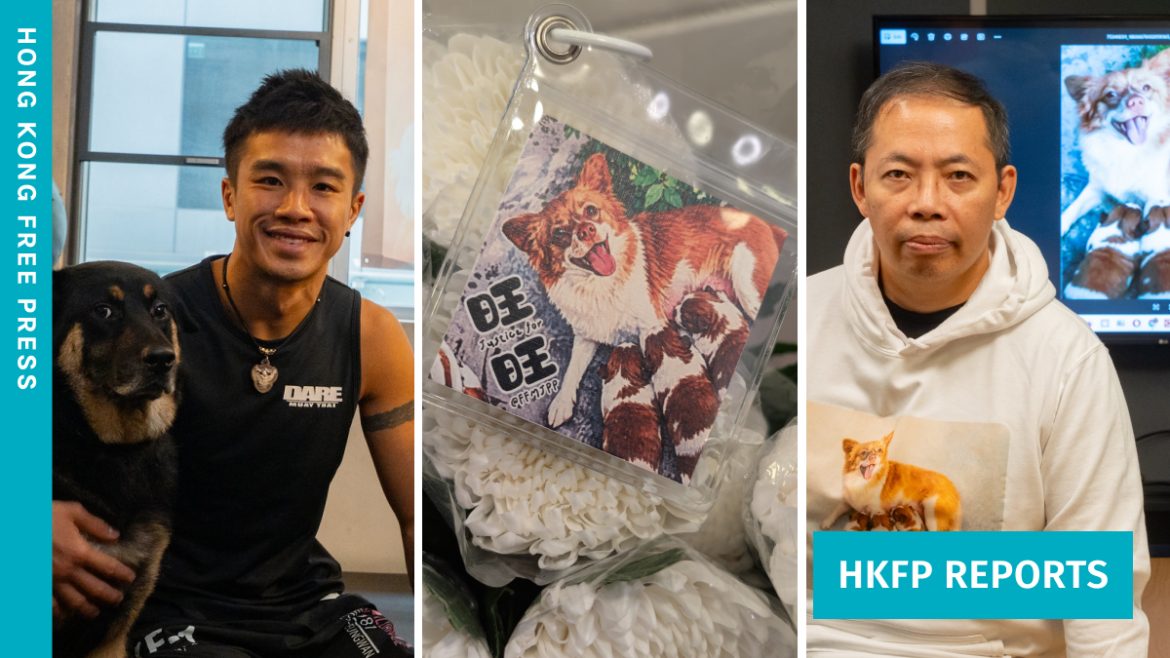
In mid-July, weeks after Wang Wang’s death, Leung Pak-yu, the founder of a Muay Thai gym in Causeway Bay, hung up a five-metre-long banner on the façade of his building.

It read: “Being a minor does not mean abuse can be lightly brushed aside.”
On the gym’s banner was a photo of Wang Wang nursing her pups. The same image had been used in countless other publicity campaigns worldwide, including on the mainland, before they were taken down.
Three days after Leung put up his banner, police officers approached the building’s management office, and Leung was asked to take it down. Although he was never personally approached by the police, Leung was told by building management that the outer wall was not included in his rental contract.
Leung then had another set of vinyl-coated canvas posters made, which he hung up behind the windows of the boxing gym. So far, he hasn’t had trouble with the authorities.
“My friends keep telling me to be careful,” Leung told HKFP at his gym last Wednesday. The fighter’s two rescues, a shy mongrel and a more pugnacious bulldog, also live at the gym, where he spends most of his time.

Leung believes that legislation is needed prevent similar tragedies. Unlike Hong Kong, which has its Prevention of Cruelty to Animals Ordinance, mainland China does not have a nationwide animal cruelty law, though some cities have specific regulations like Shenzhen’s ban on eating companion animals.
“Since Hong Kong, as a civilised society, is a part of China, we should have a responsibility to push for change,” said Leung.
‘Severe punishment’
If all goes to plan, Anthony Lai’s ad campaign will be plastered on a double-decker bus that rolls through almost the full length of Nathan Road, one of Hong Kong’s busiest thoroughfares — a sure-fire way to get the attention of tourists visiting from the Chinese mainland.

“We had to go through multiple rounds of vetting before they would accept the design,” said Lai.
A cybersecurity consultant by trade, Lai grew up around animals in a hilly region of the city and was never intimidated by the stray dogs or wild boars that lived nearby. Over the years, he has participated in several animal welfare campaigns.
When they spoke to HKFP, both Leung and Lai pointed to what they believed was a crucial factor: deterrence. Though they are by no means experts in animal rights, the two men reiterated what critics have said for years: that China’s lack of a nationwide animal cruelty law has left a legal vacuum in which abusers go unpunished.
Feline Guardians, a US-based activist group that primarily focuses on cat abuse in mainland China, issued a statement in response to the Wang Wang incident, saying that introducing legislation would “protect cats and other companion animals.”

“There has to be a severe punishment” to discourage repeats of the tragedy and prevent further escalation involving attacks on people, Lai said, adding that Wang Wang’s death was not just an isolated case but a reflection of how a society views the value of life.
“If they can do that to dogs, what’s stopping them from doing the same to humans?” he asked.
‘Arbitrary’ lines
About a week after Wang Wang’s death made headlines, Lai staged a considerably smaller protest in Causeway Bay with nothing more than a hand-drawn cardboard placard.
This time around, he is aiming higher, having crowdfunded some HK$70,000 for the bus advertisement from friends and supporters.
The first design Lai pitched to the Kowloon Motor Bus (KMB) company featured the familiar image of Wang Wang and her puppies. He didn’t get a reply — not even a rejection — until he altered the design.
Pet adoption platform Suppaw’s tram advertisement also ran into the same complications. Before its campaign made it onto the iconic vehicle, Suppaw had to change its original design depicting Wang Wang and her pups.

Lai unfurled samples of the latest mock-up when HKFP met him at his office earlier this month. Wang Wang’s face had been cropped and scaled down, and about a dozen other animals were also pictured against a soft, sky-blue background. Lai’s own Pomeranian appeared in the foreground.
“Whether it’s this draft or that one, they carry the same meaning to me, which is to protect life,” Lai said.
“This one couldn’t go up because she was tortured and killed. The whole world knows this,” he said, gesturing to the old draft with Wang Wang’s likeness. The updated version “doesn’t have that context or story, and that’s why it was approved,” Lai speculated.
Others are making smaller efforts to raise awareness. Carmen Cheng, who owns a game store in Hin Keng, has spent thousands of dollars out of her own pockets to make keychains depicting Wang Wang that customers can take for free.

Hundreds of the keychains have been given out, including some shipped overseas. But Cheng has also attracted unwanted attention. Shortly after announcing the project on Facebook, she received threatening messages warning her to stop.
Nevertheless, new shipments are already on their way.
From Hong Kong to China
Kenneth Chan, associate professor in the Department of Government and International Studies at Hong Kong Baptist University, said that even advocacy campaigns for causes as politically innocuous as animal rights are inherently treated by the government “with suspicion.”
“It is hard to ignore the perceived arbitrariness” of what people or businesses believe to be permissible in the eyes of the authorities, he said.

The experiences of the boxing gym and the transport advertisers, he added, “show how a ‘better safe than sorry’ mindset exerts strong yet equivocal impacts on every aspect of the public domain.”
“Nothing can be ‘non-political’ in clear terms in a place where the authorities talk about being vigilant towards threats arising anywhere, anyhow, anytime,” Chan said. However, he also added that siding with the authorities may provide some leeway.
Last Thursday, District Councillor Lau Chun-hoi travelled to Shanghai to attend a pet fair, where he would be representing animal welfare advocates from Hong Kong in a seminar. Shanghai, China’s largest city, does not have an anti-animal cruelty law, only a regulation for dog ownership.
Lau, a district-level official affiliated with Hong Kong’s largest pro-Beijing party, the Democratic Alliance for the Betterment and Progress of Hong Kong, is the convenor of the Animal Welfare Advocacy Alliance, a Hong Kong-based group.

In Shanghai, the councillor met with Zhao Wanping, a deputy to Beijing’s National People’s Congress and Vice President of the Anhui Academy of Agricultural Sciences. For years, Zhao has pushed for legislation to protect companion animals at the annual “Two Sessions” high-level plenaries, but China still lacks a comprehensive nationwide anti-animal cruelty law.
“If acts of animal cruelty committed by minors are not met with proper punishment and correction, they are highly likely to escalate into risks that threaten society,” Lau said in a Facebook post last month.


