
Unusually well-preserved fossils have provided the earliest known evidence of a land vertebrate that could pump air in and out of its chest using muscles between the ribs—the same strategy used by modern mammals, reptiles and birds
/https://tf-cmsv2-smithsonianmag-media.s3.amazonaws.com/accounts/headshot/Sara_-_Headshot_thumbnail.png)
:focal(1275x2359:1276x2360)/https://tf-cmsv2-smithsonianmag-media.s3.amazonaws.com/filer_public/13/9f/139f1392-3580-4b72-87f1-cf22ae034bca/the-oldest-breath-a-30.jpg)
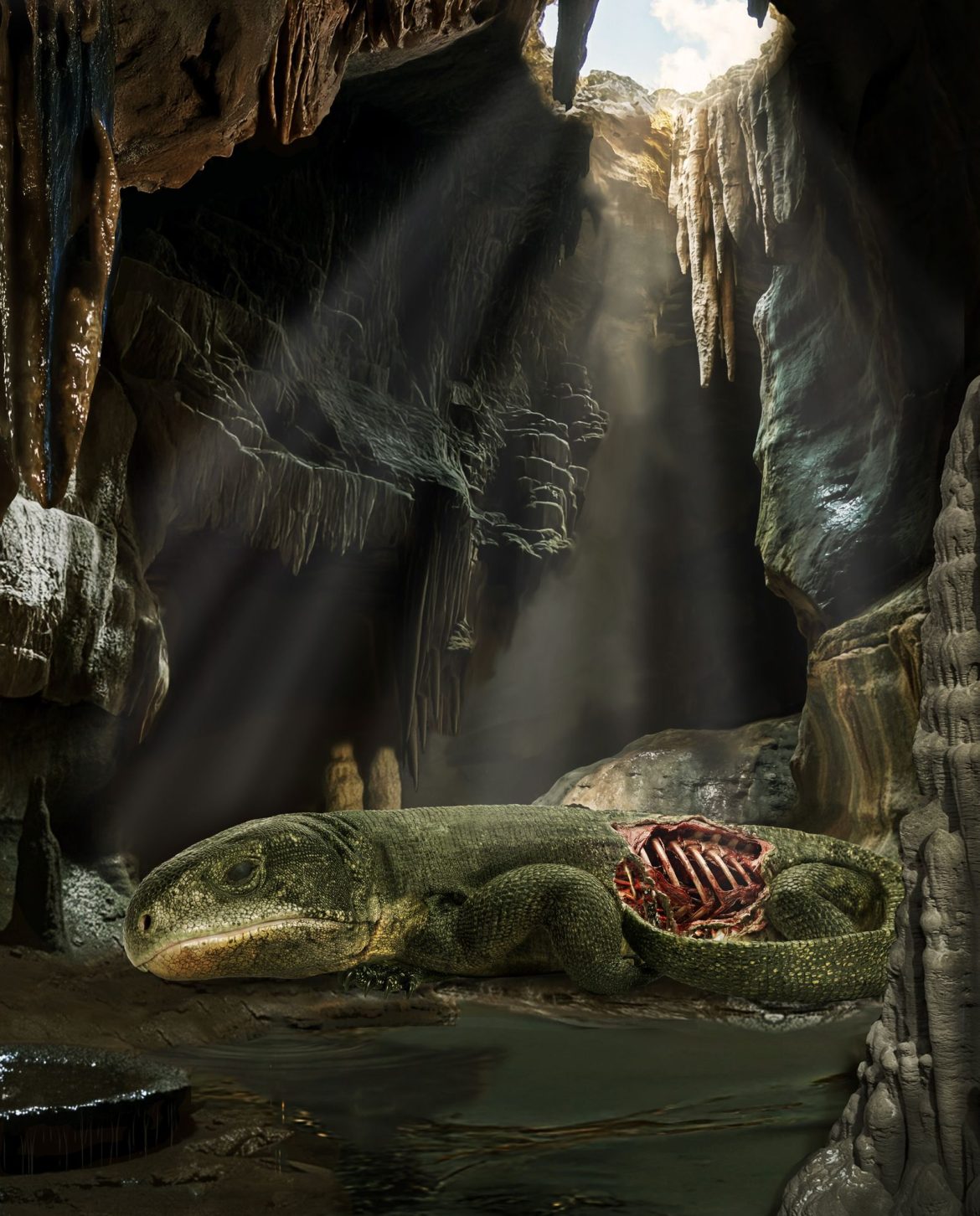
An artist’s rendition of Captorhinus in its death pose
Michael DeBraga
Take a deep breath in, and your chest rises. Blow that air out, and your chest falls. While that breathing system might seem mundane, it’s shared by many modern-day creatures, including mammals, reptiles and birds—and it goes way, way back.
Now, researchers have identified the oldest-known example of this breathing system, which is used by a broad group of land vertebrates called amniotes. In a study published April 8 in the journal Nature, a team describes the remarkably well-preserved remains of an extinct reptile, called Captorhinus aguti, dated to about 286 million to 289 million years ago. The findings reveal previously undescribed structures and provide a glimpse at early adaptations to terrestrial life.
“The mummified Captorhinus is among the most significant early amniote fossils in the world,” says study co-author Ethan Mooney, a vertebrate paleontologist who did the research while at the University of Toronto in Canada. “It has offered an unparalleled window into the appearance, lifestyles and evolution of the earliest reptiles, expanding dramatically our understanding of this pivotal episode of amniote evolution.”
Fun fact: Breaking records
The researchers also recovered bits of proteins from the well-preserved creatures, and they’re the oldest-known preserved protein remnants ever found in a terrestrial vertebrate.
A little over 300 million years ago, reptiles made the transition from aquatic living to full-time land dwellers. Their water-loving ancestors—and many amphibians today—breathed through porous skin and pushed air through their lungs with their mouths or throats, such as by raising and lowering the jaw.
However, that breathing style isn’t well-suited for amniotes’ more active lifestyles. Evolving a new system that used muscles between the ribs to pump air like bellows became a game-changer.
To investigate the origins of this breathing system, Mooney and his colleagues studied three specimens found in caves near Richards Spur in Oklahoma, a site famous for its assemblage of fossils from the Permian period, which began soon after reptiles’ terrestrial transition. Mineral-rich water and crude oil in the sediment preserved not only Captorhinus’ bones, but also the animals’ skin and cartilage, soft parts that usually deteriorate.
The team used a special imaging technique that scans objects with beams of neutrons—neutral particles in atoms—to look at the fragile fossils preserved in rock and create 3D renderings of the bygone reptiles’ body parts.
“I started to see all these structures wrapped around the bones, and they were very thin and textured,” Mooney, now at Harvard University, says in a different statement. “Lo and behold, there was a nice wrapping of skin around the torso of this animal. The scaly skin has this wonderful accordion-like texture, with these concentric bands covering much of the body from the torso and up to the neck.”
One of the fossils examined in the study Ethan Mooney/https://tf-cmsv2-smithsonianmag-media.s3.amazonaws.com/filer_public/ff/73/ff736621-332b-40eb-8064-e0f52dce74e4/low-res_fossil_2.jpg)
Two of the Captorhinus specimens helped the researchers reconstruct the ancient creature’s skeleton and figure out its breathing system. Together, they revealed how the animal’s rib cage, backbone and shoulders connected, which allowed the team to recreate the chest and neck of the early amniote.
“Once you have the rib cage moving and operated by muscles, then you can have inhalation,” says study co-author Robert Reisz, a vertebrate paleontologist at the University of Toronto, to Ivan Semeniuk at the Globe and Mail. “It really is a critical step.”
Evolving a more powerful breathing method probably helped amniotes diversify, particularly in head shape. “You can actually experiment with all kinds of shapes of skull, and that’s what gave rise to dinosaurs and living reptiles and mammals,” Reisz tells the outlet.
Elizabeth Brainerd, a biologist at Brown University who was not involved in the study, tells Carolyn Gramling at Science News that the fossils are exciting because they fit together to form a fuller picture of the flexible breathing apparatus, which is similar to those that exist today.
“We know that the rib cage and shoulder girdle work together for breathing in modern lizards,” Brainerd says to the outlet. “This fossil shows that the same breathing mechanism was possible in this ancient reptile.”
