
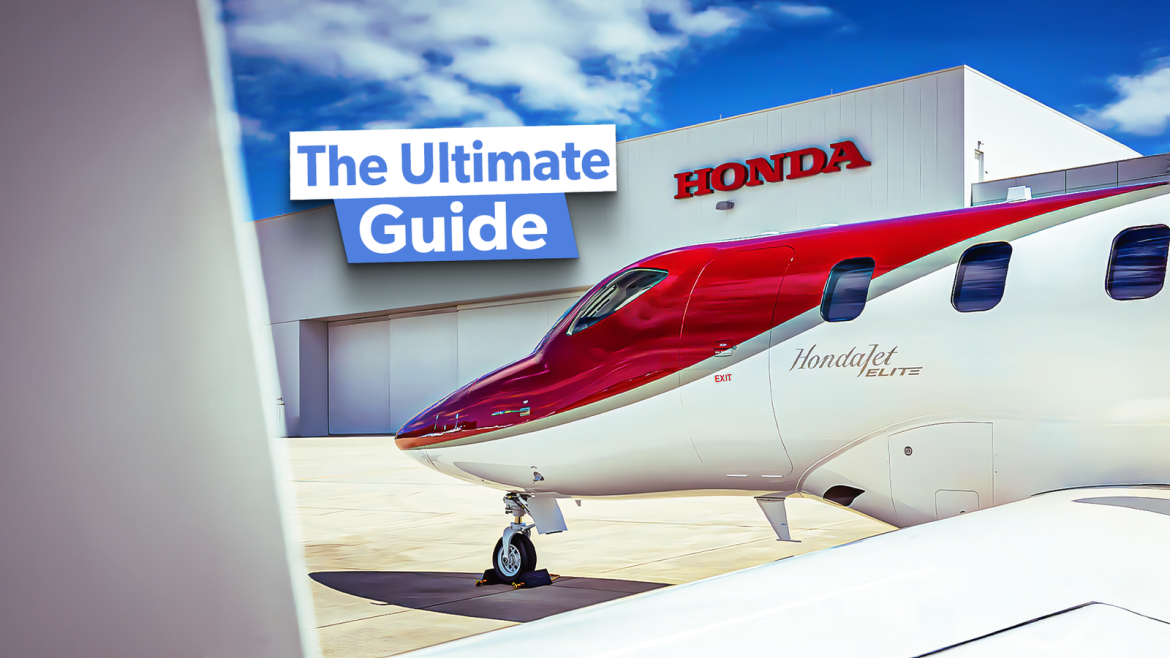
Honda Aircraft Company was founded in 2006. Honda Aircraft Company uses advanced technologies to build safer, more efficient aircraft to meet different needs. They use the latest technology to ensure their aircraft meet the needs of businesses, entrepreneurs, and medical evacuations. HondaJets are known for being very light, which allows them to be fast and fuel-efficient. Honda Aircraft Company is also aware of its carbon footprint and is trying to reduce it without compromising the performance of its jets.
The History of HondaJet
1997
In 1997, the founder, Michimasa Fujino, proposed an “Over-The-Wing Engine Mount” configuration, a very new idea in business aviation at the time. After receiving approval, the HondaJet research project was launched.

2003
In 2003, a HondaJet with two Honda HF118 engines completed initial flight testing at the Piedmont-Triad International Airport in Greensboro, North Carolina. After this flight and more testing, the first HondaJet was confirmed to meet the operational safety requirements.
2005
The experimental HondaJet debuted in 2005 at the Experimental Aircraft Association (EAA) AirVenture in Oshkosh, Wisconsin. It received massive support from aviation enthusiasts, allowing it to move a step in the right direction for commercialization.
2006
In 2006, Honda announced its plans to commercialize the HondaJet. It established a team to handle development, sales, and production. During this time, it rebranded itself as the Honda Aircraft Company.
2010
In 2010, the Honda Jet Aircraft Company started working towards government certification. That year, the first HondaJet was built, meeting Federal Aviation Administration (FAA) standards and taking its first flight.
2015
Five years later, in December 2015, the HondaJet received its FAA certification. To achieve this certification, the HondJet underwent 3000 hours of vigorous flight testing, resulting in over two million pages of documentation being submitted.
2018
The HondaJet Elite was revealed at the European Business Aviation Convention and Exhibition in 2018. It had a longer range, a different nose for better efficiency, and technology for a quieter cabin.
2021
The HondaJet 2600 Concept was revealed at the NBAA Business Aviation Convention and Exhibition. With further innovation, this will be the first light jet to fly nonstop across the United States.
Innovative design features inside a HondaJet
The shape of the nose and wing of a HondaJet follows the natural laminar flow design. Laminar flow is when the fluid travels in a regular path, and there is little to no lateral mixing between the layers, unlike turbulent flow, when the fluid’s path is irregular. In Laminar flow, the flow properties (velocity, pressure, and density, to name a few) at each point remain the same. Natural Laminar flow allows for favorable pressure gradients, reduced weight, maintenance, and complexity. This design results in less turbulence, allowing the airflow to be smooth and allowing the jet to travel faster and be more fuel efficient.

The fuselage of a Honda Jet is made from carbon composites. The two panels are combined into one solid structure to ensure the jet is sturdy and sleek. Due to the jet’s strength and lightness, it can fly at a maximum altitude of 43,000 ft, higher than commercial flights, which fly at altitudes between 30,000 ft and 42,000 ft. The air is thinner at high altitudes, meaning the aircraft experiences less drag, allowing for a smoother flight. The strong fuselage also aids pressure changes within the cabin, which keeps the passengers comfortable.
A HondaJet has an Over-The-Wing Engine Mount (OTWEM) because the height of the wings does not allow much room to place the engines below the wings like a commercial aircraft. Business jets usually have the engines placed at the back of the fuselage. However, this means that there is less cabin space, more cabin noise, and poor aerodynamic performance. After Michimasa Fujino successfully developed the Over-The-Wing Engine Mount, the HondaJet was the first business jet to have this technology. The OTWEM meant that the HondaJet could fly faster and higher than other business jets. It also meant that it had a quieter and more spacious cabin.
Different HondaJet models
Several HondJet models have been developed over the years. HondaJet has produced the following jets:
- HondaJet Classic
- HondaJet APMG
- HondaJet Elite
- HondaJet Elite S
- HondaJet Elite II
- HondaJet Echelon
Here is a summary of the Classic, Elite, Elite II, and Echelon.
HondaJet Classic
In 2015, the HondaJet Classic was introduced to the private jet market. Its engines were placed over the wings, giving it a sleek and modern look. Over-The-Wing Engine Mount (OTWEM) allows fuel efficiency and improved performance by reducing aerodynamic drag. This configuration also means that there is more cabin and baggage space.
The HondaJet has the following performance and engine specifications, which can be found in the HondaJet brochure.
|
Category |
Specification |
|---|---|
|
Maximum Cruise Speed |
422 KTAS (782 km/h) at FL300 (30,000 ft) |
|
Maximum Cruise Altitude |
FL430 (43,000 ft / 13,106 m) |
|
Rate of Climb |
3,990 ft/min (1,216 m/min) |
|
NBAA IFR Range (4 occupants) |
1,223 nm (2,265 km) |
|
Takeoff Distance |
4,000 ft (1,219 m) |
|
Landing Distance |
3,050 ft (930 m) |
|
Engines |
GE Honda HF120 |
|
Thrust Output (Uninstalled) |
2,050 lbf (9.12 kN) each (Derated from 2,095 lbf / 9.32 kN) |
|
Bypass Ratio |
2.9 |
HondaJet Elite
The HondaJet Elite, priced at $5.2 million, was released in May 2018 and began deliveries in August 2018. It had an increased range of 1,437 nautical miles and avionics advancements. Honda Aircraft Company also focused on reducing cabin noise, allowing passengers on the jet to have a more pleasant travel experience.
The cabin offers more seating options, better galley capabilities, and a fully enclosed lavatory. The jet’s better fuel efficiency results in a lower operating cost, making it a more appealing purchase.
The running cost of any jet is split into variable and fixed costs. Below is a budget template created for the base HondaJet by Liberty Jet. This budget template can be used to understand the cost of a HondaJet Elite.

What Is The Cost Of A HondaJet Elite Business Jet?
The HondaJet is a popular very light business jet.
Variable Costs (Direct Operating Costs – DOC)
|
Category |
Flying 200 hours/year |
Flying 400 hours/year |
|---|---|---|
|
Fuel Cost @ $7.23/gal (£1.54/L) |
$231,360 (£183,400) |
$462,720 (£366,800) |
|
Maintenance |
$24,788 (£19,650) |
$49,576 (£39,300) |
|
Engine Overhaul |
$48,232 (£38,240) |
$96,464 (£76,480) |
|
Misc Crew/Landing/Handling |
$40,000 (£31,700) |
$80,000 (£63,400) |
|
Miscellaneous Variable |
$5,000 (£3,960) |
$10,000 (£7,920) |
|
Total Direct Operating Costs (DOC) |
$349,380 (£276,950) |
$698,760 (£553,900) |
Fixed Costs
|
Category |
Annual Cost |
|---|---|
|
Crew |
$114,649 (£90,900) |
|
Crew Training |
$13,797 (£10,950) |
|
Hangar |
$18,050 (£14,300) |
|
Insurance |
$25,555 (£20,250) |
|
Jet Management |
$48,000 (£38,000) |
|
Miscellaneous Fixed |
$10,009 (£7,940) |
|
Total Fixed Costs |
$230,059 (£182,340) |
Total Annual Budget
|
Flying Hours |
Total Cost |
|---|---|
|
200 hours/year |
$579,439 (£459,300) |
|
400 hours/year |
$928,819 (£736,200) |
HondaJet Elite II
The HondaJet Elite II has improved performance features, such as an increased range of 1,547 nm (1,780 mi / 2,865 km), the ability to reach speeds of up to 422 knots (485 mph / 782 km/h), and two GE Honda HF120 engines providing 2,050 lbs of thrust each. The aircraft was certified by the Federal Aviation Authority in 2013.
The aircraft’s cockpit is equipped with a Garmin G3000 suite. It has three high-resolution screens, one of which has a split-view option. The touchscreen interface makes it easy to use. The aircraft is also verified for single-pilot use. The cockpit has safety and automation features such as an auto-throttle, emergency auto-land, Advanced Steering and Augmentation System, stabilized approach, enhanced checklist and visual approaches, and takeoff and landing distance calculations.

Reducing pilots’ workloads improves flight safety by reducing the chances of human error caused by fatigue and stress. It also allows them to focus more on situational awareness to monitor their surroundings, weather, traffic, and aircraft behavior. With less manual input required, pilots will react faster to unexpected changes or emergencies.
To improve the passengers’ experience onboard this jet, the cabin comes with an efficient layout, allowing for a more spacious and comfortable layout. Due to the engine placement, there is more space for passengers and luggage.
Below is a table summarizing the different specifications of the HondaJet Elite II.
|
Category |
Specification |
|---|---|
|
Performance |
|
|
NBAA IFR Range (4 occupants) |
1,547 nm (2,865 km) |
|
Maximum Cruise Speed (FL300, ISA) |
422 KTAS (782 km/h) |
|
Takeoff Distance (SL, ISA, MTOW) |
3,699 ft (1,128 m) |
|
Landing Distance (4 Occupants, NBAA IFR Reserves, Unfactored) |
2,717 ft (829 m) |
|
Engine |
|
|
Manufacturer / Model |
GE Honda / HF120 |
|
Output (Uninstalled Thrust) |
2,050 lbf (9.12 kN) each (Derated from 2,095 lbf (9.32 kN)) |
|
Exterior Dimensions |
|
|
Length |
42.62 ft (12.99 m) |
|
Wingspan |
39.76 ft (12.12 m) |
|
Height |
14.90 ft (4.54 m) |
|
Interior Dimensions |
|
|
Length |
17.80 ft (5.43 m) |
|
Width |
5.00 ft (1.52 m) |
|
Height |
4.83 ft (1.47 m) |
|
Baggage Space |
|
|
Combined Stowage |
62 cubic ft (1.76 m³) |
|
Aft Compartment |
53 cubic ft (1.50 m³) |
|
Nose Compartment |
9 cubic ft (0.25 m³) |
The HondaJet Echelon – an upcoming aircraft by Honda Aircraft Company
The HondaJet Echelon was introduced in October 2021 at the NBAA Convention and Exhibition. The aircraft will be able to occupy up to 11 people (including the pilot) and will be the longest-range single-pilot business jet. The aircraft will be competing with other mid-size jets on the market, such as the Cessna Citation CJ3/CJ4, the Embraer Phenom 300, and the Pilatus PC-24. Within two years of introducing the jet, Honda Aircraft Company received over 350 letters of interest.
The HondaJet Echelon comes with the following specifications:
|
Category |
Specification |
Value |
|---|---|---|
|
Performance |
Maximum Cruise Speed |
450 KTAS (834 km/h) |
|
NBAA IFR Range |
2625 nm (4862 km) |
|
|
Takeoff Distance |
3300 ft (1006 m) |
|
|
Landing Distance |
2550 ft (777 m) |
|
|
Exterior Dimensions |
Length |
57.79 ft (17.62 m) |
|
Wingspan |
56.72 ft (17.29 m) |
|
|
Height |
15.86 ft (4.84 m) |
|
|
Interior Dimensions |
Length |
25.38 ft (7.74 m) |
|
Width |
5.08 ft (1.55 m) |
|
|
Height |
5.21 ft (1.59 m) |
|
|
Baggage Space |
Combined Stowage |
120 cubic ft (3.40 m³) |
|
Configuration |
Maximum Occupancy |
1 crew + 10 passengers |
|
Alternate Configuration |
2 crew + 9 passengers |
