
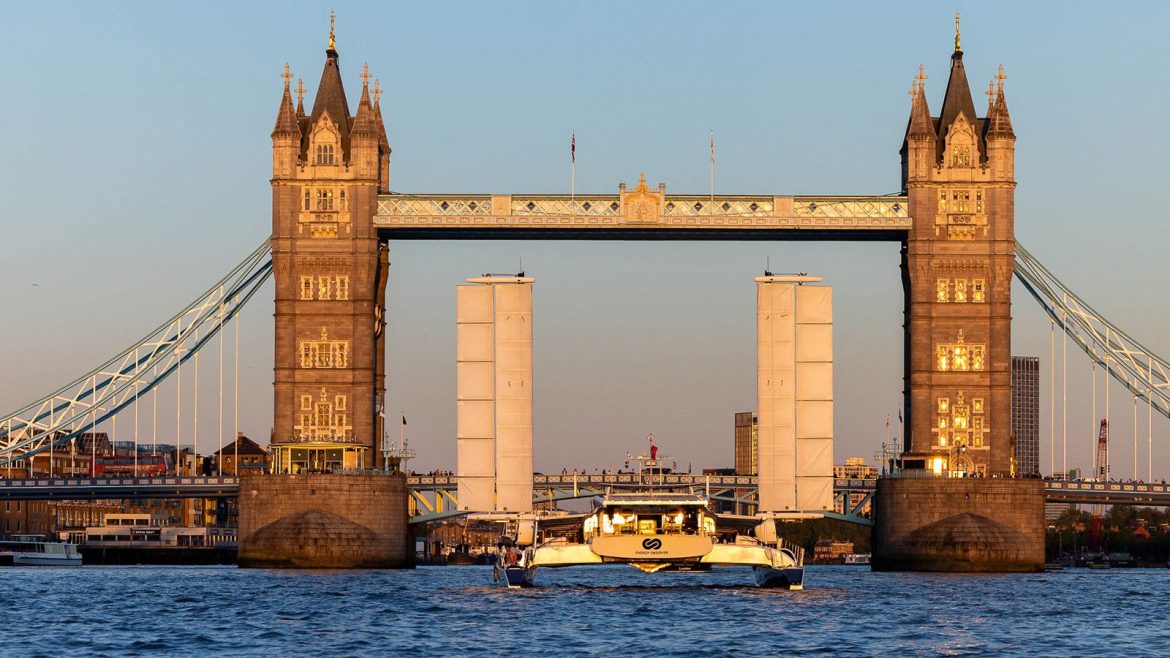
Docked in London last week (25–29 April), the 30.5-metre catamaran Energy Observer is not your typical superyacht. As crowds flooded Tower Bridge for the London Marathon that weekend, a very different kind of endurance effort was quietly underway on the water below…
Moored beneath Tower Bridge, Energy Observer cuts a markedly different profile to the gleaming superyachts that occasionally – and excitingly – line the Thames. There are no sprawling decks or infinity pools here – instead, the 30.5-metre catamaran is packed with solar panels, wing-like sails and hydrogen systems, all working together as part of one of the most ambitious clean-energy experiments in maritime history.
The vessel is no stranger to London, having first appeared beneath Tower Bridge in 2019 during its earlier Northern European expedition, when it was still in the early stages of proving its hydrogen technology. Originally built in 1983 for renowned sailor Mike Birch, the vessel has undergone a radical transformation from record-breaking racing yacht to floating laboratory. Today, she operates as a fully self-sufficient, zero-emission platform, powered by a combination of solar, wind and hydrogen energy.
The team on board Energy Observer, taken last week with the secretary general of IMO (Arsenio Dominguez) and the Energy Observerteam
Credit: Sarah Howells
“We are using the sun, the wind – and what is very nice on this boat is that we are using seawater to produce hydrogen,” explains Deputy CEO Bénédicte Gallon, speaking on board during the yacht’s London stopover. “It’s absolutely pure – no emission, no noise, no smell. It’s a very quiet boat.”
The system is as complex as it is innovative. Seawater is pumped on board, desalinated and fed into an electrolyser, which splits the water molecules into oxygen and hydrogen. The hydrogen is then compressed and stored, ready to be used as a clean energy source when conditions demand it. “Sun and wind are short-term energy,” Gallon says. “When you don’t have them, you use hydrogen. So it’s short-term and long-term storage.”
Now underway is a new nine-year global mission focused on achieving carbon neutrality, with Energy Observer once again acting as both test platform and ambassador. The current itinerary has seen the vessel exploring natural carbon capture solutions across the Mediterranean, before heading north. London represents a key waypoint in that journey – not just geographically, but as a global centre for finance and policy.
“London is where you are running the money,” Gallon notes. “You need natural solutions, technical solutions – but also governance, namely, frameworks on how to manage carbon credit. That’s why we’ve stopped here.”
From the UK , the yacht will continue on to Belgium, Germany and Scandinavia, before eventually returning to France. Along the way, the team will meet with NGOs, scientists and policymakers to better understand the conditions required to reach carbon neutrality.
Life on board is intentionally lean, with a crew of just four to five people managing both operations and research. The vessel’s automated systems – including its distinctive rotating wing sails – help reduce the need for manpower, while reinforcing its role as a testbed for scalable technologies.
Despite her groundbreaking capabilities, however, Energy Observer is showing her age. At 43 years old, she has already exceeded the typical lifespan of a vessel of her kind. Plans are now in motion for a successor: a next-generation platform that will build on the current model while introducing new innovations, including alternative fuels such as ammonia.
“The boat is like a laboratory,” Gallon explains. “On the next one, we want people to understand directly what we are doing.”
That future vessel will retain the core principles of renewable energy integration, while making its systems more visible and accessible – further strengthening the project’s educational mission. Encouraging greater diversity within the maritime and engineering sectors also forms part of that ambition, with the organisation actively working to bring more women into the field.
For now, though, Energy Observer was welcomed as a striking presence on the Thames – a quiet but powerful counterpoint to the traditional superyacht fleet. As London continues to attract some of the world’s most advanced vessels, this pioneering catamaran serves as a reminder that the future of yachting may look very different indeed.
