
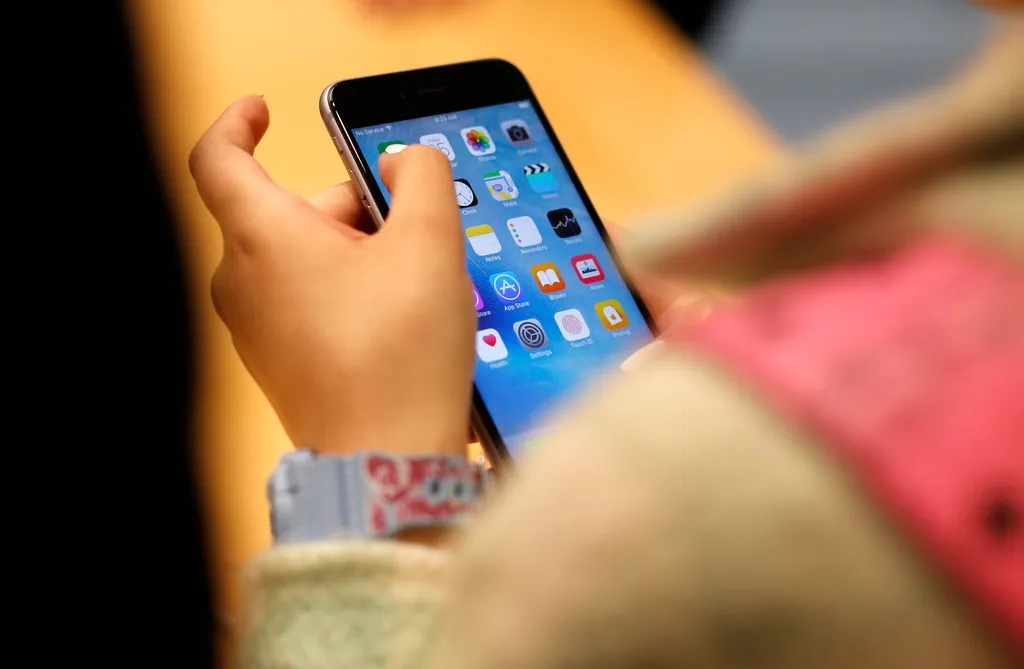
When I wanted my nine-month old to crawl, I did the most obvious thing. I put the object he has been desiring the most about 6 feet away from him. Lo and behold, he crawled to it.
Is it a problem that that object was my iPhone?
Once I stepped back from the excitement of his crawling, I frantically googled “Fake book to hide iPhone from kid.” I was disgusted with myself. I have clearly been on my phone so much when I’m around him that he wants it more than anything — more than his blocks, more than his elephant rocker.
I have also been told that my phone is the greatest danger to his growth after (or is it before?) red dye No. 3.
Having read Jonathan Haidt’s “The Anxious Generation,” I was convinced of what I think we all probably know innately: Smartphones and social media have broken our kids, and the fix is simply to take them away.
What we have seen, following his book, is a mad dash by government and parents alike to do just that. At least 37 states now ban the use of cellphones in schools, the U.S. surgeon general has called for warning labels on social media apps. A national consensus has formed at a rapid speed.
And although it completely makes sense intuitively that screens and social media would be terrible for our kids, there is one really big problem with that conclusion: The data do not support it … at least, not yet.
I really don’t want to knock Haidt. I think his work is fascinating and before I go any further let me admit that I did buy a fake book into which I now put my iPhone when I’m around my son. (Spoiler alert: It arrived a week ago, and I haven’t used it once, but it’s the thought that counts, right?)
Everything Haidt and his adherents say makes total sense. But when we review the data behind the theories, it simply doesn’t stack up.
And if that is so, then by keeping our children away from screens, might we not be holding them back from whatever is destined to create the next world-changing great company or great product?
When looking at schools for our kids, should we choose the one that has no screens and still teaches cursive? Or does that disenfranchise our children from learning how the world is going to work, thereby holding them back from incredible future creation?
I think it is a question worth asking. On the MIT data science podcast which I host with my much more intelligent co-host Munther Dahleh, I expressed my exasperation that schools aren’t teaching cursive anymore. In reply, he asked me whether there is any data on that? Do we know that learning cursive actually grows your brain? Or have we just always done it that way?
Moreover, as we see this next generation dumbed down on standardized test scores from the previous one for the first time in history, we must ask: Are they really any dumber, or are we testing the wrong thing for what the future needs?
I think simply taking away smartphones is too simple an answer. The question is deeper than that, and the data support this hypothesis.
Haidt’s main claim is that the “great rewiring” of human brains occurred between 2010 and 2015 — the years when smartphones and apps saturated adolescent life. This caused the surge in teen depression, anxiety and ultimately suicide. A very alarming graph (link TK) shows the correlation.
But, aside from the pesky issue about correlation not necessarily implying causation, the timelines don’t match up. Whereas social media adoption among American teens crossed the majority threshold by 2006 and reached nearly 75 percent by 2009, teen depression rates didn’t really start to increase until 2012. So the effect, if it really is the effect, would have to have come a lot later than the cause, if it was indeed the cause.
Hundreds of researchers have tried to find the cause-and-effect relationship that Haidt and many others hint at, and which intuitively makes sense. But in those hundreds of studies, no one has ever demonstrated a statistically significant effect. A widely cited meta-analysis by Oxford’s Andrew Przybyslki found that the link between screen time and adolescent well-being is roughly as significant as the link between wellbeing and eating potatoes. That is hardly the foundation for national legislation, let alone a diagnosis for an entire generation.
Does this mean I should let my baby have my iPhone? No. But it does mean that fixing the child anxiety and depression crisis is not as simple as just taking away screens.
If we get the diagnosis wrong, we have major problems. We stop looking for the actual drivers and the crisis continues. We don’t adapt. Our kids are potentially losing out on real progress.

Moral panics are usually moral first and accurate second. The history of American childhood and parenting are littered with them. First, it was comic books, then rock music, hip-hop, Dungeons and Dragons and the internet itself.
In each case, the experts and then the parents were sure. But in each case, the data arrived later, offering a perspective much more complicated than the headlines. We must leave room for the possibility that this time is the same.
Liberty Vittert Capito is a professor of data science at Washington University in St. Louis and the resident on-air statistician for NewsNation, a sister company of The Hill.
Copyright 2026 Nexstar Media Inc. All rights reserved. This material may not be published, broadcast, rewritten, or redistributed.
