
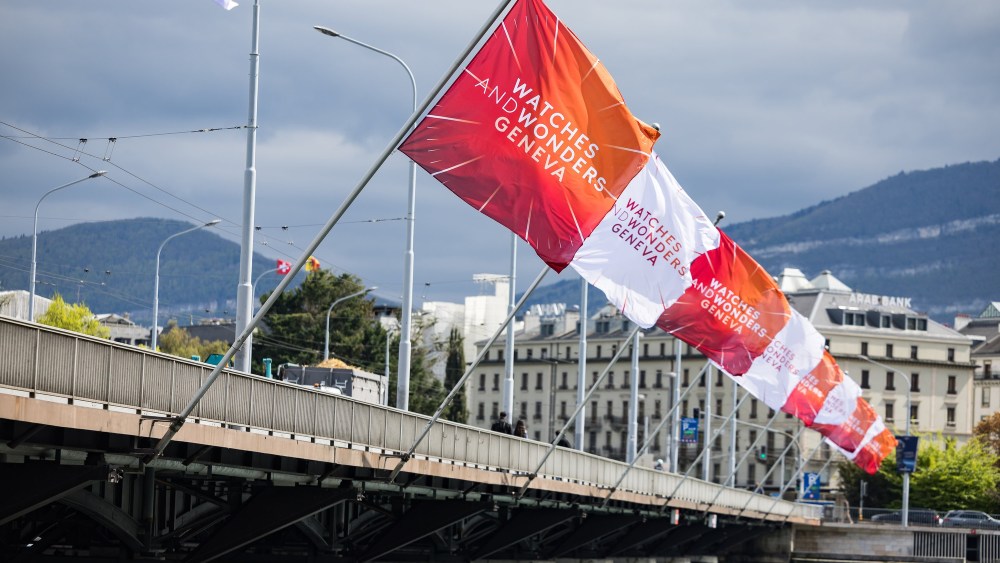
GENEVA – The watchmaking industry finds itself in a paradoxical position.
Rarely has it been more visible, rife with history and players of all sizes ready to flex their design or innovation muscles as the 2026 edition of Watches and Wonders opened on April 14.
Yet in the plush avenues of the fair, watchmaking executives were cautious, keenly aware gleaming prospects could fast turn brittle against a backdrop of renewed geopolitical flashpoints, macroeconomic uncertainties — and a consumer base far more informed and demanding than ever.
Still, the industry looked forward and upward in this annual rendezvous that reiterated its global reach. The 65 exhibiting brands, which included industry heavyweights Rolex, Patek Philippe and now Audemars Piguet, hailed from Switzerland as well as France, Germany, the U.K. and even China.
The roster could still “grow a bit, but not too much,” for Matthieu Humair, chief executive officer of the Watches and Wonders Foundation that organizes the event.
Some 60,000 visitors, up from 55,000 last year, were expected to have visited the Palexpo exhibition center by the time the doors closed on April 20, Humair told WWD midway through the fair. All visitor categories were up around 9 percent, including a tally of 6,000 retailers, organizers later confirmed. Online, the reach topped 900 million.

Roger Federer and Matthieu Humair
Courtesy photo
On day four, Humair noted that the Middle East contingent remained stable, despite travel and other disruptions due to the ongoing war.
Interest from younger generations continued to be strong, with an average visitor age of 35 and 25 percent of tickets sold to people below 25. “A watch now is a mechanical, a cultural object that goes from one generation to another and it becomes something very unique, and young people are looking for that,” said Humair.
It reinforced the importance of Watches and Wonders as “the place to unite the industry, to meet also the men and women who design, who draw the watches, the watchmakers,” he said. “Young people are looking for that connection.”
A Case for Balance
With the Middle East as vital to watchmakers as it is volatile, the industry had the region top of mind going into the fair.
There were also encouraging signs. “We were wondering if Middle Eastern [visitors] would be coming,” said Zenith CEO Benoît de Clerck. “They’re all here — more [numerous] than last year, and they’re buying.”
Still, the first effects of the war in Iran and its repercussions through the region could be felt.
Swiss watch export figures, which came out on April 21, showed that while shipments to the United Arab Emirates showed a modest 0.7 percent uptick to 90.5 million Swiss francs in March, Saudi Arabia dropped 16.1 percent and Qatar slumped 24.8 percent, although their sizes remain modest at 21.9 million and 16 million Swiss francs respectively.
There may yet be a run-on effect from the war on other markets, with Bremont’s CEO Davide Cerrato pointing out that “with everything that happens around the world, the flows of tourists switch off — you can imagine that the Middle Eastern ones have completely disappeared.” However, the U.K.-based watchmaker is little exposed to the region, where it is present with leading luxury watch retailer Ahmed Seddiqi.
Hermès, which reported sales for the three months to March 31, saw its watch division slip 3.7 percent. According to Hermès International’s executive vice president, manufacturing division and equity investments Guillaume de Seynes, there was on one hand exposure to China, which is yet to pick up strongly for luxury players.
On the other, the tipping point was the toll on March sales of the developing situation in the Middle East, “a very interesting zone” with “very dynamic” clientele that had “become a reservoir” of growth for the French company, he told WWD.
Meanwhile, a year after the shock announcement of sweeping tariffs and subsequent see-sawing on what levy would be applied to Swiss-made goods, the U.S. remains a land of opportunity for watchmakers.
By this time next year, it’s likely to be the top market for Bremont. Growth there is in “very, very high double-digit numbers” and Cerrato said the watchmaker was looking to have much more distribution by building up its American retailer network.
Rewards are even greater for those who have played the long game.
Karl-Friedrich Scheufele, copresident of Chopard, said it was “very encouraging to see that the U.S. has really developed very well in the past two years,” driven by intimate events with collectors.
Japan and “quite a few countries in Europe and the Middle East” were also doing quite well, which reflected for him that Chopard’s “watchmaking efforts the past 30 years are really starting to pay off.”
“The U.S. remains a country where we’re still growing — for the maison and for watchmaking — even if the economy isn’t exactly dazzling,” de Seynes said. “There’s a very powerful bond with Hermès there: it’s built on long-term investment in the market, even when others were only swearing by China.”
Nowadays, executives are cautious not to hitch their wagon on a single territory, as geographic balance is one of the few real hedges the industry has to weather current turbulences.
“We are very adamant to make sure the brand is successfully global and then very balanced — and we are, which was not the case 10 years ago,” said Patrick Pruniaux, CEO of Ulysse Nardin and its parent group Sowind. “We became very balanced in terms of revenue, and we have to strive to maintain that.”
At Frederique Constant, which has “nice business” in Asia and is “very, very well entrenched in Europe,” the U.S. is “the biggest growth market” with “tremendous growth” across all the Americas, said Jeffrey Cohen, president of its parent Citizen Watch America.
But now that the post-pandemic boom has well and truly gone bust, just showing up with a great looking timepiece isn’t going to cut it.
Younger, Savvier – and Into Complications
In 2026, the consumer walking into a watch retailer or brand’s boutique has read the forums, checked secondary market prices — and could even cost out a movement with surprising accuracy, as Pruniaux recalled from one encounter.
They even arrive in boutiques with screenshots and clear ideas of the movements, heritage and stories they want, said Zenith’s de Clerck. “This is amazing because this is credibility on its own.”
No longer swept along by hype and allocations, they are better equipped to evaluate watches on their design and technical chops, and are value-aware, highly sensitive to authenticity and coherence.
“They like the products, but [when it] is connected to what they think the brand is about,” said Piaget’s CEO Benjamin Comar.
In the watchmaker-turned-jeweler’s case, “this chic, creative, maybe ’60s, ’70s vibe modernized” took the shape of the Polo 79 watch with a stone dial, a sculptural Piaget Sixtie gem-set cuff and the Pebble pendants.

Zenith G.F.J. Bloodstone in yellow gold; Piaget Sixtie rose gold, white diamond and opal cuff watch.
Alex Teuscher/WWD
“I’m very surprised that we have people of 30 years old — they weren’t even born when the Polo 79 was discontinued — saying ‘this is so Piaget,’” Comar said. “I’m very proud of this collection and happy also that these designs inspired by that era are still very desirable.”
That shift has made the market “unforgiving,” as Tag Heuer’s chief marketing officer George Ciz put it.
“If you do all those right, people buy. However, if you miss just one of these factors, it will not perform,” he said. “Three years ago, you could get away with one or two of these factors not being perfect and [watches] sold. Now the industry is much tighter. The competition is really strong.”
For brands that get it right, rewards can be immediate. Frederique Constant’s Cohen said that teenagers are coming to buy, not just browse.
“There’s a young generation that’s really loving watches, and they want authenticity. They want things that are credible, they want, you know, the design-value relationship,” he said. “And they’re really researching product, and so they’re seeing the value behind Frederique Constant versus other brands.”
Women Clock In
Traditional gender-based distinctions are also fading. Cohen said the brand is “seeing a growing women’s audience that are really interested in the complication.”
A similar move could be felt at Roger Dubuis, where CEO David Chaumet described two clear groups, one sensitive to “design, materials, storytelling, and beauty of execution” and another “chasing for complication, mechanical achievement, with still a storytelling around that is driving emotion.”
Chanel’s president of watches and fine jewelry Frédéric Grangié told WWD he is reading similar signals from the women’s market. “These two, watch-as-jewel and true watchmaking substance, are not opposing but complementary, and reflect how women approach watches today,” he said.
For the French fashion house’s watchmaking division, “women’s watches have become one of the most resilient growth engines, fueled by rising women’s wealth and engagement,” he said. “The past months clearly confirm this appetite, and we have seen it with double-digit growth figures on this very segment.”
This was fueled in tandem by its jeweled offerings, such as the Première line, and “purpose-engineered automatic calibers” such as its J12 line.
New Collector Currencies
With a more sophisticated and diverse consumer base that is discerning in its spending, a new trifecta for competitive advantage has emerged.
First comes coherence, particularly with one’s identity, paramount to capture and retain attention.
For Hermès, clients appreciate “originality,” in the sense that “Hermès expresses rather classic watchmaking complications in a renewed, somewhat original and sometimes playful way,” said de Seynes. “It appeals because the equivalent isn’t found elsewhere.”
Van Cleef & Arpels’ CEO Catherine Rénier framed watchmaking as an extension of the house’s jewelry heritage, where complications serve storytelling and emotion as much as mechanics.

Panerai booth.
Valentin Flauraud/ Courtesy of Keystone
But behind a poetic reading of time, she positioned the brand’s watchmaking at the crossroads of mechanical ingenuity and decorative crafts, where innovation in materials is as vital as the movements themselves.
Take enamel and aventurine glass. Behind the delicate hues are a research and innovation studio where materials science experts, chemists and experts in each craft develop new “recipes” that respect tradition while creating contemporary expressions.
Speaking at a roundtable with journalists, Cartier’s CEO Louis Ferla said that the brand’s strong desirability came from being instantly recognizable and consistent, with designs firmly rooted in Cartier’s “watchmaker of shapes.”
In a more anxious world, clients seek reassurance in what they perceive as iconic designs — or ones they hope will be — hence Cartier’s focus on its distinctive playbook such as this year’s return of the Roadster, as well as the Cloche, Tortue and Crash Squelette models it showcased.
But coherence doesn’t mean relying solely on heritage. IWC Schaffhausen, which has partnered with Vast, an American aerospace company that aims to build the first commercial space station, is looking to the new space age.
CEO Christoph Grainger-Herr said the focus on “the good old days” ended up reading like “future-phobia,” but that in the last five years, a next-generation space age has been gaining momentum — culminating with the Artemis II mission to the moon that concluded the weekend before the fair.
Matching this is IWC’s Pilot’s Venturer Vertical Drive, billed as the first tool watch for human spaceflight and timekeeping in orbit. For Grainger-Herr, there was real excitement around “working on a future-focused design, which does not have to work around [existing] codes and is trying to radically reinvent how we do things,” he said. “And hopefully, you find a new vision that is aspirational.”
Bang for One’s Buck
Being true to one’s identity also means carefully balancing exclusivity with accessibility and ensuring a sense of value for money.
“Today, the client particularly wants to understand the price. If the price feels fair for the hours of work, the quality of the movement, the most of materials, they’ll buy, whatever the number,” said Julien Tornare, CEO of Hublot. “But if they feel something is too expensive for what it is, they walk away.”
Ulysse Nardin’s Pruniaux summed it up as “we just have to describe what we are making.”

Usher at the 2026 fair.
Gabriel Monnet/ Courtesy of Keystone
But given that factory and atelier visits can only host so many, Bulgari took it one step further with “Bulgari Touch,” a digital passport that has been introduced throughout its entire offering, spanning watches, jewelry and bags.
On watches, a data matrix — it looks like a minute QR code — gives access to all the details about a product, from its sourcing to its servicing, backed by Aura Blockchain. “This makes us the first luxury company which is traceable at 360 degrees,” CEO Jean-Christophe Babin said.
But some executives feel pricing has been pushed to its limits.
“There is a very big point on value for money, and we are obsessively working also to be capable of positioning our watches with a very, very high value for money,” said Cerrato at Bremont. “And we are really recognized for that, which is very important.”
Case in point, Bremont’s integrated-bracelet Supernova line, which sits around the $8,000 mark, “considerably more aggressive than what exists on the market that is $10,000 and up,” the CEO said. It brought in consumers priced out by increases at other brands but also high-end collectors who wanted an additional, perhaps more quotidian, option for the wrist wardrobe.
Asked where he felt the industry is overly optimitic, Citizen’s Cohen said “the price value relationship…is at a critical point right now,” he said. “You’re going to see a reset in the industry in the coming few years,” with massive change to come.
Futureproofing the Ecosystem
However the chips may fall, executives agreed that preserving the industry is paramount, particularly after the post-pandemic bubble has popped.
“It is a bit of an old [flaw] of the watch industry to sometimes be overwhelmingly excited and then overwhelmingly depressed,” said Scheufele. “This movement is really difficult to cope with when it comes to teaching young people.”
He was among executives framing training as a core responsibility, with Chopard hiring eight apprentices a year — sometimes over the finance department’s objections.
“I always refuse [cutting numbers] because I think this is the backbone of our business in the future, and can’t give in to short-term ups and downs,” Scheufele said.
At Ulysse Nardin, which trains 12 people a year, very few stay at the company but that’s fine by Pruniaux, who said it was part of a wider responsibility to the industry.
Others are deepening their investments, with executives talking about the responsibility of ensuring the ecosystem is not hollowed out in this downturn.
For Chanel’s Grangié, “it is essential to partner with players who truly contribute to the creation of our products, rather than simply expanding our creative resources.”
“Looking ahead, we are committed to pursuing collaborations with talented individuals and companies who share our long-term vision,” he continued. “While expanding our business, it is also important to protect and support the techniques of manufacturers having exceptional know-how.”
In addition to its stake in the maker of automatic timepiece movements Kenissi and its own watchmaking manufacture, the French house is investing in independents.
Last year, it took a 30 percent stake in Kross Manufacture, the precision manufacturing atelier launched in 2020 by Marco Tedeschi, the watchmaker who is behind Kross Studio.
Likewise, Hermès favors the long-held partnership mindset it has across its different activities, over a vertical integration strategy. In January, Hermès increased its stake in high-end Swiss movements maker Vaucher Manufacture Fleurier to 40 percent.
“Of course, we’re demanding on quality and reactivity, but we are partners so when there is a downturn, we try to give visibility, to preserve them. It can be tough but we are in a spirit of partnership where everyone prospers,” de Seynes said. “We don’t spend our time tightening the screws to shave prices — that’s not our style.”
That said, “if we realize that a know-how, a key resource or material is under threat, we are open to investing” whether through a majority or minority stake.
The Numbers Game
Throughout the fair, there was little nostalgia for the heady production figures of the post-pandemic euphoria.
“We have also learned that overproduction is definitely to be avoided,” said Scheufele. “We have to accept now that if the demand exceeds the capacity of production, then we won’t be able to reply — and we prefer not to — because this way, we can guarantee a more fluid production process.”
The last two years have been “a reset button,” said de Clerck. “Now we’re getting back to normal.”
Of course, no one would turn their nose at a stronger rebound but in the meantime, “we’ve done our homework and our housekeeping,” de Clerck added. Plus, the more restrained growth of today still comes on top of a much larger business, the Zenith CEO pointed out. He was also happy the company had last year “sold more watches than it produced.”
For Hublot’s Tornare “2021 and 2022 reminded the whole industry that luxury is, by definition, something you don’t need,” he said. “You can’t take those years as the new normal. If you start chasing volumes on that basis, you’re going to hit a wall.”
To last the distance, “we should always deliver one watch less than the demand,” he said.
