
Short tutorial-style videos extracted from Samsung’s Galaxy Glasses companion app — and first published by the leaker SammyGuru on June 30 — have settled a question that many prospective buyers already suspected: Samsung’s forthcoming AI smart glasses use essentially the same physical control scheme as Meta’s Ray-Ban smart glasses. Gesture for gesture, the match is close enough that a current Ray-Ban Meta owner could pick up the Warby Parker edition Galaxy Glasses and navigate them without a learning curve. The reason is not imitation for its own sake — it is a deliberate hardware architecture choice, driven by the Qualcomm Snapdragon AR1 chip that both products share, and it is the same tradeoff that keeps the glasses at 50 grams and below $500.
With Samsung’s Galaxy Unpacked event scheduled for July 22 in London — 19 days from now — the leaked footage gives prospective buyers the clearest pre-announcement comparison available against Meta’s established product.
What the Leaked Videos Show: Every Gesture, Button, and LED
The tutorial clips walk through the Warby Parker edition of Galaxy Glasses in step-by-step detail. The right temple carries a touch-sensitive pad: a single-finger swipe forward skips to the next track; a swipe backward returns to the previous one; two-finger swipes adjust volume; a tap pauses or resumes media playback and answers incoming calls. SammyGuru published the complete hardware walkthrough with video demonstration of each gesture.
A dedicated camera button sits near the hinge at the top of the right arm. A single press captures a photo; pressing and holding begins video recording; pressing again stops it. The SammyGuru walkthrough confirms the camera controls match this sequence exactly.
Two LED indicators address the privacy signal problem that has trailed every camera-equipped wearable since Google Glass. One faces outward, alerting anyone nearby when recording is active. A second faces the wearer, confirming that the camera is still running — a practical concession to the fact that a display-free device offers no other way to show status to the person wearing it. Both LED positions are documented in SammyGuru’s hardware videos.
Captured photos and videos appear in the Now Bar on a paired Galaxy phone, where the wearer can preview and reframe the shot. The content can also surface on a paired Galaxy Watch. The charging case carries an external LED displaying pairing status and battery level, similar to how Galaxy Buds cases work. SammyGuru’s walkthrough confirms the Now Bar integration and the charging case LED behavior.
Snapdragon AR1: Why Both Glasses Weigh About the Same
The convergence on Meta’s control scheme is not accidental, and it is not merely a UX decision. It traces directly to the silicon inside. The Galaxy Glasses (codenamed “Jinju” internally at Samsung) are reported to run on Qualcomm’s Snapdragon AR1 chip — the same processor that powers the Ray-Ban Meta Gen 2 glasses, which launched in fall 2025 at $379. Qualcomm’s official Snapdragon AR1 product page details the chip’s architecture.
The Snapdragon AR1 is purpose-built for display-free camera-audio smart glasses. It is a heterogeneous compute architecture that integrates a Kryo CPU, an Adreno GPU, and a Hexagon processor dedicated to AI and computer vision workloads, plus dual image signal processors (ISPs) capable of 12-megapixel photo capture and 6-megapixel video recording directly from the frame. Qualcomm’s AR1 product page confirms these ISP specifications.
What the chip does not do — by design — is run a display pipeline. That omission is the direct engineering reason that Galaxy Glasses can weigh approximately 50 grams with a 155mAh battery and still achieve all-day use. A true AR device with a waveguide or birdbath optic — the class of hardware represented by Snap’s Specs ($2,195) or Xreal’s AURA (under $1,500) — adds the weight of a microdisplay, the optic that guides light to the eye, and a rendering pipeline to push content to that display. The result is 95 to 136 grams, two to four hours of battery life, and a price at least three times higher. A comprehensive look at both competitors documents the Snap Specs weight and pricing in detail.
Samsung’s choice to eliminate the waveguide is therefore not a limitation that will be fixed in a software update. It is the tradeoff that makes the $379–$499 estimated price range achievable. The company’s forthcoming “Haean” model — the display-equipped follow-on expected in 2027 — will carry a waveguide, a different chip, a heavier frame, and a price that reflects it. Reporting on Samsung’s two-model roadmap details the Haean timeline.
The AR1’s other key architectural decision is compute offloading. Heavy AI inference — the work that Gemini does when it sees what the glasses see and responds to a question — runs on a paired smartphone or in the cloud, not on the glasses themselves. That is why full Galaxy ecosystem integration (with a Galaxy phone, Watch, and Ring nearby) delivers the richest experience: the glasses are a sensor platform and audio interface; the phone is the brain. Qualcomm’s AR1 architecture documentation outlines the chip’s design philosophy for tethered compute.
Where Android XR Parts Ways With Meta
Hardware parity on the Snapdragon AR1 means the differentiation between Galaxy Glasses and Ray-Ban Meta glasses is entirely in software and ecosystem — and that is where the companies diverge most meaningfully.
Galaxy Glasses run Android XR with Samsung’s One UI XR skin. Google’s Gemini AI serves as the primary assistant, with the ability to process what the camera sees, answer questions about the user’s surroundings, handle messaging and appointments, provide turn-by-turn audio directions via Google Maps, and translate signage in real time. At Google I/O 2026 in May, Google demonstrated Gemini taking actions across apps without losing context — a cross-app continuity that Meta AI, operating within Meta’s closed platform, does not yet match. TechTimes covered the Google I/O reveal in full.
The platform architecture difference is structural. Android XR is an open, multi-manufacturer platform — the same operating system runs on Samsung’s Galaxy XR headset, Xreal’s AURA glasses, and will run on upcoming Kering luxury eyewear expected in 2027. Meta’s Horizon OS is a closed stack that runs only on Meta hardware. The parallel to Android versus iOS in smartphones is intentional: Google and Samsung are betting that an open ecosystem accumulates developer investment and hardware variety faster than a walled garden. The Google I/O announcement outlines the open-platform strategy.
Two ecosystem features set Galaxy Glasses apart from anything Meta currently offers. First, leaked app code reveals a dedicated Galaxy Glasses Controller application for Galaxy Watches, and code strings suggest Galaxy Ring gesture controls — meaning a wearer can interact with their glasses through a tap on their wrist or a subtle hand gesture without touching the frame at all. Second, Galaxy Glasses will be compatible with iPhones — a cross-platform capability that Meta’s Ray-Ban glasses, which are tightly bound to Meta’s own ecosystem, cannot match. Google positioned Gemini as a cross-platform service layer rather than a Galaxy-exclusive feature, and the glasses reflect that. SammyGuru’s Galaxy Glasses Manager app first look reveals both the Galaxy Watch controller app code and the Galaxy Ring gesture code strings.
Holding the Gemini assistant: the leaked footage shows that pressing and holding the touchpad invokes Gemini, making it the default entry point for voice-driven tasks. On Meta’s glasses, the equivalent is the “Hey Meta” wake word or a button press that invokes Meta AI. The functional experience — ask a question, receive an audio response, continue your activity — is similar. What differs is which AI answers, what data it retains, and which ecosystem it connects to.
The Fashion Bet: Warby Parker and Gentle Monster
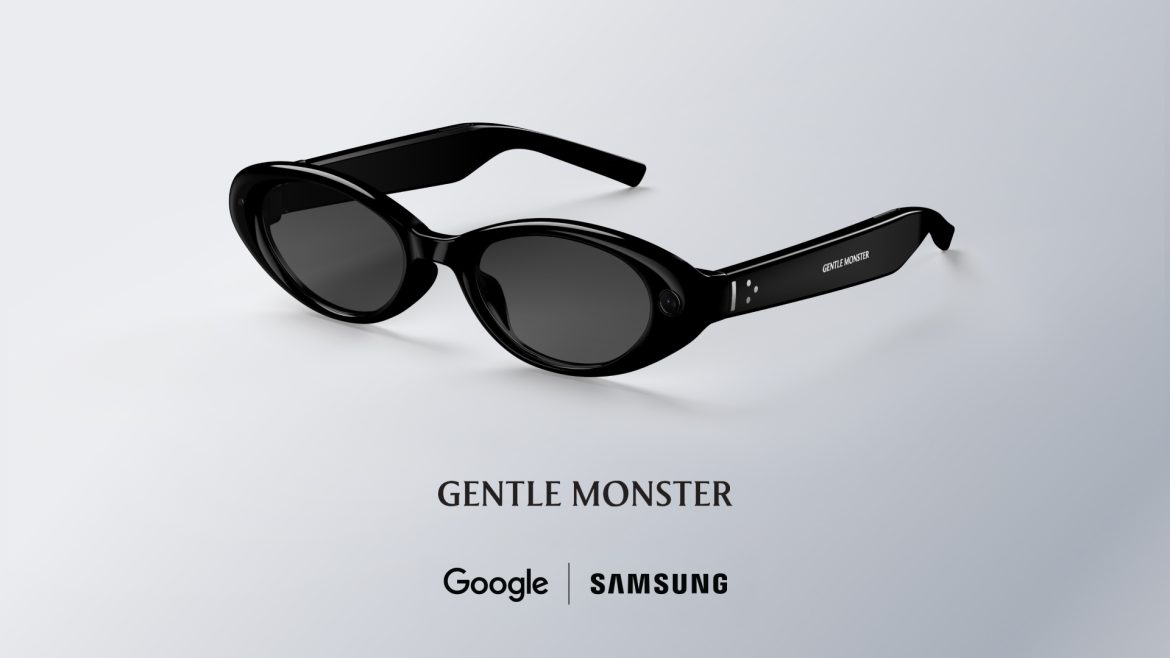
Samsung is approaching the smart glasses market the way it approaches Galaxy Watch: as a hardware platform that outside brands can skin with their own design language. Two eyewear partners are publicly confirmed. Warby Parker brings direct-to-consumer credibility and a mass-market retail presence across the United States, including prescription handling and insurance billing. Gentle Monster, the Seoul-based luxury label known for avant-garde frames, brings established fashion credibility and significant reach across East Asia, where design-forward aesthetics carry particular weight in purchase decisions. TechTimes’ Google I/O coverage confirmed both partnerships.
The strategy addresses the problem that ended Google Glass: glasses people are willing to wear in public. The Warby Parker Jinju edition shown in the leaked videos features a slightly glossy modern wayfarer-style frame that could pass for standard eyewear. It is considerably slimmer than Meta’s Ray-Ban Display model, which carries additional bulk for its in-lens HUD element. The slimness is, again, a direct consequence of the missing waveguide.
Samsung has confirmed that the Galaxy Glasses Manager app will work with both its own-branded glasses and the Warby Parker and Gentle Monster editions, managing settings, camera controls, AI assistants, accessibility features, notifications, and a Find My Glasses tool from a single hub.
What Galaxy Glasses Inherit From the Ray-Ban Controversy
Any display-free camera wearable that runs on the Snapdragon AR1 chip enters a market that is not controversy-free. The same hardware class — camera-equipped, display-free smart glasses — has generated significant documented misuse since Meta’s Ray-Ban glasses achieved commercial scale at seven million units sold in 2025 alone. Fortune’s investigation documents the privacy concerns that followed Meta’s commercial success.
A class-action lawsuit (Bartone et al. v. Meta Platforms, filed March 4, 2026, in the U.S. District Court for the Northern District of California) alleges that Meta marketed its glasses as “designed for privacy, controlled by you” while routing captured footage through a human review pipeline at a Kenya-based subcontractor. The reviewed footage reportedly included content from private home spaces. The UK Information Commissioner’s Office opened a parallel investigation into Meta on March 5, 2026. Both proceedings are ongoing. The Fortune article covers the lawsuit in detail.
Samsung and Google are not named in either action, and their data policies differ from Meta’s. Google’s Gemini Apps Privacy Hub, updated May 5, 2026, explicitly covers “Gemini on Android XR” and stores user activity for 18 months by default; human-reviewed conversations are retained separately for up to three years and are not deleted when a user clears their activity history. Samsung has not published separate data handling terms for Galaxy Glasses as of July 3, 2026. Google’s Gemini Apps Privacy Hub is the authoritative reference for these terms.
Brian Hall, a privacy and AI attorney at Stubbs Alderton & Markiles, told Fortune in March 2026 that the structural gap in smart glasses privacy law is not about what wearers do with their own data. “The bystanders, the people who are being filmed and identified, they’re the ones that are at risk,” Hall said. “Sadly, our privacy laws are not designed to protect those people.”
Buyers who care about this should note two things: that Galaxy Glasses will ship with the same outward-facing LED notification system the leaked videos show, and that Google has not yet disclosed whether footage processed by Gemini through the camera will be used to train AI models. The camera-wearable category as a whole is carrying these questions into 2026; Samsung’s product joins it on its own merits and its own terms, but it does not sidestep the category’s unresolved debate.
July 22 and Beyond: Unpacked, Pricing, and the Display Question
Samsung is expected to reveal Galaxy Glasses at its Galaxy Unpacked event on July 22 in London, where the company also plans to unveil the Galaxy Z Fold 8 range and Galaxy Watch 9. The July 22 event is likely to serve as a formal product reveal and the start of pre-orders, with retail availability expected later in 2026 — fall is the confirmed window, potentially timed to IFA in September for European market details. TechTimes’ Unpacked preview covers the full event lineup.
Pricing estimates from multiple sources cluster in the $379–$499 range for the Jinju generation, though Samsung has not confirmed a figure. That would position Galaxy Glasses above the $299 original Ray-Ban Meta but in the same general tier as premium audio wearables. The display-equipped Haean model, expected in 2027, will compete against Snap Specs ($2,195) and Xreal AURA (under $1,500) in the full AR tier — a different market entirely. TechRadar’s coverage includes the $379–$499 price estimate.
The category Samsung is entering has genuine commercial momentum. EssilorLuxottica, Ray-Ban’s parent company, sold more than seven million AI smart glasses in 2025 — more than tripling the two million sold across 2023 and 2024 combined — with Meta and EssilorLuxottica together holding approximately 82 percent of the global smart glasses market by the second half of 2025, according to Counterpoint Research. That lead is the obstacle; the leaked control scheme is Samsung’s answer to removing the switching friction. UploadVR’s reporting on EssilorLuxottica’s 2025 earnings covers the market share data.
The bet, in brief: by giving Android users a glasses product that feels immediately familiar at the hardware level, runs a more capable AI assistant, integrates more deeply with an existing Galaxy device ecosystem, and supports iPhones that Meta’s product cannot reach, Samsung and Google are hoping that the control scheme’s familiarity is the last friction point a prospective buyer needed removed before switching — or buying a first pair.
Frequently Asked Questions
What is the difference between Samsung Galaxy Glasses and Meta Ray-Ban smart glasses?
At the hardware level, the differences are smaller than the marketing suggests: both products run on Qualcomm’s Snapdragon AR1 chip, use a touchpad on the right temple for media controls, include a dedicated camera button, carry a front-facing LED to indicate recording, and lack a heads-up display. The meaningful differences are in software and ecosystem. Galaxy Glasses run Android XR with Gemini AI, connect natively to the full Galaxy ecosystem (Galaxy Watch, Galaxy Ring, Galaxy phone), and are compatible with iPhones. Meta’s Ray-Ban glasses run Horizon OS with Meta AI and are closely tied to Meta’s own ecosystem. The open-platform approach of Android XR also means future Samsung eyewear partners will share the same software and developer ecosystem — a structural advantage if it accumulates developer investment the way Android did in smartphones.
Does Samsung Galaxy Glasses have a display?
No — not in the first generation. The 2026 “Jinju” model launching this year is a display-free camera-audio wearable: it captures video, plays audio through directional speakers, and runs Gemini AI through a paired phone, but there is no heads-up display or visual overlay. Samsung’s forthcoming “Haean” model, expected in 2027, is planned to include a waveguide-based display for true augmented reality overlays. The absence of a display in the current model is a deliberate engineering decision: eliminating the waveguide optic and its rendering pipeline is the reason the glasses can weigh approximately 50 grams with all-day battery life at a sub-$500 price point.
Are Samsung Galaxy Glasses safe to use from a privacy standpoint?
The honest answer is that important questions remain unanswered. Samsung has not published separate data handling terms for Galaxy Glasses as of now. Google’s Gemini Apps Privacy Hub explicitly covers Gemini on Android XR and retains user activity for 18 months by default. Whether footage processed through the camera can be used to train AI models is not disclosed. Beyond the wearer’s own data: bystander privacy law does not protect people who appear in footage captured by smart glasses without their consent — an issue that generated a class-action lawsuit and regulatory investigation against Meta in early 2026. The dual LED system on Galaxy Glasses (one facing bystanders, one facing the wearer) is a disclosure mechanism, not a consent mechanism. Buyers should review Google’s Gemini privacy policy and wait for Samsung’s specific data terms before drawing conclusions about their own exposure.
When will Samsung Galaxy Glasses be available to buy?
Samsung is expected to reveal Galaxy Glasses at Galaxy Unpacked on July 22, 2026, in London. The confirmed retail availability window is fall 2026, though a specific date has not been announced. Some reports suggest a European market reveal at IFA in September. The estimated price range, based on multiple leaks, is $379–$499 — though Samsung has not confirmed any figure. Pre-order registration may open at or after Unpacked on July 22.
