
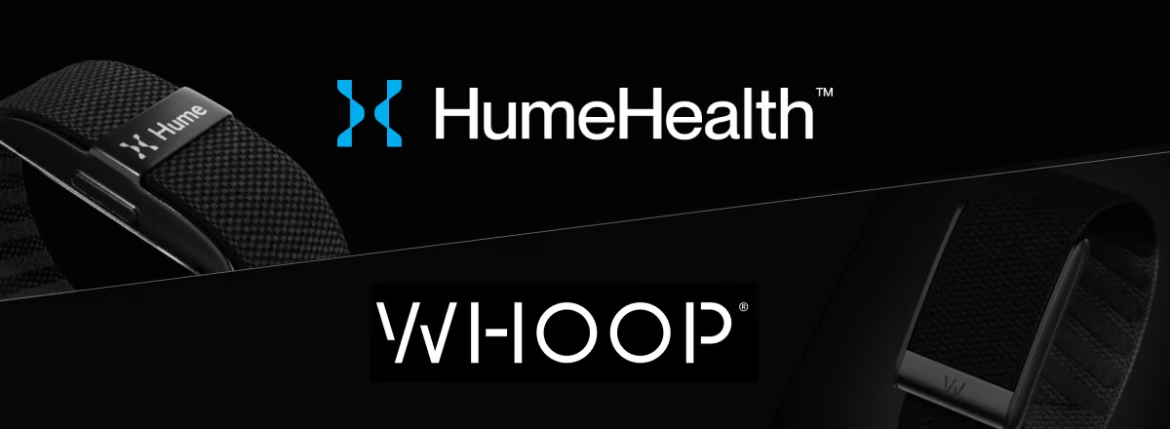
Although it is a relatively new player in the fitness tracker market, Hume Band has already attracted significant attention. As you may recall, the company entered the smart gadget race with the launch of the Body Pod, a smart scale offering full body composition tracking.
Their recent addition, Hume Band, simplifies health tracking by providing weekly insights and focusing on long-term health improvements. But how does it compare to Whoop 5.0, one of the leading players in the wristband market? Can Hume compete with an established company with a decade of experience?
The Cybernews research team and I set out to find out. We examined these bands based on numerous aspects, including tracking features, data accuracy, design, pricing, and more. Below, you will find a thorough comparison of Hume Band vs. Whoop.
While I’m personally not a fan of its utilitarian design, Hume Band is my top pick in the fitness band space. Unlike the Whoop 5.0, which focuses on how you’ve slept and how you’re recovering from the previous day or workout, Hume Band is all about long-term health. It measures your metabolic capacity to determine your body’s age and examines how it’s adjusting to your diet, exercise routine, and rest.
Hume Band vs Whoop: overview
Before we jump into the details, we should take a quick peek at each device’s key features, so you know what to expect from each:
| Rating | 4.8 | 4.6 |
| Weight | 8.6g | 26.5g |
| Display clock | ❌ No | ❌ No |
| GPS | ❌ No | ❌ No |
| Water resistance | IP68 (submersible up to 10m for up to 2h) | IP68 (submersible up to 10m for up to 2h) |
| HSA/FSA eligible | ✅ Yes | ✅ Yes |
| Battery life | Up to 7 days | 14+ days |
| Price | One-time purchase, from $199 | Subscription-based, from $149/year |
| Subscription cost | None required | Required, from $149/year |
| What we like |
|
|
| What we dislike |
|
|
Winner

What is Hume Band?
Hume Band is a newcomer that, unlike most fitness trackers, places the focus on the long-term effects of your lifestyle.
It uses metabolic capacity, metabolic momentum, and several other factors that shape your metabolic age to create a longevity-based recovery score. This shows your body’s actual resilience and tells you whether you’re on the right track to improving your health.
What is Whoop?
Whoop has been in the fitness game since 2015. While its wristbands are best known for tracking daily strain and recovery, they also measure other sleep and stress-related metrics. The band then syncs the data with the robust Whoop app, which turns it into personalized daily insights to help you build healthier lifestyle habits.
Why You Can Trust Cybernews
Our team of in-house researchers, writers and editors reviews and analyzes health tech products using a research-driven approach. We gather data from multiple sources, fact-check all information, and conduct our research based on peer-reviewed studies, expert opinions, consumer ratings, and regulatory approvals.
You can learn more about how we test health tech products here.
50+
Peer-reviewed studies checked
1000+
Hours of fact-checking and research
How we test smart devices (methodology)
At Cybernews, we don’t just recommend gadgets we randomly come across. Instead, we thoroughly evaluate each product to ensure our recommendations are objective and accurate. When it comes to fitness trackers, we look into the following:
- Tracking features and accuracy (35%). Our testing starts by examining each device’s set of sensors. We then look into independent tests and user feedback to gauge the accuracy of each gadget’s tracking.
- Comfort and ease of use (25%). Next, we examine comments to understand what real users think about the comfort of the hardware and the user-friendliness of the accompanying software.
- Value for money (20%). We also evaluate the price-to-performance ratio of each device by putting the cost up against the included features.
- Battery and charging speed (10%). How long a gadget can last on a single charge and the time it takes to juice up again are also vital for our evaluation.
- Ecosystem and integrations (10%). Finally, we check the band’s apps and their compatibility with other health-related tools and systems.
Hume Band vs Whoop: design and comfort
Hume Band and Whoop are both wrist-worn devices, but their design languages differ significantly.
If you’re after a small and lightweight wrist-worn gadget, Hume Band is the way to go. There are no customization options here, as the screenless, utilitarian band is all about function. It’s simple, flexible, and comfortable to wear in the long run.

Whoop is also screenless, but comes in a much wider form factor than Hume Band. The device is fully customizable in terms of materials and colors, so you can pick a design that best suits your needs in terms of visuals and comfort.

Wrapping up
While beauty is in the eye of the beholder, I just can’t get over the fact that Whoop looks like someone set out to design a smartwatch and then forgot the smartwatch component.
Winner
Hume Band vs Whoop: core metrics tracked
Both Whoop and Hume Band cover the basics exceptionally well, but the latter takes it up a notch.
When it comes to Whoop, the features depend on the membership tier you’re on. At its core, Whoop includes sleep and activity monitoring, women’s hormonal insights, VO2 max, heart rate zones, personalized coaching, and daily sleep, strain, and recovery scores.
The real-time stress monitor and the health monitor with alerts, as well as the Healthspan and Pace of Aging features, are restricted to higher-tier plans.

Conversely, Hume Band features a similar set of sensors and thus, offers similar-looking readings. However, it also builds upon these metrics by incorporating metabolic capacity to provide insights into your endurance, recovery capabilities, and actual resilience.
Hume Band also provides a metabolic momentum score, which is a reflection of how your body is adapting to your diet, physical activity, and sleep. This way, you know where you’re headed and can take control to build healthier habits.
Wrapping up
Hume Band goes beyond the norm with metabolic capacity, metabolic momentum, and even chronic illness detection, so it gets a point here.
Winner
Hume Band vs Whoop: longevity differentiation
One of the main differences between Whoop and Hume Band lies in their philosophies.
Even with the recent Healthspan and Pace of Aging features, Whoop focuses on the now and shows whether you’re ready today.
In contrast, Hume Band is built for longevity, not just performance or recovery. While it covers the basics, it places much greater focus on long-term health. The device turns simple readings into aging-focused scores that show you how you’re aging and adapting for the next decade.
Wrapping up
Hume Band focuses on the bigger picture, which gives it an advantage.
Winner
Hume Band vs Whoop: data accuracy and analysis
While both devices track almost every aspect of your health, what the Hume Band does with the data also matters.
Whoop features highly accurate sensors that measure heart rate variability (HRV), resting heart rate (HR), respiratory rate, and sleep. In fact, a study on wearables that included the Whoop 3.0 found its HR and HRV sensors to be more than 99% accurate.
Hume Band matches that clinical-grade accuracy. The brand claims its HR sensor was tested against ECG standards and blood oxygen (SpO2) tracking validated against FDA-approved pulse oximeters.

Hume then ups the ante with AI-powered biomarker algorithms that turn simple measurements into easy-to-understand metabolic momentum and long-term recovery scores and provide daily guidance tips.
Wrapping up
Whoop’s above-average accuracy is impressive, but Hume Band edges out with proactive insights.
Winner
Hume Band vs Whoop: software and user experience
As far as apps go, Whoop and Hume Band both do a great job, but one offers a more polished experience.
Whoop can’t be connected to third-party apps. However, it makes up for it with a user-friendly interface and detailed insights. Switching between sleep, recovery, and strain dashboards is a breeze, whereas the community tab lets users share experiences and compete with each other.

Meanwhile, the Hume app offers modern visuals with detailed insights but simplified weekly health scores. However, it has been reported to crash on specific devices.

Wrapping up
Until Hume resolves stability issues, the Whoop app automatically gets this one.
Winner

Hume Band vs Whoop: battery and charging
While users can get about a week out of each device, Whoop is simply on another level.
Hume claims its wristband can go 5-7 days on a single charge. Meanwhile, charging takes 20-80 minutes, depending on your current battery level.

Conversely, charging Whoop takes about 120 minutes, which is an acceptable trade-off considering its 14+ days of always-on tracking. However, it’s worth noting that the wireless PowerPack is only available with Whoop Peak and Life tiers, while One members get a wired charger.

Wrapping up
With more than double the Hume Band’s battery life, Whoop easily wins this round.
Winner
Hume Band vs Whoop: pricing and subscriptions
These two wearables take vastly different approaches to pricing.
Hume Band requires a one-time payment of $199. The premium membership isn’t necessary unless you want personalized coaching and workout videos. But with the premium 40% discount – which you can secure with the Hume coupon code CYBER20 – the membership is definitely worth the consideration.
Conversely, while Whoop’s 30-day free trial is an advantage, the wearable is exclusively available through subscription tiers:
| Device | Whoop 5.0 | Whoop 5.0 | Whoop MG |
| Band | CoreKnit | SuperKnit | SuperKnit Luxe |
| Charger | Wired | Wireless | Wireless |
| Price | $149/year | $239/year | $359/year |
Wrapping up
Unless you plan to keep the wearable for less than a year, Hume Band is the better choice.
Winner
Hume Band vs Whoop: pros and cons
If you’re thinking about picking up either of these devices, it would be beneficial to check out their strengths and drawbacks beforehand:
Hume Band pros
- Simplified weekly health scores
- Metabolic capacity and momentum
- Subscription-free tracking
Hume Band cons
- Simple design
- Possible app crashes
- Fewer integrations
Whoop pros
- No upfront cost
- Impressive battery life
- Decade’s worth of experience
Whoop cons
- Expensive subscription-based tracking
- Features like Healthspan restricted to higher-tier plans
- Smartwatch-like design with no display
Wrapping up
All things considered, Hume Band excels in more vital areas with fewer drawbacks.
Winner
Who should buy which?
Whoop and Hume Band are both excellent options for users who want a wearable with comprehensive fitness tracking. But how do you decide which one to get?
Well, it’s simple, really. Whoop offers detailed today-focused strain and recovery scores. As such, it’s ideal for users who want to know how their body is doing right now and whether they’re ready for action.
On the other hand, Hume Band is a much more future-focused wearable. It’s intended for users who want aging-based insights and care about catching health risks, such as early signs of chronic illness, before they can become problematic.
Conclusion and verdict
It should now be evident that these two devices serve different types of users. Ultimately, the best option depends on your individual preferences and needs.
Hume Band covers all the basics well, but it is more geared towards longevity. Its aim is to help users build resilience and improve their long-term health.
If you’re not actively working towards that, then Whoop is still a reliable choice. Its daily strain measurements and scores make it ideal for gym goers, athletes, and fitness enthusiasts alike.
Other reviews you might be interested in:
Hume Band vs Oura: which device builds true resilience?
WHOOP vs Oura: which wearable tracks your health better?
WHOOP vs Fitbit: which fitness tracker is worth it in 2026?
FAQ
Does Hume Band require a subscription?
Unlike Whoop, which is entirely subscription-based with no up-front costs, you don’t need a subscription for Hume Band. However, a premium membership is available for those who want additional features.
Does Whoop count steps?
While the company’s previous devices didn’t do this, all wristbands from Whoop 4.0 and onward have accelerometers and support step tracking. This data is easily viewable in the Whoop app, where users can also set daily step goals.
Is Whoop better than Apple Watch?
The answer to which device is better depends on what you’re after. Apple Watch is primarily a smartwatch, so fitness tracking comes second. Meanwhile, Whoop is strictly focused on tracking sleep, recovery, and fitness.
Does the Hume Band track sleep?
Yes, Hume Band offers comprehensive sleep tracking. It measures sleep quality, duration, and even discrepancies to gauge how rested you are, and how this affects your body in the long term.
Can I sync Hume Band data with other health apps?
The Hume app integrates with Apple Health, FitBit, Garmin, and more. So, yes, you can easily sync its data with these tools or export it at any moment.
