
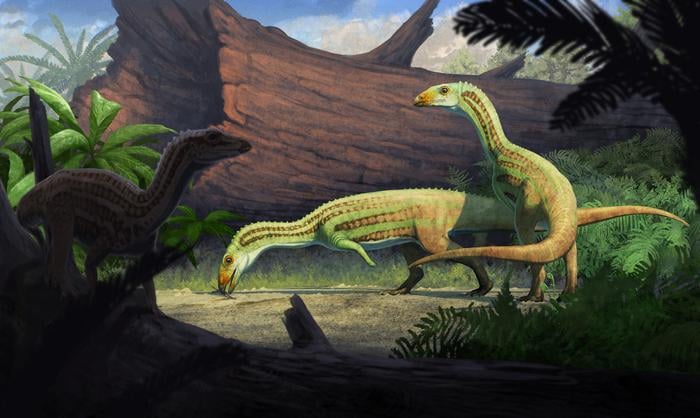

Modern crocodiles are powerful, heavy reptiles. They spend much of their lives along riverbanks, waiting to ambush prey. But their ancient relatives looked and lived very differently. One example is Sonselasuchus cedrus (S. cedrus). This recently discovered crocodile species lived about 215 million years ago during the Late Triassic Period.
S. cedrus stood just about 25 inches (64 cm) tall. This is about the size of a standard poodle. Though related to crocodiles, the reptile resembled the ostrich-like dinosaurs that roamed Earth about 100 million years later. Instead of teeth, the animal had a sharp, toothless beak for slicing food. Its massive eye sockets suggested strong vision. Its hollow, lightweight bones were built for sprinting across land instead of swimming. Scientists think S. cedrus lived in lush forests, not muddy rivers or swamps.

The most surprising thing about S. cedrus was how it moved as it grew older. Younger individuals likely walked on all fours. But as they matured, their back legs grew longer and stronger. This allowed adults to walk on two legs. This shift has never been seen before in ancient crocodiles.
The study, published in March 2026 in the Journal of Vertebrate Paleontology, was led by Elliot Armour Smith at the University of Washington. It was based on about 950 fossils of the ancient crocodiles found in a bonebed at Arizona’s Petrified Forest National Park. They included remains from at least 36 individuals of different ages. This gave the team a rare look at how the animals changed as they grew. The area also contained fossils of ancient fish, amphibians, dinosaurs, and other reptiles. The researchers believe these animals may have gathered around a drying watering hole during a severe drought before they died.
Resources: Livescience.com, Phys.org, Smithsonianmag.com
