
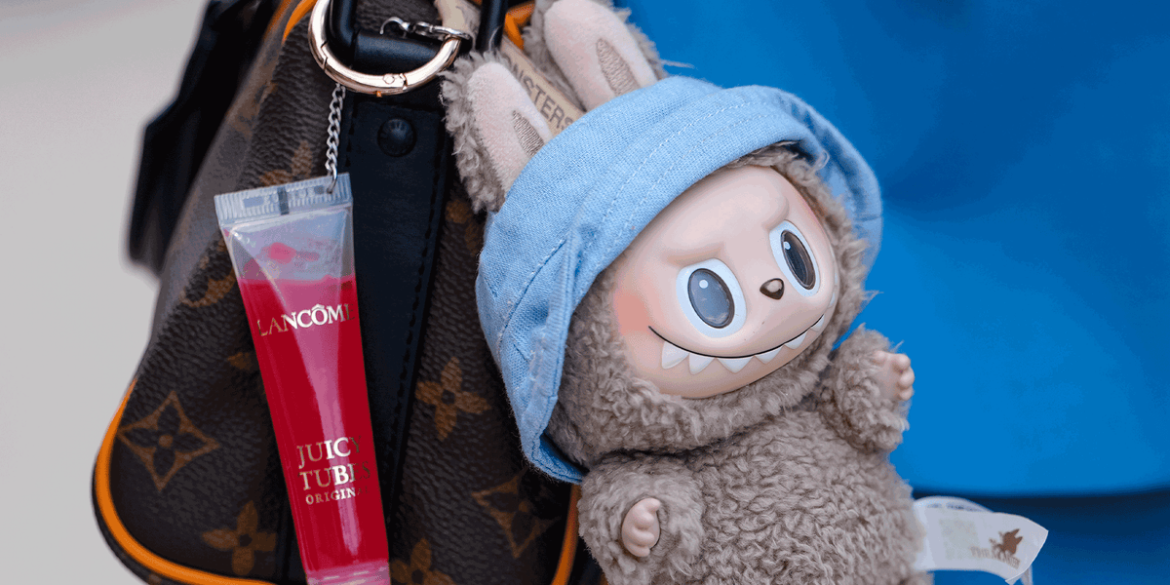
In past seasons, beauty trends focused on a color, technique, or ingredient—but for summer 2026, it’s all about visibility. From Laneige’s Glaze Craze Lip Serum to the newly relaunched Marc Jacobs Beauty bag charms, our favorite products are now being designed to hang from our handbags instead of disappearing inside them. Beauty isn’t just something we wear anymore; it’s something we display.
If toy-like accessories dangling from handbags feel oddly familiar, that’s because they echo one of last summer’s biggest cultural phenomenons: Labubus. Remember those fuzzy little things everyone from your tween neighbor to Rihanna had clipped to their bag? While they may no longer be culturally relevant, their influence remains. The Labubu-fication of beauty is officially here, driven by a new generation of beauty consumers who aren’t just buying skincare, makeup, or fragrance for efficacy. They want them to double as collectibles, status symbols, and accessories.
That obsession with personalization extends far beyond bag charms. From Starface’s decorative pimple patches to Louis Vuitton’s logo-embossed lipsticks, we’ve entered an era where beauty is as much about self-expression as self-care. According to Sara Tan, beauty expert and cohost of the podcast Gloss Angeles, the shift accelerated when Rhode’s viral lip treatment phone case transformed a skincare product into a fashion accessory, helping catapult the brand into the cultural zeitgeist on its way to a billion-dollar acquisition.
As consumers, sure, it’s convenient to have your go-to products on hand without digging to the bottom of your bag, but the appeal to the brands making these charms and novelty items isn’t about convenience. The real value is visibility. Think: beauty products designed to function as status symbols, turning everyday essentials into accessories that signal taste, identity, and cultural relevance.
DAISE Beauty (a fragrance and bodycare brand)’s whole ethos is centered around this concept, so much so that they recently launched Labubu-coded Mini Fragrance Body Mist Charms. Founder Jaimee Lupton says she built the brand with Gen Z and Gen Alpha in mind. “For those generations, beauty is so tied to identity and self-expression, so wearing it—not just using it—makes so much sense.” The data backs her up: A 2025 study found that 52 percent of Gen Z consumers use beauty products to express different aspects of their identity and personal style. “The Body Mist Charms are beauty you can show off, accessorize, and personalize,” Lupton adds. “They’re cute, they clip on, and they let you carry your favorite scent with you wherever you go.”
Bag charms aren’t the only cue beauty marketers are taking from the Labubu playbook. Brands like Charlotte Tilbury, The Lip Bar, and P. Louise are now offering blind boxes (the same packaging as Labubus) that conceal your product until it’s opened. Labubu unboxing videos have racked up hundreds of millions of views on TikTok, so it only makes sense for beauty brands to try to replicate the same viral buzz.
Demi Ngai, a content creator and former creative director at Eos, says some of her highest-performing videos are reviews of beauty advent calendars, which she likens to blind boxes. “It’s really fun and novel, and everyone loves a surprise and delight.”

Add Cosmopolitan as a preferred source in your Google search results.
Use your Google account to add this to your settings.

That desire to participate in a shared cultural moment helps explain why Labubus—and, by extension, bag charms and blind boxes—have resonated so deeply with younger consumers, particularly during a period marked by economic uncertainty.
“We’re living in very difficult, dark times where everyone is just trying to get by,” says fashion psychologist Jennifer Heinen, founder of StylMynd. “Having something whimsical gives people a spark of joy and dopamine. Labubus offered a little escape from reality. If you want a luxury, a bag charm is a relatively accessible entry point. Fashion and beauty have always been about having fun and making things wearable.”
But is the dopamine hit from our bag charms and surprise-and-delight moments ultimately worth the environmental cost? Does an industry already grappling with overconsumption really need more stuff? And when the hype inevitably fades, what happens to the stuff we stop carrying or the blind box products we never wanted because they’re the wrong shade or simply not something we’d ever use?
The answer is complicated. Like most trends, the obsession with beauty bag charms will eventually die down. A year ago, it was impossible to buy a Labubu—now, it’s quite the opposite. “Vintage stores are now reselling Labubus everywhere because they probably don’t know what to do with them,” says Heinen. “I think a good place to start is: Do I love this product enough to buy a bag charm of it? I can’t assume that many people do.”
As a beauty editor, I’ve received plenty of these charms—and very few have actually earned a permanent spot on my bag. For products you genuinely reapply throughout the day, like lip gloss or fragrance, the functionality makes sense. (I’ve even clipped a lip gloss charm onto my work tote.) But for more involved products, such as skincare or blush, you have to question the thought process. Realistically, how many of us are going to carry around a brush to apply extra color to our cheeks or use a dirty finger to dot on eye cream? At that point, I choose to assume these charms are being created solely for marketing purposes. Of course, if your goal is simply to wear your favorite beauty brand as part of your personal style, that’s a different story.
Tan agrees, adding it’s important for product development teams to think critically before jumping on the bandwagon. “I just don’t think that every brand needs to be participating in the bag charm or blind box trend unless it really truly makes sense for the identity, the campaign, or the launch,” she says.
At the end of the day, though, Tan doesn’t fault consumers for buying into little pockets of fun and luxury. The reality is that we’re living in hard times, and beauty and fashion have always provided us with an escape. “If a little lip gloss keychain and a Labubu are going to make your day a little brighter, then who are we to say that shouldn’t be something you should purchase?” says Tan.
But it can’t hurt to check in with yourself before you do: “Enjoy the whimsy and the fun, but then also keep in mind, Am I gonna use this a year from now?” If the answer is yes, then maybe it is more than just a trend.

Ariana Yaptangco is a New York-based writer and editor covering beauty, culture, and entertainment. She previously held staff positions at Glamour and ELLE. You can follow her on Instagram @arianayap.
