
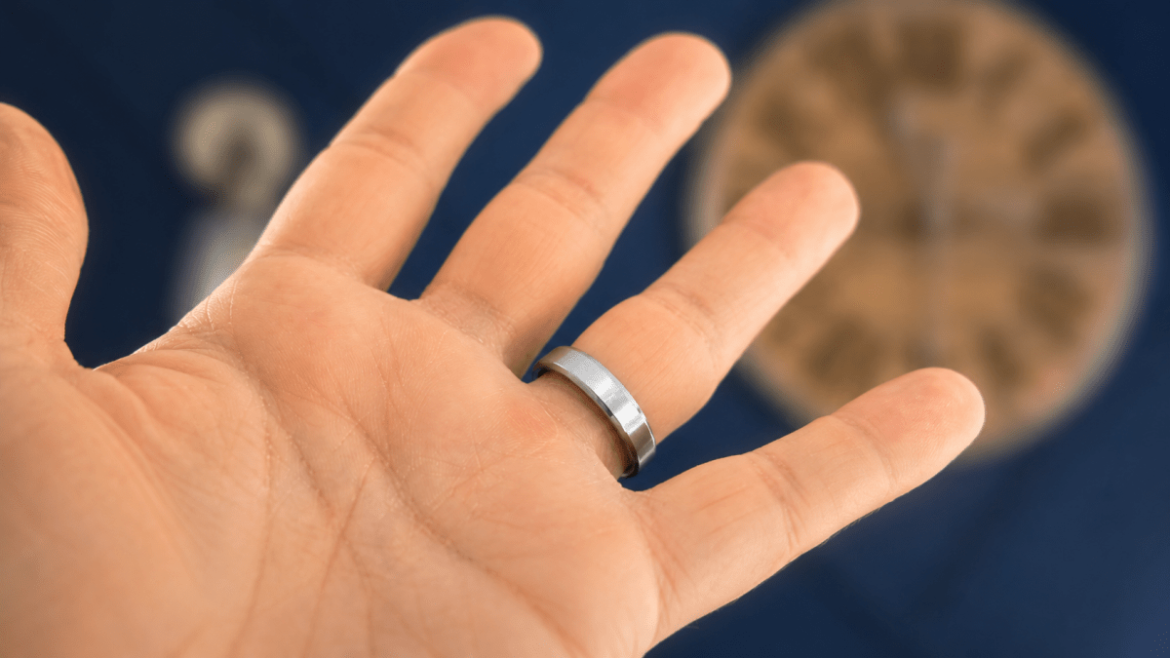
The idea behind the Oura Ring 5 is fairly straightforward: the identical health monitoring features from before, now packed into a ring approximately 40% more compact than the previous generation. The Ring 5 comes in at 6.09 mm wide and 2.28 mm thick, while its predecessor, the Ring 4, measured 7.90 mm wide and 2.88 mm thick. The new model weighs between 2 and 2.69 grams depending on which size you choose, compared to 3.3 to 5.2 grams for its predecessor. Oura is claiming the title of world’s smallest smart ring, and on the numbers, that’s hard to dispute.
The size reduction required a full internal redesign – Oura reduced the number of light paths from 18 to 12, but offset that change by making the sensors four times brighter. The result, per the company, is a 12% improvement in nighttime HRV accuracy. In practice, heart rate accuracy during workouts holds up well for most activities, but this is certainly the weakest part of the hardware. Indoor cycling produces reliable readings (I still struggle to stay in Zone 2 – damn), but walking and even running can sometimes return broken measurements.
The only consistent weak spot is exercises which necessitate holding something like a weight. I would assume the pressure from barbells or the like pushes the ring slightly out of the right position – at least on my shaped hand – and the hardware failed to pick up my exercise and sporadically lost my heart rate.
I’d suggest looking elsewhere if you’re wanting something solely for tracking workouts.
What does hold up is Oura’s battery claims. The company advertises a 6-to-9-day range, and a size 11 unit easily bore that out, dropping from a full charge to around 7% across just over seven days. That’s an improvement over the Ring 4’s 5-to-8-day window.
Oura rings are well documented for degrading battery capacity over time. But you can depend on this company. My wife’s ring’s battery degraded to the point where it would barely last a day, but after speaking to the app’s AI, it was replaced quickly and for free under warranty despite it being over a year old.
Pricing? Well it now starts at $399, a $50 increase over its predecessor, while opting for finishes like Gold, Stealth, Brushed Silver, or the newly added Deep Rose brings the price up to $499. The monthly subscription stays at $5.99, or $69.99 annually. Sizing runs from 6 to 13, which is actually narrower than the Ring 4’s range, so buyers with smaller or larger fingers should check compatibility before ordering. Before your actual ring arrives, Oura sends a plastic sizing kit to help determine the right fit – wearing it for a full day is recommended, because your fingers expand and contract depending on what you’re doing.
Also – don’t lose weight unless you fancy buying another! Been there, done that.
The Sports Tracking Gap Is Getting Harder to Ignore
Here’s what the spec sheet doesn’t tell you: Live heart rate monitoring during workouts is not self-contained on the Ring 5 – the real-time activity tracking functionality, introduced with this device generation, depends on pairing an external Bluetooth heart rate sensor to capture that data. I use the Polar H9, just in case you wondered.
The ring won’t display live heart rate on its own during a workout – just a timer and, for outdoor activities, distance via GPS. No map. No heart rate zones. No live feedback of any kind beyond elapsed time and mileage.
That alone would be frustrating, but the deeper problem is the Strava integration. Despite Oura’s long-running Strava integration, the export still leaves out the one metric the hardware is built to capture in the first place: heart rate. It gets worse from there. Pair an external heart rate sensor to the ring during a workout, and the activity doesn’t just lose its heart rate numbers, the whole session fails to reach Strava at all. No file, no record, nothing. For anyone training with any seriousness, this may be a deal-breaker.
The app itself got a visual refresh several months back that cleaned things up cosmetically while stripping out some depth. Readiness, sleep, stress, activity, and heart rate all live on the main dashboard, and the data underneath is really useful. Sleep timing accuracy is reliable. The stress tracking scores workouts as high-stress events, which is technically correct physiologically but misleading in practice – Garmin nullifies those events from daily stress totals, and Oura doesn’t, though it does exclude them from the aggregate figure. The VO2 max estimate, however, isn’t overly believable. But if you’re only using the ring to track performance, then a simple increase or decrease will let you know if you’re moving in the right direction.
If you want an accurate reading, you’re going to have to give some money to a company with a lot more equipment than a smart ring.
I’ve owned the Oura 4 for a long time, and I wasn’t sure quite what I expected from the upgrade. The good thing, is there’s very little change apart from the size and battery – two of the major issues I had with the previous generation. But this isn’t a bad thing. In fact, it proves just how goo the 4 was. The 5 only builds on and refines its already impressive performance.
If you’re wrist-averse and want reliable sleep and wellness trends without wearing a watch, it does the job quietly and well. If you already own a Garmin, Apple Watch, or anything else in the sports wearable space, then you may think twice about a $399 plus a monthly fee. And if athletic performance data matters to you at all, you may want to look elsewhere.
But if you’re a normal person who just wants a better, more optimized life. Well, this is exactly the piece of tech you should be reaching for.
Oura Ring 5 — Full Specifications
