
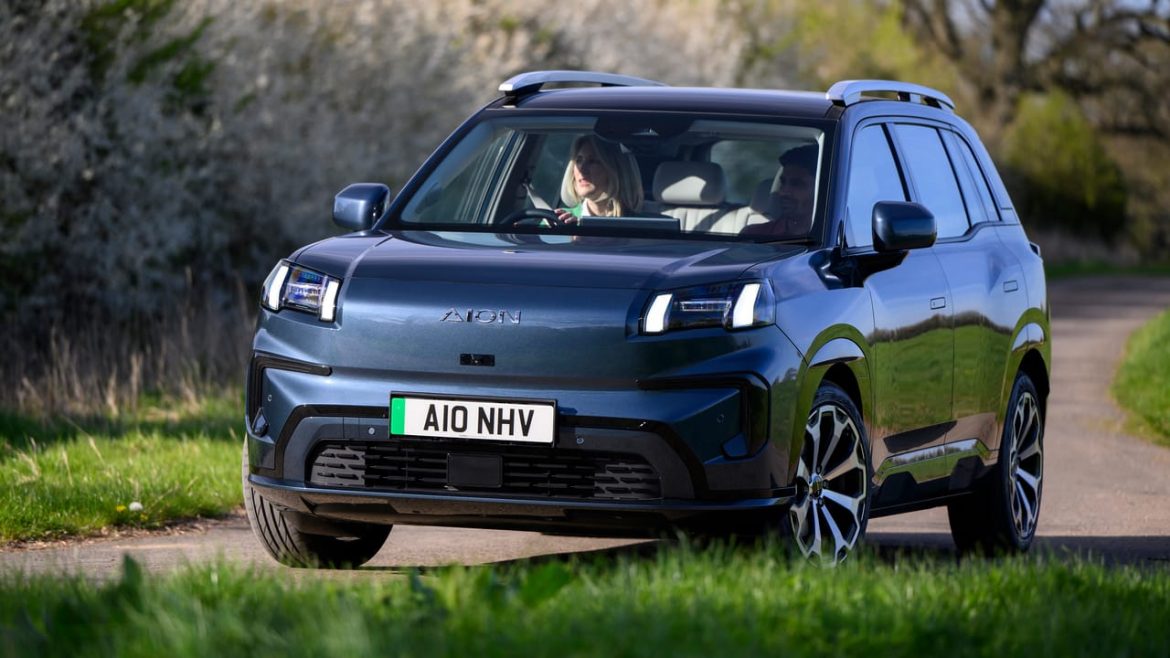
Another family electric SUV, and another new UK entry from a Chinese brand. It’s pitching at the heart of the market – prices in the mid-to-high thirties – with a car offering lots of room, plenty of range (317 miles WLTP), and the sort of performance that won’t scare witless someone coming from a normal petrol crossover.
So as a car it certainly covers the bases. Mind you, so do rivals. Take the Vauxhall Grandland Electric, Ford Explorer, Kia EV5, and Jeep Compass. They’ll all give you similar batteries for similar money, and you’ve heard of them. The Renault Scenic has a much bigger battery actually, as do some versions of the Nissan Ariya.
Advertisement – Page continues below
To be fair, we’re talking about bottom-trim versions of those cars and the Aion has top-trim levels of equipment. But how much do you really need electric seats and a glass roof? If you really do crave equipment, there’s the MG S6 EV, which is decent, and the patchy Changan Deepal S07. Or the Leapmotor C10, about which the less said the better.
Most other Chinese makers, conspicuously including BYD, Omoda and Jaecoo and Chery, don’t have an EV this size because they’ve realised it’s PHEVs that sell. Aion knows that too. The V is its first entry but plug-in hybrid SUVs will follow.
So what’s the USP?
Aion’s pitch is the ownership. The tagline is ‘Great Eight’. That stands for eight years of car warranty, battery warranty, roadside assistance, servicing and MOT. Now, eight years’ warranty is little advance on some rivals that offer seven. Eight years’ battery warranty is now an absolute industry standard. But the servicing and MOT fee – all this is transferable when you sell the car – is novel, even if EV servicing is cheaper than ICE servicing. It’ll prop up used values which in turn reduces leasing/PCP cost to the new buyer. For more on that, click the Buying section of this review.
If you don’t live near a dealer, and it’ll take a while to get a full network established, AION has a partnership with the AA so an AA tech will come to you in a specially equipped van to do servicing or repair.
Advertisement – Page continues below
Right. And who or what is Aion?
Aion has some home-market heft behind it. It’s part of long-established state-owned GAC. GAC has been building huge numbers of Hondas and Toyotas in China for years. GAC now has its own electric tech including the batteries, an advanced NMC cell-to-pack design. Toyota must trust GAC as the China-market Toyota bZ3x is an Aion V given a different nose and tail.
The V has had its suspension recalibrated for British roads – a setup that’s been adopted for all Europe – and its screen system reprogrammed.
Would I be able to spot it in the car park?
The design’s moderately distinctive, boxy in outline with neat almost-planar surfacing, and mirrored arrowhead creases over the front and rear wheels. They’re 19s by the way, yet look small which shows how deep the body is.
There’s every sign Aion has good knowledge of body engineering. This is a genuinely roomy car, almost BMW X5 in the back, and has a five-star Euro NCAP rating. The body certainly feels solid as it goes over bumps. Yet overall weight is a trim 1,880kg.
What are the electric stats?
The LFP battery’s capacity is 75.3kWh, for a WLTP range of 317 miles. Although we weren’t on battery-sapping motorways much, our test showed a decent 3.6 mi/kWh which would be 271 miles, a decent real-world result.
Charging time is also – by a couple of minutes – class-leading: 24 minutes 10-80 per cent at a peak 180kW. It’ll also accept 11kW three-phase. Vehicle-to-load is part of the spec, as is a heat pump for winter economy.
How is it to drive?
It’s FWD, and canters from 0-62mph in 7.9 seconds on a 204bhp motor. No drama. Regeneration is variable by screen options. Despite the simple torsion-beam rear suspension, the steering is impressively precise and progressive, and you can feel the tyres’ efforts. To know more, and also about the infuriating driver ‘assist’, click the Driving tab of this review.
But as a family SUV comfort is surely the issue. It starts well, with soft springs and quiet suspension and tyres. Excellent for A-road cruising and disguising urban potholes. But on a trickier road it’s a bit floaty and underdamped. Sick bags at the ready.
Is it family friendly?
It’s big and plush inside. The back seat has huge legroom and reclines partially. Overhead is a big glass panel. The rear doors open to near enough 90 degrees so it’s a cinch to insert a toddler into a child seat, or help aboard an infirm grandparent. Big boot too.
And everyone will be happy with the plush finish and gadget count. Optionally, the front armrest box is a fridge-slash-oven that’ll hold ice-cream at freezing point or takeaways toasty.
What’s the verdict?
“The electric qualities are good and the cabin is roomy and nicely finished. It’s not bad to drive”
This is a remarkably thorough box-ticking exercise. It’s a perfectly decent electric crossover that has been worked-over some more to suit British families. The ownership promise – buying, maintaining, charging – looks to have been mercilessly gone-over to round off likely pain points.
The electric qualities are good and the cabin is roomy and nicely finished. It’s not bad to drive.
But what of that eight-year promise? It’ll be great if Aion is as committed to the UK as it says and is still here eight years hence. But already we’ve seen the arrival and failure of various GWM brands including Ora and Haval, and GWM is a deep-rooted company back home. Still, maybe that doesn’t matter if you buy on lease – it’s someone else’s problem if the brand disappears.
The main appeal of the Aion seems to be a left-brain decision for those who shop around. So make sure you really do shop around. There are just so many well-established rivals out there.
