
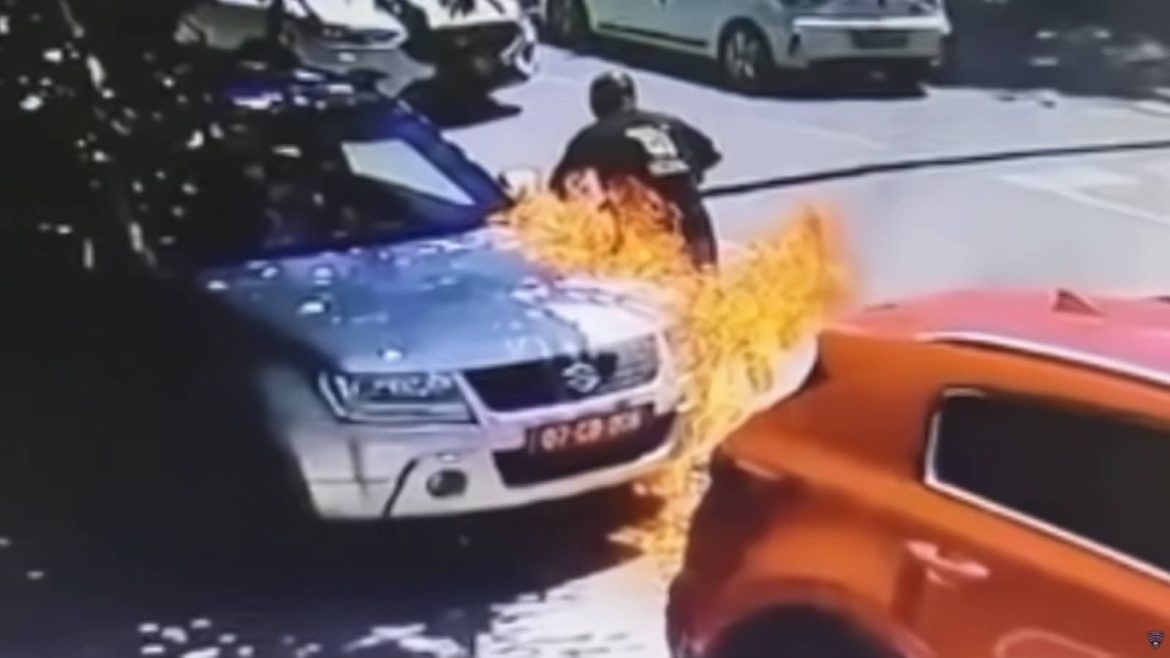

A screen grab from a security camera video showing Bulgarian diplomatic vehicles being set on fire in Skopje. Source: North Macedonia’s Interior Ministry.
Bulgarian President Iliana Yotova on Tuesday criticised the vandalism of two cars belonging to the Bulgarian embassy, which were set on fire in Skopje the previous day, saying that violence against diplomatic property is unacceptable.
“This is property of the Bulgarian state and I personally take it as an attack on Bulgaria,” Yotova said, adding that this incident should not be overlooked during discussions on North Macedonia’s EU membership ambitions.
Bulgaria issued a condemnation shortly after the incident was reported, and called for a swift investigation.
North Macedonia’s Prime Minister Hristijan Mickoski also swiftly condemned the attack, saying that such acts had no place in relations between the two neighbouring countries. “This is an act that I strongly condemn. Such incidents do not contribute to building good relations and friendship,” Mickoski said on Monday.
“The perpetrator has been detained and has already admitted to the crime,” Mickoski added.
North Macedonia’s Interior Ministry said that police had identified and apprehended a 44-year-old suspect connected to the burning of the vehicles. The authorities said an investigation was underway to establish the circumstances, including the motive, which is still unknown.
The incident comes amid years of strained relations between Sofia and Skopje, largely linked to Bulgaria’s objections to North Macedonia’s progress towards European Union membership.
Bulgaria blocked the opening of North Macedonia’s EU accession negotiations in 2020, arguing that Skopje needed to address disputes related to history and language and the treatment of Bulgarians in North Macedonia.
While Bulgaria claims that Macedonians and their language have Bulgarian roots, and that there are many more Bulgarians in the country than the few thousand counted by the last census, many in North Macedonia view Bulgaria’s assertions and demands as highly offensive and as an attempt to challenge the country’s identity.
The dispute was partially addressed through the EU-backed “French proposal” in 2022, under which North Macedonia agreed to amend its constitution to include Bulgarians among its recognised communities as a condition for advancing the accession process. However, political disagreements over the constitutional changes have continued, and North Macedonia’s path towards the EU remains stalled.
The incident comes only days after a meeting in Sofia between North Macedonia’s President Gordana Siljanovska-Davkova and Bulgarian President Yotova, where the two sides discussed the long-running dispute. The talks, held on the sidelines of the South-East European Cooperation Process summit on June 10, were presented as an attempt to maintain dialogue despite deep disagreements between the two neighbours.
After the meeting, Siljanovska-Davkova said it had become clear that Sofia’s concerns went beyond North Macedonia’s planned constitutional changes to include Bulgarians. She said Bulgaria also raised issues connected to historical disputes and the work of the joint history commission, established after the 2017 bilateral friendship treaty. North Macedonia’s Foreign Minister Timco Mucunski said Skopje wanted assurances that there would be no further demands related to identity, language and history.
Bulgaria, meanwhile, reiterated that North Macedonia must implement commitments already included in the EU negotiating framework, including constitutional changes and respect for the rights of citizens identifying as Bulgarians. Sofia has argued that these are European criteria rather than new Bulgarian demands.
The burning of the diplomatic vehicles came a day before North Macedonia commemorates, on Tuesday, the 83rd anniversary of the Vatasha massacre, one of the most painful events in the country’s World War II history.
On June 16, 1943, 12 young men from the village of Vatasha, near Kavadarci, aged between 15 and 28, were executed by Bulgarian military and police units, then part of the Axis occupation authorities, after being accused of supporting the Macedonian partisan movement.
