
 Imagine the government threatening to tax ex-smokers for no longer contributing to health funding via tobacco tax revenue. It would be the dumbest policy ever conceived.
The slightest disincentive to quitting is always amplified by an addict into a rolled-gold reason to avoid changing unhealthy habits. And that’s precisely what a road user charge on EVs will achieve: it will give petrol and diesel users one more excuse to keep pumping pollution into everyone’s lungs.
Punishing Good Behaviour
The health costs of particulate emissions, the NOx, the PM2.5, shortening lives near busy roads, almost certainly exceed the 3-4 cents per kilometre being proposed. EV drivers aren’t currently freeloading. If anything, it’s the other way round.
So the bad news is it’s a dumb tax that punishes the right behaviour. There are indications it will be postponed until the fuel crisis that is driving so much EV uptake subsides, but it’s likely coming sooner or later, no matter how much I moan about it.
But thankfully, there is good news: with some simple, free changes, it’s easy to claw back at least 4 cents per km – once you have an EV. Enough to wipe out the tax altogether – and hopefully remove the ‘EV tax’ as an excuse to not quit that filthy liquid fuel addiction.
Here’s how:
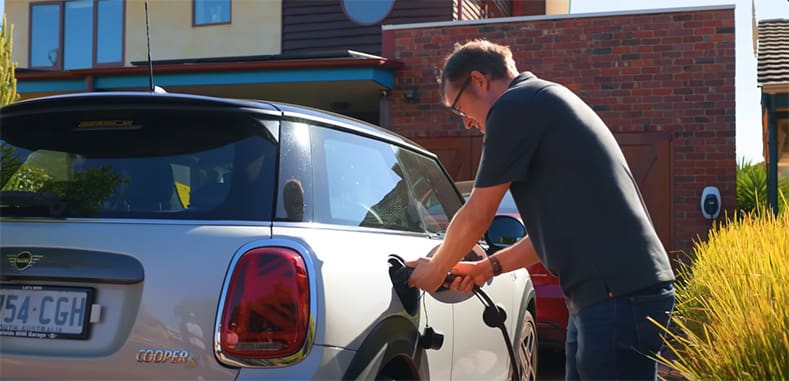
Charging during the day is one of the ways to cancel out the cost of an EV road user charge.
Behaviour change #1: Charge smarter. If you have solar and a car at home, charge during the day. If you’re on a time-of-use tariff, set a timer for off-peak. At 6km per kWh, you’ll save 3-10 cents per kilometre compared to charging at peak grid electricity rates.
Behaviour change #2: Drive more like a grandma. Chill mode – or the non-Tesla equivalent – reduces acceleration and tyre wear significantly. An enthusiastically driven EV might need tyres at 30,000 km; a relaxed one at 50,000 km. At $1,000 a set, that’s roughly 1 cents per kilometre saved.
In fact, now I’ve worked it out, forget this step. Keep Chill Mode off, ready for when that modified HSV ute appears at the lights. Well worth it.
Behaviour change #3: Shop around for insurance. EV premiums vary by hundreds of dollars annually across insurers – some still price EVs as exotic cars. The RUC costs around $600 a year at 15,000 km driven. One afternoon of comparison shopping can recover most of that, every year.
Behaviour change #4: Keep your car longer. Your EV at 150,000 km drives as it did at 30,000 km with little to service. So there’s no mechanical reason to replace it, and any upgrade decision is psychological, not practical. Delay it three years, and the $25,000 gap between selling your old car and buying a new one works for you. At 5-6% cost of money, that’s $450 per year saved – amortised over 10 years of ownership.
Politicians Can’t Stop EV Savings
Mix and match those behaviours, and the EV tax becomes a financial nothing-burger. The politicians may be hell-bent on a dumb tax, but they can’t change the physics of an electric motor, the price of sunlight, or the fact that your EV will still drive like new when their policy is a distant, embarrassing memory.
Phase Shift is a weekly opinion column by SolarQuotes founder Finn Peacock. Subscribe to SolarQuotes’ free newsletter to get it emailed to your inbox each week along with our other home electrification coverage.
