
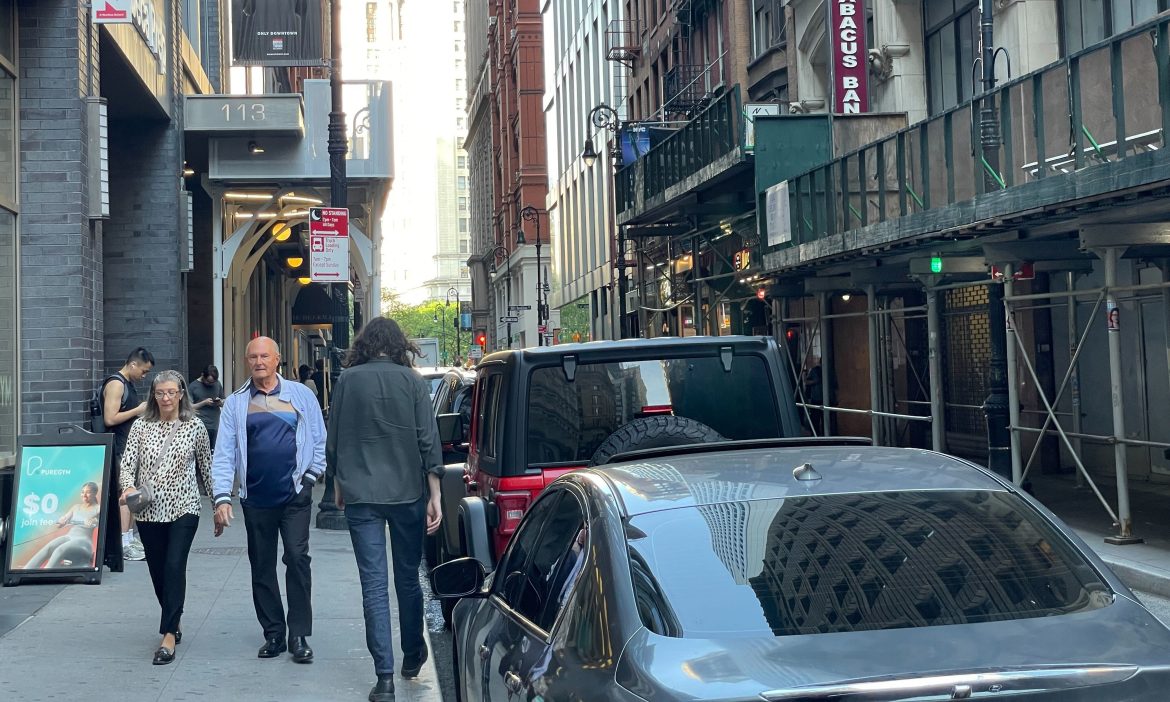
Thousands of people walk through the Financial District’s centuries-old streets every hour, according to recently released pedestrian traffic data that give even more reason for Mayor Mamdani to reclaim Lower Manhattan’s historic narrow paths from private automobiles.
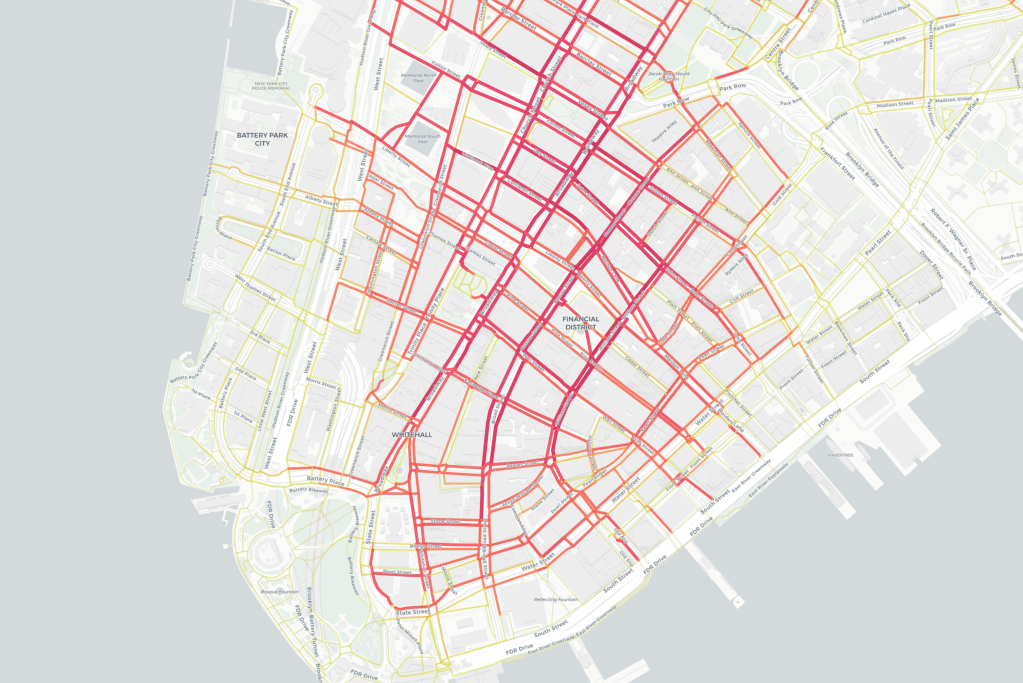
The dense downtown quarter boasts some of highest foot traffic in the city, with upwards of 2,000 pedestrians per hour on some sidewalk segments. A recent heat map graphic, published by Vital City in tandem with a February study by researchers at Georgia Institute of Technology and Massachusetts Institute of Technology, makes it vividly obvious why the mayor should keep his landmark campaign promise to pedestrianize FiDi.
“Now that we have the data, we know what we can do to make it better,” said Catherine Hughes, a board member of the civic group Financial District Neighborhood Association, which is comprised of residents of the neighborhood. “This administration [has said it] really wants the city to work for people, and part of the city working for people is making sure that the sidewalk and streets work as well for people.”
The graphic shows that thousands of people walk around Lower Manhattan, hour after hour, particularly in the area sandwiched by Broadway and Water Street. The area has tight and winding streets that harken back to New Amsterdam, the city built on Native land by Dutch fur traders in the early 17th century. During the weekday evening rush, key arteries like Nassau, William and Fulton Streets exceed 2,100 walkers per hour.
Only Midtown counts larger numbers, but that neighborhood follows Manhattan’s famous grid and offers more pedestrian space. The Department of Transportation recently added even more space for walking in Midtown with painted “super sidewalks.”
In FiDi, however, generations of city planners have prioritized private motor vehicle traffic and storage on streets that are often too narrow to accommodate both — or, in some cases, either — leading drivers to jump curbs and squeeze foot paths.
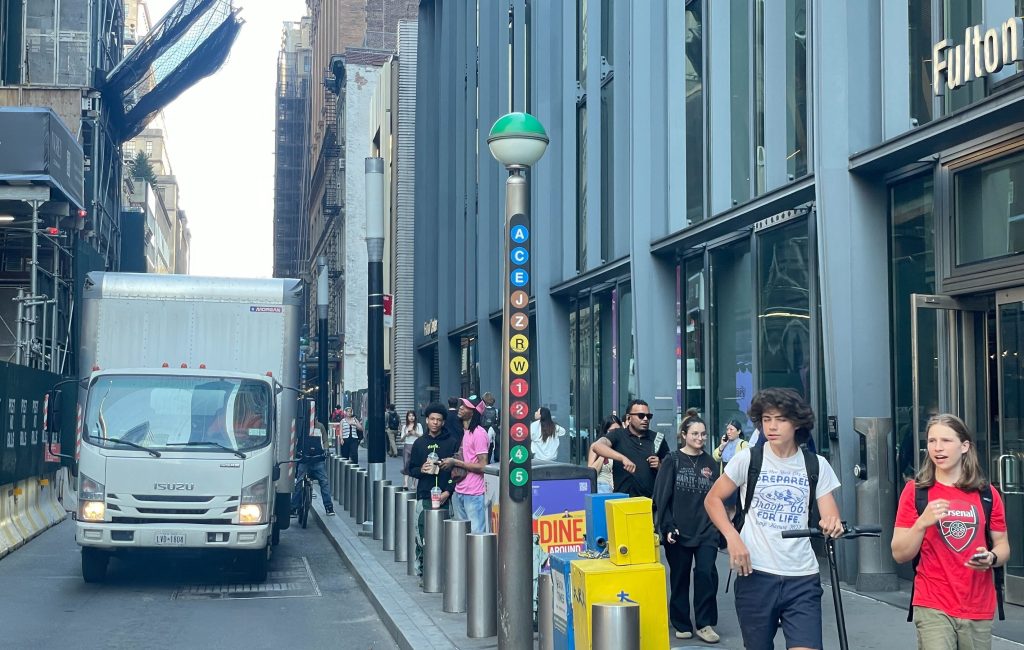
“All of FiDi is desperate for pedestrian priority,” said Betty Kay, who chairs the Manhattan Community Board 1 Transportation and Street Activity Committee, but emphasized she was not speaking on behalf of the civic panel. “It requires a whole rethinking.”
In the graphic, the deep red streets create a miniature grid whose boundaries overlap with several recent proposals to cut car traffic on the tip of Manhattan. These include a one-day shared streets initiative under former Mayor Bill de Blasio in 2016, and a pandemic-era open street on Nassau Street in 2022.
And last year, the FiDi Neighborhood Association proposed its own plan, called Make Way for Lower Manhattan, that encouraged the city to implement 5-mph slow zones on most roads east of Broadway and south of the Brooklyn Bridge.
Indeed, New Yorkers have agitated to get cars out of FiDi for several decades. The Giuliani administration looked into pedestrianization in 1997 and former Mayor Michael Bloomberg took another gander in 2008. The latter study noted cities saw big business gains after they banished cars; in Copenhagen, retail sales jumped 30 percent.
Half a century ago, then-Mayor John Lindsay proposed “pedestrian emphasis” streets on Broadway, Nassau, Fulton and Wall streets as part of a 1966 plan to catalyze development in the area. For a while, the city even booted cars from Nassau during weekday lunch hours.
Although he was unfamiliar with previous attempts, one of the MIT study’s authors said that city officials could now use the study’s granular data to better design the streetscape to meet the overwhelming demand for more pedestrian space.
“In the COVID era, a lot of streets were kind of temporarily pedestrianized as shared streets and so forth, and I think some of them backfired because there was not a very clear strategy of why this street [and] not that street,” said Andres Sevtsuk, an associate professor of urban science and planning at MIT. “The next phase would benefit from being very well informed by, where is the demand really the highest, and it could be quite acupunctural or surgical.”
The City Council gave the city $500,000 to complete its very own pedestrianization study in 2019, but that effort faced opposition within DOT and the influential Downtown Alliance, a business group that counts as its funders some of the most powerful and wealthy titans of industry, very few of whom live in the neighborhood. Business improvement districts such as the Downtown Alliance are not resident associations, but speak for business communities and prioritize corporate interests over residential priorities.
For instance, the area’s Council Member Chris Marte, elected by residents, not appointed by a business group, called on the agency to stop stalling.
“This study affirms what anyone can witness in the Financial District on any day of the week – the streets are teeming with pedestrians,” Marte told Streetsblog. “With many security checkpoints and limited need for cars, many of the streets in this plan already essentially operate as pedestrian walkways. Formalizing our commuters and residents daily walking paths will require investment from the city, but will improve the safety of our neighborhood and further enliven this growing community.”
The transit-rich area has witnessed a boom in residential population in the 21st century — but the car still reigns, especially if that car has a government-issued parking placard that allows its owner to dump their vehicle wherever they please. By contrast, cities like London and Paris have successfully curbed private car access to benefit the general public, such as by limiting through-traffic within so-called low traffic neighborhoods.
Hughes said Mamdani should capitalize on the upcoming FIFA World Cup and celebrations for the United States’s 250th anniversary by carving out space for the incoming wave of visitors.
“There’ll be a lot of people in our neighborhood and it’s an opportunity to put our best foot forward and prioritize the pedestrians so that their experience is as safe as possible,” she said.
DOT spokesman Vin Barone declined to provide specific comment about the downtown area, but said in a statement that the Mamdani administration will be rolling out “bold new ideas to make our streets safer and more welcoming to all and we appreciate the [Financial District Neighborhood] association’s support of this work.”
