
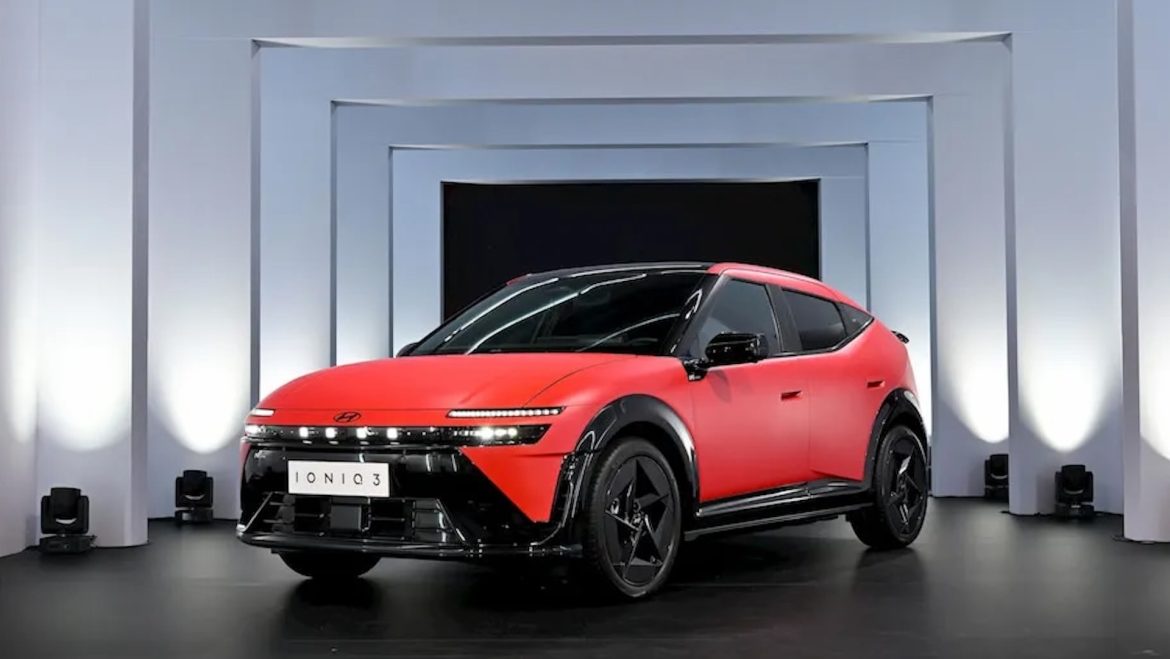
U.K. buyers can place orders for Hyundai’s new IONIQ 3 electric hatchback after the automaker opened orders in the country on August 17, adding a lower-priced option to its EV range.
Priced from around $30,000, the compact model arrives after Hyundai said early demand surpassed that of any previous new-model launch.
Here’s what to know
At £22,245, or about $30,000, the entry-level IONIQ 3 Advance comes with a 42-kilowatt-hour battery and an estimated range of up to 213 miles.
Moving up to the 61-kWh battery pushes the starting price to £25,745, or roughly $35,000, and extends the maximum range to 308 miles.
Hyundai told Electrek that the vehicle has already generated “the highest-ever level of customer interest recorded for a new Hyundai model.”
British customers will be able to choose from four IONIQ 3 trims — Advance, Premium, Ultimate, and N Line Evo.
In the Netherlands, pricing begins at €27,995, or about $32,000, and the car will be available in six trims.
Ashley Andrew, President of Hyundai and Genesis UK, said the IONIQ 3 “delivers genuine EV innovation at a price point that makes electric mobility attainable for even more households.”
Lower-cost EVs can help drivers save money in two major ways: lower fuel costs and reduced routine maintenance bills, since EVs generally do not require oil changes and have fewer moving parts than gas-powered vehicles.
More background
Hyundai is positioning the IONIQ 3 as a more compact counterpart to the IONIQ 5, though it has its own design identity and a practical layout geared toward daily use.
The hatchback uses Hyundai’s new “Art of Steel” styling approach and has a 0.263 drag coefficient.
Despite its compact size, Hyundai says the car makes efficient use of interior space. It includes underfloor “Megabox” storage and up to 116.5 gallons (441 liters) of cargo capacity.
The IONIQ 3 also marks the debut of Hyundai’s new Pleos Connect infotainment system in Europe and the U.K. Built on Android Automotive OS, the setup offers app-based features, customizable screens, an integrated EV route planner, Plug & Charge, Digital Key 2, and vehicle-to-load functionality.
Models such as the IONIQ 3 reflect how mainstream buying an electric vehicle is becoming more practical and more affordable.
What’s being done?
Hyundai began producing the IONIQ 3 at its Izmit plant in Turkey on August 14, and the facility is initially slated to produce 30,000 units per year. Vehicles are expected to reach showrooms in late September.
The company has also kept charging times competitive while relying on a cheaper 400-volt system rather than the IONIQ 5’s 800-volt architecture. Hyundai said the IONIQ 3 can still go from 10% to 80% on a fast charger in roughly 29 minutes with the standard battery and about 30 minutes with the long-range pack.
For consumers, the biggest savings often come from charging at home, though basic Level 1 charging is slow. Qmerit provides free, instant installation estimates to speed up Level 2 home charger installations.
While this particular model is aimed at Europe rather than the U.S., its debut adds to the growing global push toward lower-cost EVs that can help drivers spend less on transportation over time.
Get TCD’s free newsletters for easy tips, smart advice, and a chance to earn $5,000 toward home upgrades. To see more stories like this one, change your Google preferences here.

