When Jay Leno talks about cars, we (all) should listen. The man is a living treasure. In a recent discussion with MotorTrend, the former comedian and TV personality shared revelatory thoughts about the latest high-performance vehicles, battery-powered semi-trucks, California, electric vehicles, Ford, GM, and the imminent Chinese vehicle takeover. Here’s what’s worth remembering.
America is going through a rough patch at the moment, as are most countries in the Western world. Gas is expensive, companies are focused on trimming their workforce, inflation is making prices of everything rise, few businesses are hiring, people are forced to fight humongous AI data centers, and it seems like there’s no escaping the rat race for a decent life.
Few Americans are still dreaming about care-free living. Most just want to be able to pay their bills and see their families on weekends, while younger people try their best to find their place in this challenging economy. On top of that, the average price of a new vehicle is reportedly already over $50,000 in a country where the median yearly salary is barely $62,000. And if there’s one thing everyone knows, it’s that you need a car to be able to move around.
The worst part of it all, however, seems to be that Uncle Sam stopped supporting carmakers who made or planned to manufacture EVs in the U.S. right before oil almost doubled its trading value. The incentives, including those for companies building battery plants, have been gone for quite some time now.
Similarly, the federal EV tax credit is no more. A few states, such as Colorado, still offer some financial perks, but they’re not enough.

Photo: Jay Leno’s Garage on YouTube
Nobody’s acting their wage anymore
So, we’re in limbo. More precisely, we’re in a K-shaped economy where the winners keep winning and the losers… Well, they feel all its downsides.
But that cannot stop us from enjoying what comes out of America nowadays. Nobody aspires to one day own a Hyundai Venue. But a Chevy Corvette ZR1X that’s almost as enthralling as a Ferrari SF90? That’s poster material, and it’s about a supercar made in the U.S. by unionized workers. Given what’s been happening in the country lately, that’s an achievement that deserves celebration. It’s a source of inspiration.
And, better yet, Jay Leno has one! And he loves it to pieces! In a recent talk with MotorTrend, the experienced gearhead said he believes that the Corvette is amazing because it can be had at a very reasonable price. He considers it the “performance bargain,” which is considered to have an MSRP of $72,500 in the Grand Sport trim.
He also appreciated that General Motors was able to build it without trying to cut corners. In Leno’s opinion, the Corvette is made with care, attention to detail, and the most appropriate materials.

Photo: Jay Leno’s Garage on YouTube
“It’s got as much carbon, and magnesium, and exotic metals as anything,” said Leno, who didn’t hesitate to point out that GM managed to create a short supply chain for the Corvette that puts American prowess on display. The company has been trying to do the same with EVs. They were the first to get involved at Thacker Pass. Too bad that isn’t a priority any longer.
America can do it. But will America work for it?
Leno also underlined that Ford was able to reduce costs dramatically for high-performance cars, including for novelties they premiered, such as the lightweight carbon fiber wheels. In under two decades, the Blue Oval managed to transform these rims from being only fit for hypercars into something affordable for enthusiasts. The cost dropped to around $10,000 from $80,000.
But the best thing about it was probably the cost of the vehicle that came with those wheels from the factory, which had an MSRP of $64,500 in 2017 ($87,103 in today’s money).
“It’s fun to see America leading,” said the steward of a mighty car collection.
This discussion about how American automakers can create beautiful, fast, and well-built vehicles with the right amount of innovation in them led Leno to say that the ’09 bankruptcy was the best thing that happened to the domestic automotive industry.
These large companies were forced to trim the fat, but not by firing workers. They had to get rid of all sorts of executives who did not understand the world of cars. They treated beloved brands like appliances. Core American automakers did not have the luxury to behave like Tesla has been for so long, which is known for promising buyers the world and delivering the most corporate sleuth-approved car possible.

Photo: Jay Leno’s Garage on YouTube
The problem was that they did behave like Tesla, but in the opposite way. Instead of presenting a missing indicator stalk as revolutionary or ignoring buyers who asked for simple things such as a front-facing camera, they pumped out all sorts of vehicles that saturated the market, diluted the brand image, and led to serious economic problems for themselves.
But now, according to Leno, the washing machine consultants are finally gone from the jobs that matter most to an auto company and its buyers. Instead, we have people like GM President Mark Reuss, who frequently gets behind the steering wheel of his company’s cars and even tracks them, leading the charge.
Ford’s Jim Farley has also traveled in the U.S. to meet with his company’s customers and discuss with dealers, while also traveling overseas to see what the Chinese hype is all about.
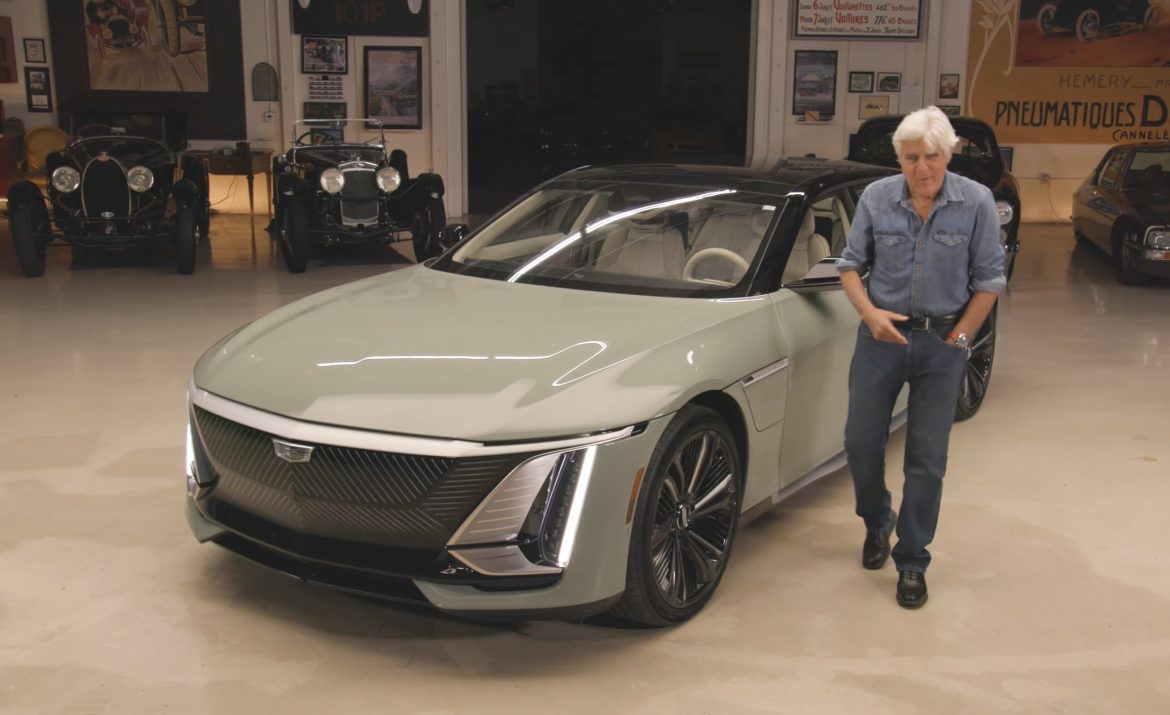
Leno also underlined that Cadillac has been shining lately. They managed to capture the demographic of slightly younger buyers, make great EVs, and put out real sports cars that can even be had with a manual gearbox.

Photo: Jay Leno’s Garage on YouTube
A much-needed global solution that can be a domestic threat
But the real danger for the American auto industry lurks in the shadows. Both Canada and Mexico are letting Chinese vehicles into their countries without tariffing them. It won’t be long before things like the Zeekr 9X will appear in some places in the U.S. and will attract American interest.
The internet is already full of people who keep showing how affordable and luxurious these Chinese vehicles are, and most of them also come in PHEV or EREV form. You don’t have to get used to an EV-only lifestyle if you don’t want to.
Europe will also have BYD’s Flash chargers very soon, which enable 800V+ EVs to replenish their batteries to over 80% in a couple of minutes, not half an hour.
But Jay Leno does believe a transition to cleaner powertrains is necessary. He briefly mentioned how smog used to be a big issue in California before all the greenhouse gas emission regulations were enacted.
Leno even said that the Tesla Semi felt like it had the “hand of God” underneath it because it just picked up speed so easily and made traveling with a big rig feel natural and calm.

Photo: Jay Leno’s Garage on YouTube
Aside from battery-powered haulers, the comedian-turned-YouTuber also appreciated the fact that zero-tailpipe emission luxury vehicles can represent quite the perception change for those with deep pockets. Even Leno finds himself driving the Rolls-Royce Spectre more often than any other of his vehicles. Who can fault him for that, right? Especially since he’s very happy about not having to do $6,000 oil changes anymore.
But America also makes a great EV for those who want to travel in silence and comfort, and that’s the Cadillac Escalade IQ. It may not be as posh as the Spectre, but with a range of around 450 miles and interior room for days, who is going to complain?
So, we do have alternatives in America that work as well, if not better, than European or Asian rivals. They’re just not marketed well or priced appropriately. The latter could be a fatal error for some car companies.
Jay Leno said that the Chinese moved from making knockoffs to having their own stuff, and admitted that they know how to make high-quality items that cost 10-15 less than in Europe or America. With people earning less and the cost of living increasing too fast, we might see a drastic change in consumer preferences.
In the end, that’s the only thing that’s on our mind now: could another bankruptcy, this time caused by China’s overwhelmingly powerful (and heavily subsidized) automotive industry, force core American automakers to wake up once more and stop acting like Americans are forced to buy their subpar mass-marketed products?