
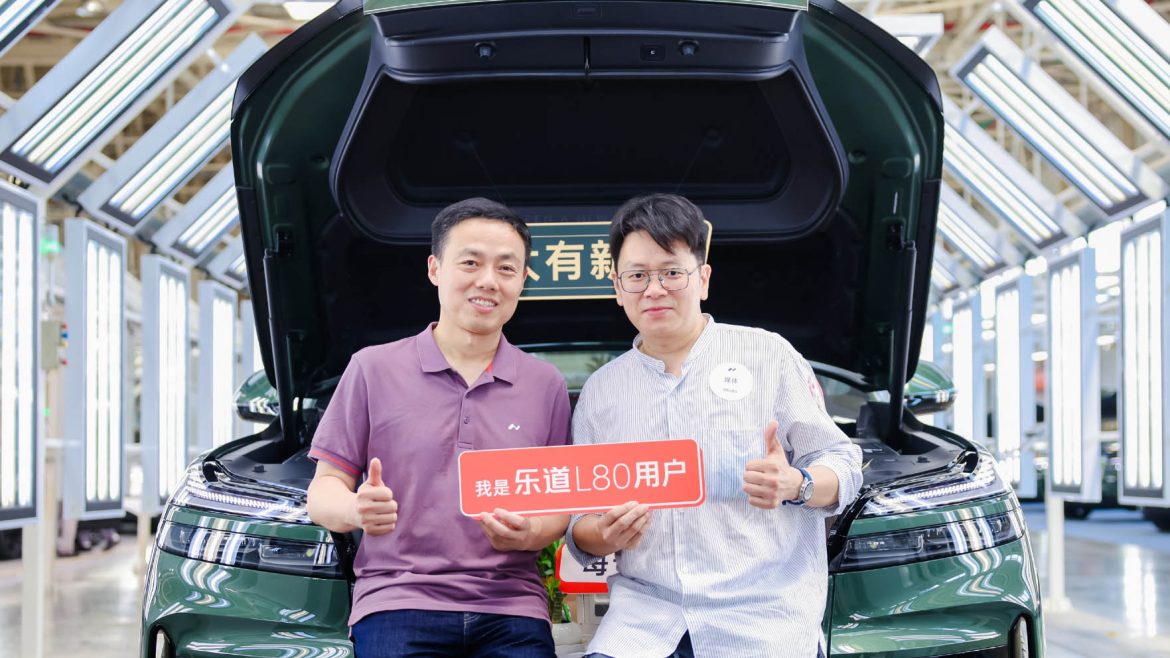
The head of Nio‘s Onvo sub-brand said the third generation Onvo L60 completed a 1,000-kilometer drive on each of four separate routes while pausing for only three minutes of energy replenishment along the way, a result he used to argue that EV buyers worry about the wrong thing.
Shen Fei made the claim in a post on the social platform Weibo on Tuesday, two days before Onvo relaunches the refreshed L60 at an event scheduled for June 11.
His message reframed a debate that has shaped China’s electric-vehicle marketing for years.
Drivers fear running out of charge, the conventional view holds, so manufacturers race to fit larger batteries and advertise longer driving ranges.
Shen rejected that premise saying that the real pain point for a fully electric car “is not driving distance,” he wrote, but how long it takes to add energy and how certain that process is.
The Exec Who Built the Swap Network
Shen joined Nio in 2015 as the company’s 274th employee, according to a 2022 interview with Automotive Powertrain Technology International.
As senior vice president of Nio Power, he spent close to a decade building the carmaker’s battery-swap and charging business from the ground up.
That network now runs more than 3,800 swap stations in China and has handled well over 100 million swaps, serving the Nio, Onvo and Firefly brands.
Nio named him president of Onvo on April 1, 2025, replacing Alan Ai, who left after the sub-brand missed its early-year sales targets.
Shen reports to Nio co-founder and president Qin Lihong, while his former energy portfolio passed to chief financial officer Stanley Qu.
“I take on a new challenge today,” he wrote on the Onvo app at the time, framing the move as an extension of his swap-network work, as EV detailed in a profile of his career.
The Network
As of Tuesday, Nio operated 3,903 battery-swap stations across China, according to the company’s website.
The dashboard put cumulative swaps at 113,630,714, alongside 29,089 Nio-built chargers and access to 1,513,664 third-party charging piles.
Onvo drivers, however, can use only part of that swap network.
Only Nio‘s fourth-generation stations can handle Onvo‘s battery packs, while Nio-brand vehicles can swap at stations of every generation.
1,000 Kilometers on a Single Swap
Four media teams ran the test in China, each on a long regional loop, according to Shen’s post.
One group covered a Beijing loop of 1,037 kilometers. A second drove 1,019 kilometers around Lake Taihu, near Shanghai. A third shuttled 1,021 kilometers between Chengdu and Chongqing in the southwest.
A fourth completed a 1,026-kilometer loop around Xiamen on the southeast coast.
Every route cleared 1,000 kilometers, and every car finished, Shen said.
The headline figure was not the distance but the downtime.
Across each drive, the L60 spent roughly three minutes replenishing energy, the time required for a single battery swap at one of Nio‘s automated stations.
A swap replaces a depleted pack for a full one while the owner stays in the car, a process the company has spent years compressing toward the speed of a fuel stop.
Shen thanked the four teams for confirming what he called a worry-free experience, summarized in a slogan: “east, west, south, north and center — wherever you go, battery swapping is easy.”
The four routes, spread across the north, east, west and south of the country, were chosen to make that point.
Speed and Certainty, Not Distance
Shen’s broader argument took direct aim at the industry’s fixation on range.
Plenty of rivals stage “thousand-kilometer range challenges,” he noted, treating the distance a car can travel on one charge as the decisive measure.
He called that the wrong yardstick.
Over a 1,000-kilometer journey, he wrote, a route passes far more than a single swap station, so a driver can swap once or “swap several times as you please.”
Either approach works, in his telling, because each exchange takes only minutes.
A swap station delivers more than a fast full charge, Shen said.
What it adds, he argued, is “a kind of certainty” — the confidence that topping up will be quick and predictable wherever the trip leads.
That certainty, he wrote, produces “the freedom to travel long distances much like a gasoline car.”
A Relaunch Built Around the Swap Network
Onvo, Nio‘s family-oriented sub-brand, will relaunch the refreshed L60 on June 11, and the swap network is its strongest selling point.
The L60, Onvo‘s first model, is a mid-size electric SUV pitched against the Tesla Model Y, the segment’s global benchmark.
Onvo sits below Nio‘s premium main brand and aims at mainstream family buyers, but it shares the parent’s technology and, crucially, its swap infrastructure.
Buyers can charge the L60 like any other electric car, yet they can also draw on stations where the battery is changed rather than recharged.
That network is expensive to build and operate, and it is the feature that most clearly separates Nio from competitors that rely on charging alone.
Spreading the cost of the network across more cars is part of the reason the company created a lower-priced sub-brand in the first place.
Staging a 1,000-kilometer demonstration days before the launch puts that advantage at the front of the marketing campaign.
For a model the company needs to sell in volume, the message is that the L60 removes the inconvenience of charging rather than merely matching rivals on a range spec.
Some manufacturers chase ever-larger batteries and headline range figures.
Others promote ultra-fast charging, advertising the ability to add hundreds of kilometers in a few minutes — such as BYD.
Nio has bet on a third path, swapping the battery on top of charging it, and Shen’s post is a defense of that bet.
Swapping aims to reproduce that habit for electric cars, making the capacity of the battery, and therefore the advertised range, beside the point.
