
During any warm spell in the summer there is a good chance a spot in the Borders will get a mention.
The record for the hottest day in Scotland was set in July 2022 when 34.8C (94.6F) was reached at Charterhall.
It surpassed the previous record of 32.9C (91.2F) also recorded in the Borders, at Greycrook, nearly 20 years earlier.
The automatic weather station (AWS) at Charterhall opened in 1987 – but the area has an unusual military and sporting history that goes back more than a century.
The weather station at Charterhall opened in 1987 [Met Office]
Charterhall – which sits between Coldstream, Duns and Greenlaw – began life as RFC Eccles Tofts, a World War One landing site for No. 77 squadron in about 1917.
It supported reconnaissance and training aircraft before being abandoned after the war in 1919.
However, when global conflict broke out again it was rebuilt during 1941/42 as RAF Charterhall.
Its principal role was as a training base for No. 54 Operational Training Unit (OTU), which trained crews on various aircraft.
The station gained a reputation for the dangers of wartime flying training, suffering numerous accidents – many of them fatal.
One of them, in January 1943, resulted in the death of fighter pilot Richard Hillary, author of the book The Last Enemy.
He is commemorated to this day – along with others who died in crashes at the site – with a memorial.
A number are also buried nearby, a reminder of just how dangerous training could be.
The OTU left in late 1945 and various fighter units subsequently used the airfield before the RAF departed in 1947, and the station was officially closed.
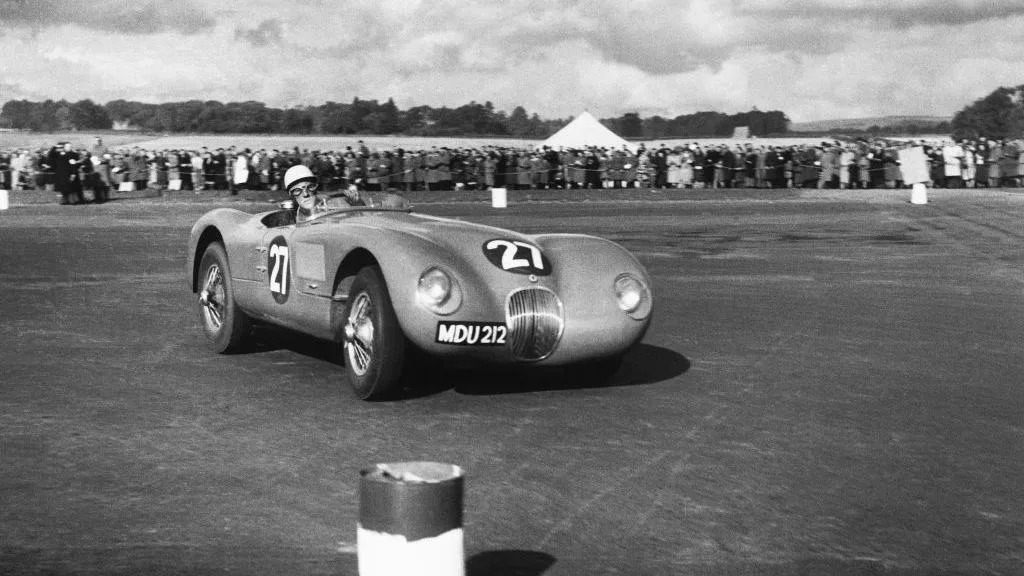
Scottish racing legend Jim Clark, who grew up in the Borders, also raced at the track [Getty Images]
It would, however, enjoy a new lease of life in 1952 when the former airfield was turned into a racing circuit.
Among the famous drivers to compete there were motorsport legends including Jim Clark, Jackie Stewart, and Stirling Moss.
Racing continued for more than a decade until 1964 – while rally events were held intermittently into the 21st Century.
It was not until the 1980s that the weather station came into being – consisting of just a wind vane and anemometer.
The station recorded Scotland’s highest temperature four years ago [Met Office]
Throughout the 1990s additional instruments were added, including rain gauges, pressure sensors, wind gust monitoring, soil temperature measurements, sunshine and global radiation sensors, and visibility equipment.
The site expanded further in 2000 with the installation of a Stevenson Screen used to protect meteorological equipment, cloud height measurement and a range of temperature sensors.
Further upgrades and modernisations have taken place since then and real-time communications and an automated rain gauge added.
Alongside its record temperature in 2022, it records a huge range of other detailed information like cloud height, rainfall, sunshine duration, and wind speed and direction.
Together, these observations provide a “valuable long-term record of local weather and climate conditions, supporting forecasting, climate monitoring and wider meteorological research”.
However, some echoes of the wider area’s unique past remain.
The site is privately-owned and still occasionally used as a small private airstrip.
Much of its wartime layout, too, is visible – including sections of the runways, taxiways, and two original hangars.
No doubt somewhere will come along in due course to surpass the temperature recorded at Charterhall a few summers ago.
Whether it can match its unusual history, though, is another matter.
