
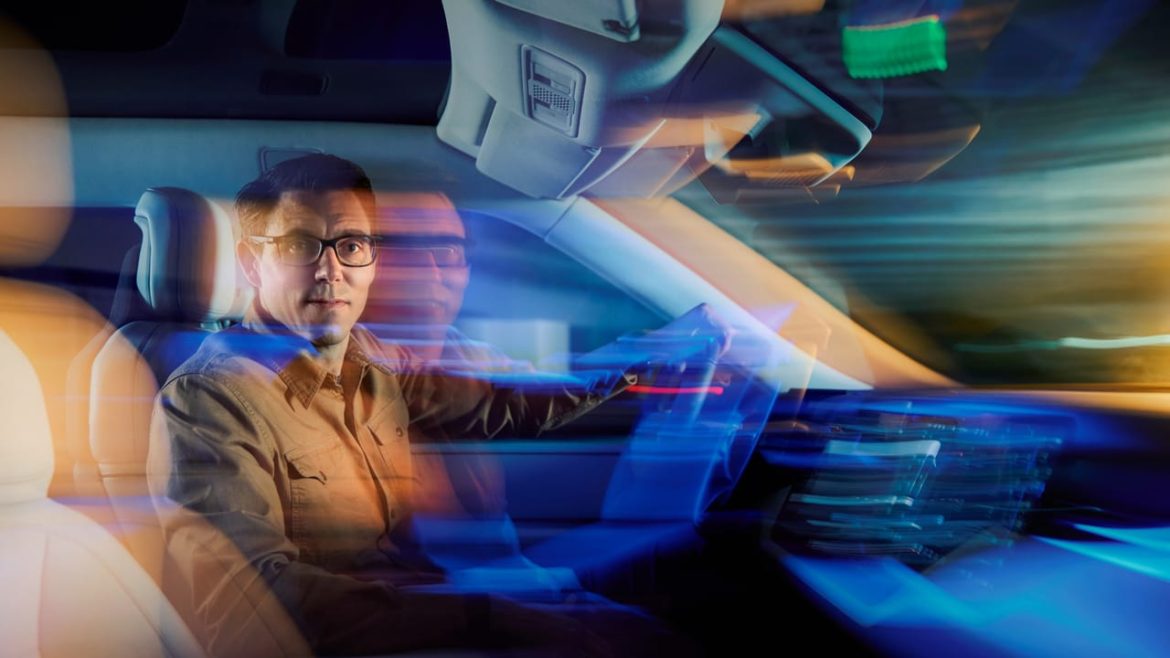
RJ Scaringe asks as many questions as he answers. Rivian’s founder and CEO is with TG for an early drive in the new R2, on a route that skirts the company’s modernist HQ, an hour south of LA. The R2 is the smaller Rivian, the follow-up to the impressive pure electric R1 pickup and SUV. That’s succeeded where Ford’s F-150 Lightning faltered, and has proven a hit with well-heeled Musk-averse liberals in the bicoastal areas of the US. In excess of 42,000 have been sold so far. Now the R2 ramps up the ambition, spearheading Rivian’s push into Europe.
It feels better than it needs to be, I venture, not quite overengineered but clearly done with care. “Where do you sense that?” Scaringe replies. In the damping, for starters, and the generally polished way it gets along the road.
Advertisement – Page continues below
Dynamically it’s right up there with the likes of the new iX3, which is no mean feat given how much BMW has poured into the Neue Klasse project.
Photography: Greg Pajo
But Rivian’s attention to detail is everywhere. The brand message is “adventure forever”, on road and off. Scaringe talks of “brand tonality” and admires Apple in terms of how it built an entire ecosystem around its products. Rivian makes its own tents, flashlights and portable kitchens, to go with the cars. Honestly, if Apple made tents, flashlights or portable kitchens, they’d look like this. Clever, beautifully constructed, but human.
Now the second act is set to begin. Production is scaling up dramatically, and a second factory in Georgia opens later this year. It’ll manufacture the R2 and R3, and has been designed to operate with very high levels of automation, backed up by a new Rivian robotics spinoff company. “We want to build millions of cars per year,” Scaringe says.
Advertisement – Page continues below
He recently added to his workload by starting a micro mobility company, called Also, Inc. “Bikes and scooters, not just cars,” he explains. “You have to electrify everything else.” Yet he talks fondly of his latest purchase, a VW Corrado VR6, and admits to keeping an eye on the classifieds for others. Scaringe, the big picture strategist, remains an irredeemable petrolhead. Factor in the $5.8bn (£4.4bn) joint venture he nailed with the VW Group, swayed by Rivian’s sensational software stack and vertical integration, and it’s clear why RJ is TG’s EV Influencer of the Year.
Top Gear: Congratulations on the R2.
RJ Scaringe: Thanks. The R1 did a really wonderful job serving as the brand’s handshake with the world. It demonstrated what we mean by enabling adventure. And it really has resonated. If you’re going to buy a premium SUV in California, you’re most likely buying a Rivian. But we wanted to make something at a more affordable price point, that still felt intentional, aspirational and thoughtful, on and off road.
We grew up watching 1980s American TV. The cars never seemed to handle very well.
That was not the calling card of an American car. Some people who drive a Rivian don’t think it is American. The R2 has more European-style bushing strategy and wheel control. We’ve done a lot of work to ensure the steering feel is there.
It must have been challenging at times…
It’s like holding a dinner party and you’re running around making sure everything’s right. And finally you sit down and realise it actually looks and tastes sort of nice.
This is a big moment for the company. Do you feel poised?
This is an inflection point for us. It’s a question of focus and execution. We have a significant ramp up here in the US, and we plan to do it in Europe, too, in 2027. We’re very bullish on autonomy, we think level four autonomy is going to be here much sooner than people think. As for the 2030s? Put market share in a blender, put your ideas of vehicle ownership and model hierarchy into a blender… everything’s going to come out differently.
Let’s go back to autonomy. Forgive our cynicism, but it’s been a hot topic since… forever. And it’s still not fully here.
Previously, autonomous cars used a rules-based environment, in which humans tried to code how the world behaved. To massively oversimplify this, if you see a car in front, don’t hit it, stop at a stop sign, go forwards at a green light. But we’ve shifted to the use of ‘large language models’ (LLMs) to create neural nets, multidimensional models weighted on learnings from real world data. We’ve basically thrown away the rule-based environment.
Now we’re picking up data from all the vehicles out there and using it to train a ‘large driving model’, which is learning to drive in the same way that a human or human brain would. It’s accretive, you can grow perception.
Get all the latest news, reviews and exclusives, direct to your inbox.
So it’s finally coming…
The rate of change between 2026 and 2030, compared to what’s been happening in self-driving since 2010, is an order of magnitude faster. Look, I can ask an LLM almost anything now and it answers better than a human. The R2 is like the ultimate data acquisition machine. The real money is being spent on GPUs [graphics processing unit – it processes digital images and accelerates computer graphics using parallel processing].
Anyway, we think we’ll move from level two to three – hands off and eyes off – within the next 18 months. By the end of the decade, it’ll be level four. That’s going to be the most disruptive and sticky feature we’ve seen in automotive. Because people will be very drawn to something that will give them time back when they’re in the car.
It’s going to be the most disruptive feature we’ve seen.
Why have OEMs struggled so much with software definition?
Car companies were born differently to the way Rivian was born. Before the advent of fuel injection, there were no micro controllers or computers in cars. When they arrived, car companies decided that these were not core competencies, so they pushed it to suppliers. ‘We build engines, we build bodies, we designed the car, we own the brand.’ That was the thinking.
So before long you had this mess of ECUs, domain-based and each on its own island of software, written by different teams. Fast forward to now and a modern car – one that’s not a Tesla or Rivian – is an absolute train wreck because you have 100-plus ECUs with 100 different islands of code. Coordinating between those suppliers when it comes to updates is a costly nightmare.
So your thought leadership on this is a major USP… can the OEMs catch up?
At the highest level, most companies recognise that there needs to be a shift towards more software-defined architectures. But if your business evolved in a world in which software wasn’t critical, and you have layers of management who grew up in a world that wasn’t tech, you have to essentially remove your existing leadership team and replace them. Most companies are unwilling to do that. And there’s also the problem of the supply base wanting to support the existing way of doing things.
So how do you see it playing out?
My view is this. If you haven’t built a software-defined vehicle, and haven’t built in high levels of self-driving into the vehicle, it’s impossible to imagine a scenario in which you’re not losing market share. There are multiple layers of abstraction. It’s also not a very attractive place to recruit software talent. If you’re starting with a clean sheet, you’d build one operating system, have a strong software team, and design and build features in one platform. So, if you’re a big company, the question is, how do I undo this multi-decade evolution of our electronics architecture?
The R2 also embraces AI in a fundamental way. Convince us.
AI is here. And not just as a feature in the car. We’re using large language models in ways that would have been seen as pure science fiction until recently. In the next 10 years, it’s going to come into the physical world in ways that are even more difficult to imagine. Robotics, for example, in repetitive or dangerous work in manufacturing, or regarding jobs that are difficult to hire for. But it’s also going to impact global economic systems. Manufacturing has shifted to places where the cost of labour is low. Advanced robotics means you no longer have that challenge. That’s why I created a separate company, Mind Robotics, to focus specifically on highly dextrous industrial robotics.
And yet we still get frustrated when our car insists on regular OTA updates.
[laughs] Sorry for making your car better! Anytime we make big changes, to the UI for example, we think a lot about it, and we monitor customer requests very closely. If you were moving the buttons around every month that would be annoying. We have AI scrubbing every platform to get feedback and inform changes. There are bug fixes, of course, but most of it is finding ways to add new features.
People can be so unpredictable…
The beauty of humanity is that we’re all different, and we respond to the same inputs differently. We’re a non-linear input/output device and everybody’s calibrated their own way. People can hear different parts of something you say. So it takes a lot of intention and thoughtfulness to keep the teams and organisation aligned. I didn’t go from being employee number one to 10,000 employees and beyond that overnight. I learned how to run a meeting. In fact, you’re always learning, and you don’t even realise that it’s happening.
