
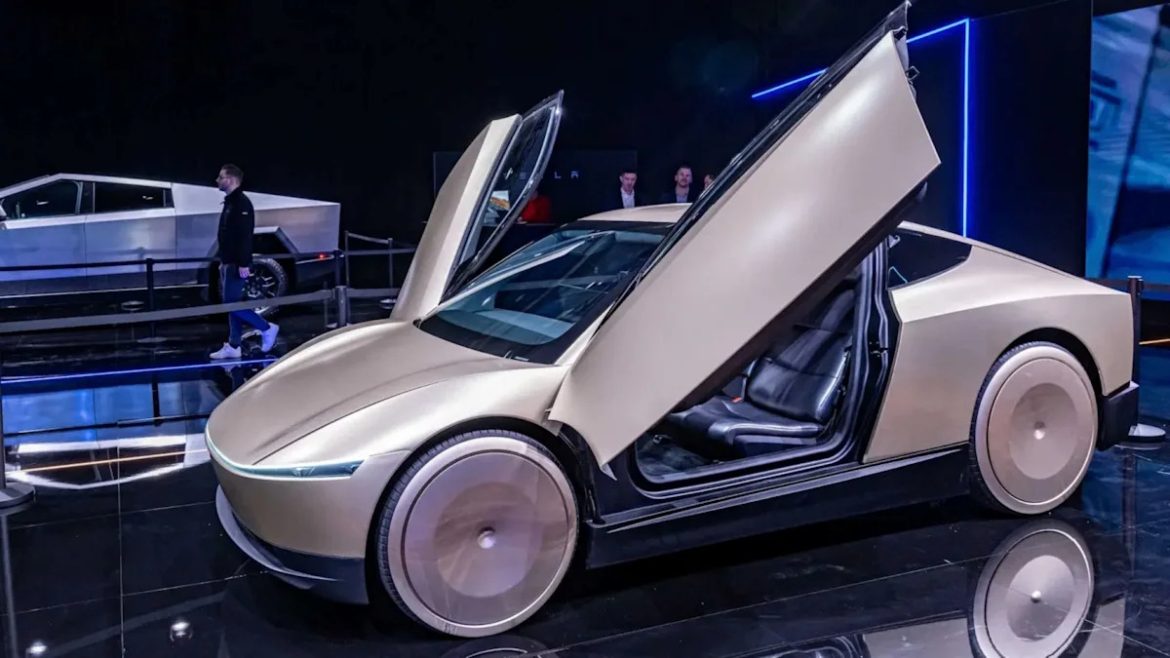
Tesla’s push into driverless rides is becoming harder for consumers to ignore with a new eye-catching change appearing on social media.
On Austin streets, new footage posted by the brand shows Tesla testing what appears to be a production-spec Cybercab on public roads without a steering wheel or pedals, as TechCrunch reports.
What happened?
Nearly two years after revealing the Cybercab’s design, Tesla’s X account (@Tesla) showed the brand is now road-testing the two-seat vehicle in Austin, Texas.
The run is not fully unattended, however, as a safety monitor is still seated in the passenger seat. The sighting suggests Tesla may be getting closer to rolling out a purpose-built robotaxi, as TechCrunch noted.
Advertisement
Advertisement
Unlike Tesla’s current robotaxi testing efforts, which use Model Y SUVs, this version appears to have been built without a steering wheel or pedals.
In this new Austin footage, though, the gold-colored vehicle is traveling on public roads while a safety monitor rides in the front passenger seat.
A separate regulatory shift could also help make that design viable. TechCrunch noted that regulators proposed rules last week that would not require brake pedals in “vehicles designed to be driven exclusively by automated driving systems.”
If approved later this year, the change could remove a major regulatory hurdle for this sort of vehicle to go into service.
Why does it matter?
The biggest appeal is the promise of lower costs, greater efficiency, and increased convenience. For consumers, the concept only becomes meaningful if Tesla can make the service cheap enough to scale.
Advertisement
Advertisement
Elon Musk and other Tesla executives say the company has an edge over Waymo because it develops both the vehicles and the software in-house, which they argue could lower costs over time. If that plays out, a robotaxi network could eventually mean cheaper rides, less reliance on personal car ownership in some cities, and broader access to EV transportation.
Still, there are clear drawbacks and unanswered questions. Tesla’s Austin robotaxi service has experienced minor crashes, including at least two involving remote operators, while Waymo has also dealt with recalls and operational issues related to highways, flooding, and interactions with school buses.
The road to large-scale autonomous driving remains uneven, even as the technology continues to advance.
What are people saying?
Commenters on X mostly applauded the cutting-edge vehicle.
Advertisement
Advertisement
“OMG it’s glorious,” Tesla enthusiast Sawyer Merritt wrote.
“It will have been obvious in hindsight,” another X user opined. “A vehicle without steering wheel or pedals has never been mass produced before this btw.”
“The explosion in valuation and cash flow all hinges on the speed of fleet rollout and the regulatory approval pace across every state in the U.S. and then every country,” an X user from Australia cautiously predicted.
Get TCD’s free newsletters for easy tips, smart advice, and a chance to earn $5,000 toward home upgrades. To see more stories like this one, change your Google preferences here.
