
Electric car charging in minutes? I tested BYD’s answer to petrol stops.
Currently, the fastest public chargers in the UK will take your electric car battery from 10-80% in less than 20 minutes. But what if you could do it in almost the same time it takes to fill up a petrol car?
Chinese manufacturer BYD may have found a solution: flash charging. Its new charger can deliver up to 1.5MW (1,500kW) through a single connector, allowing an EV to charge from 10% to 70% in as little as five minutes.
I travelled to BYD’s UK headquarters to see the flash charger for myself and test the technology firsthand. Here’s what I thought – and whether it really can make charging an EV feel as quick and convenient as a petrol stop.
Remember, you can buy a brand new or used car right here on Carwow. And you can sell your car, too. We’re here to help you through every step of your car-changing journey.
What is Flash Charging?
BYD’s Flash Charging is an ultra-fast EV charging system designed to dramatically cut charging times for compatible vehicles. The Chinese manufacturer’s aim for its charging system is to narrow the gap between EV charging times and petrol refuelling times.
“A petrol pump can typically serve around 50 vehicles per day, while a high-power EV charger may only serve five to seven vehicles per day because charging sessions take much longer,” explains Diego Pareschi, director of EV Charging at the BYD Group. “This highlights how critical faster charging technology is.”

Charging speeds
BYD states that, when used with its second-generation Blade Battery, flash charging can achieve:
- 10% to 70% charge in around 5 minutes
- 10% to 97% charge in around 9 minutes
- Around 12 minutes from 20% to 97% in very low temperatures (-30°C)
Its real-world performance will vary depending on vehicle type, battery condition, and environmental factors.
How it works
BYD Flash Charging relies on two main parts working together: the vehicle’s battery and the charging station.
Battery
BYD’s second-generation Blade Battery is designed to handle very high charging speeds more efficiently. BYD says it improves energy storage by around 5% and reduces internal resistance, allowing faster charging while maintaining safety and durability.
Charging stations
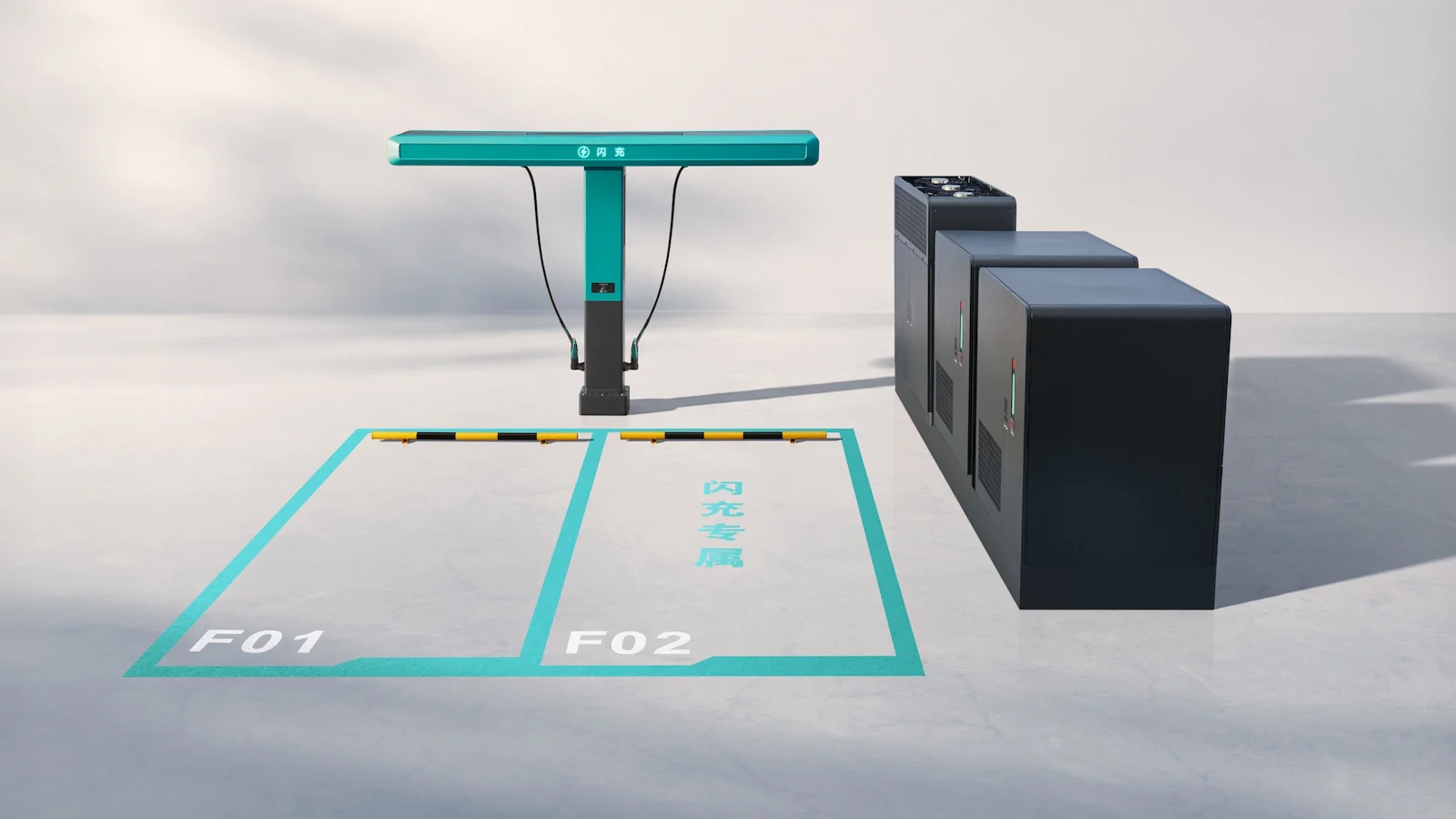
Flash charging stations use built-in energy storage systems to help deliver very high power without placing full demand on the local electricity grid at peak times. This allows faster charging in more locations.
“These chargers are open to all brands,” said BYD UK and Ireland country manager Bono Ge. “However, achieving 1.5MW charging requires BYD’s second-generation Blade Battery and a specific battery chemistry and architecture. Most current EVs are limited to significantly lower charging rates.”
The battery technology is currently only available in a handful of models across BYD’s line-up. This includes the Z9GT, a high-performance model from its luxury sub-brand Denza, which is scheduled to launch in the UK in autumn 2026.
However, Ge said that customers who buy a Denza Z9GT will receive 18 months of free charging at the sites BYD plans to roll out across Europe.
Testing the charger
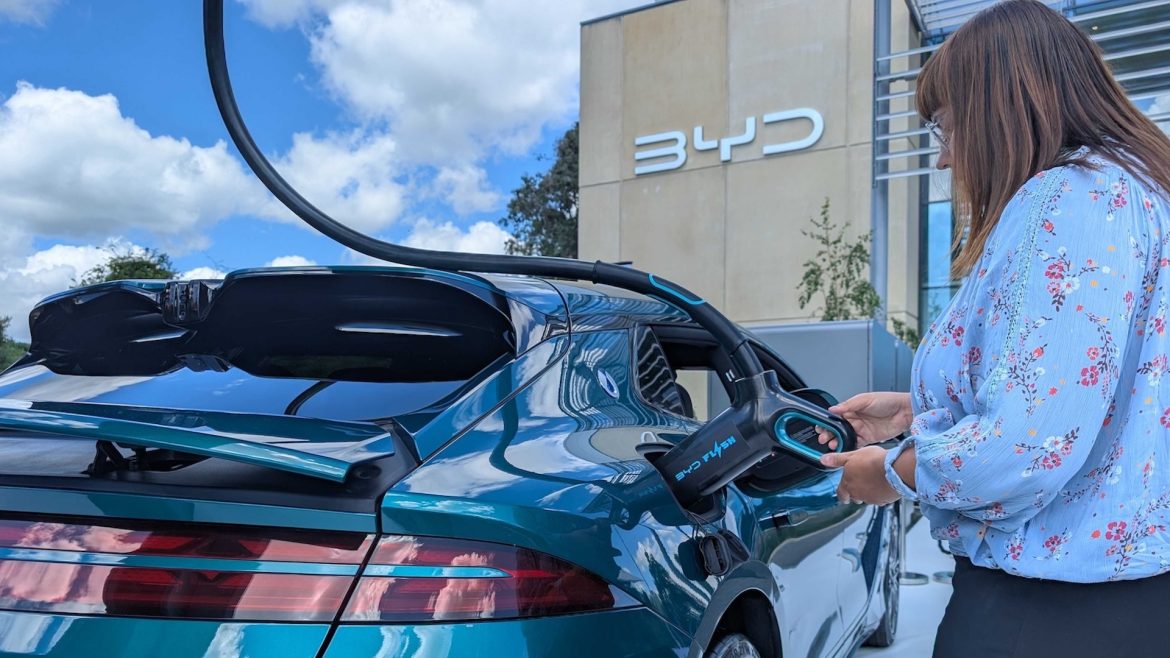
During the live demo, I had the chance to plug the charger in myself. The car in question that I charged was a Denza Z9GT.
The cables hang from the top of the charging unit rather than resting on the floor, which I find reassuring as they’re less likely to get wet in the rain or be covered in snow.
The charger itself felt lighter to handle than the rapid chargers you’d typically find at Gridserve stations, for example. The cable is also fairly long, giving you much more leeway to bring the connector closer to the car.

However, because the cable hangs down instead of retracting from a central unit like many other chargers, it was a little fiddly to line the connector up correctly.

Once I eventually got to grips with it and plugged the charger in, though, it locked firmly into place and charging began almost instantly.
The live demo showed us in real time just how quick it could charge up from 10% to 100%. The infotainment touchscreen inside the Denza actually showed this, including the charging time, estimated remaining time to charge to 100%, and how much range it added.
Charging reached 80% within six minutes and 28 seconds, adding 301.45 miles of range to the Denza. By the time it reached 100% of charge, the stopwatch recorded 8 minutes and 57 seconds.

I think it’s genuinely impressive technology, and the live demo proved that charging an EV really can become more like a quick petrol stop. By the time you’ve grabbed a coffee and taken a quick toilet break at a service station, the car is almost ready to go again.
When and where are these chargers appearing?

BYD aims to install roughly 3,000 Flash Charging sites across Europe, including around 300 in the UK, by the end of 2027. The company also indicated that some stations could go live as early as this month.
In the UK, the rollout will begin with its existing dealer network of 144 stores, with around 35-40 already suitable for the high-power chargers. Each system requires “around 150-560kW power input” and can deliver up to “1.5MW through a single charging connector”, enabling ultra-fast charging speeds.
Beyond dealerships, BYD is also partnering with charge point operators to accelerate deployment using existing grid connections and planning permissions.
Ge says: “The main challenge is reaching commercial agreements, because in some ways we would become competitors. At the same time, we would bring significant traffic to their sites.
“The advantage is that many charge point operators already have grid connections, planning permission, and operational charging sites in place, which allows for much faster deployment.”
BYD is also in talks with retail and transport locations including supermarkets, retail parks, airports, train stations, and fast-food chains.
“This gives us broad national coverage rather than focusing only on major cities,” Ge adds.
How much could charging cost?
BYD told Carwow that it is targeting charging prices of around 50p per kWh at its charging hubs. That would undercut many existing rapid charging providers, which currently charge around 70-89p per kWh.
The lower pricing is possible because the company is installing its own battery storage systems on site, rather than relying entirely on third-party charging operators.
Pricing is yet to be finalised, but the company said that “the integrated battery storage systems will help reduce operating costs and improve efficiency”.
Ge said: “I think most people who drive EVs don’t actually rapid charge that often. People assume they do, or that they charge every night at home and only occasionally use rapid charging.
“So I think this would be a great ‘comfort blanket’ – it helps encourage adoption.”
Car change? Carwow!
Looking for a new set of wheels? With Carwow you can sell your car quickly and for a fair price – as well as find great offers on your next one. Whether you’re looking to buy a car brand new, are after something used or you want to explore car leasing options, Carwow is your one stop shop for new car deals.
Want to see the latest car content first? Add Carwow as a preferred source here. Click here to follow us on Reddit, where you can keep up-to-date with all the latest news, reviews, advice guides and videos. You can also subscribe to our WhatsApp channel to get the latest news sent straight to your phone.
