
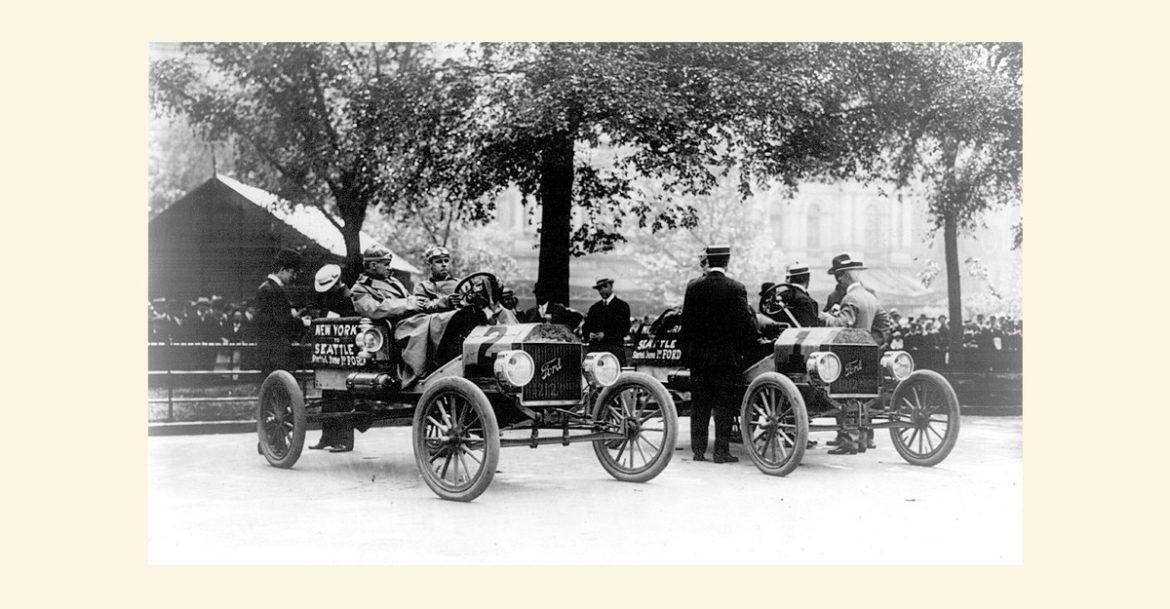
Thirteen and a half days had elapsed since President William Howard Taft pressed a golden telegraph key at the White House, simultaneously opening the World’s Fair in Seattle and signaling for New York Mayor George B. McClellan Jr. to fire a gleaming revolver from the steps of city hall, starting the ocean-to-ocean automobile race for the Guggenheim Cup. Now it was June 14, 1909, and the members of the Shawmut team were alone in front, clinging to an unlikely lead in southern Wyoming, determined to reach the finish at that World’s Fair ahead of one or both of the Ford Model Ts nipping at their heels.
Four of them were rumbling along in the big, high-riding Shawmut automobile—the three crewmembers from Boston, sunbaked and dusty, plus the latest in a series of guides helping them find their way across the unpaved, unmarked West—with little in sight but big-sky vistas and broad swaths of beige earth. They hadn’t seen either Ford all day, not since they cut out of Cheyenne in the predawn darkness. But still, they couldn’t shake the feeling that the nearest Model T was bearing down on them, along with the sense that the entire race wasn’t on the level, having had too many suspicious mishaps to be a coincidence.
The cars had been dogfighting for 2,500 miles, trading leads along a scythe-shaped route from the skyscraper canyons of Lower Manhattan to the smokestacks of the Great Lakes, through the gumbo muds of Kansas and up high now in the Rockies, these leaders shaking off the rest of the pack but never one another, as if connected by a thread. Just 18 minutes had separated the frontrunners the night before, when the Shawmut crossed over from Colorado in second place.
Every stretch had brought its own challenges, but these past few days had been especially brutal, the crewmembers fording streams, inching through hub-deep mud, sleeping in the car, dodging hail under rubber blankets, catching a night’s rest at a farmhouse as violent rain pounded the roof. No wonder most of America’s 250 automakers wanted nothing to do with the race, which was bankrolled by a playboy heir to the Guggenheim fortune and intended to boost the World’s Fair, promote the automobile, and illuminate the need for better roads.
Succumbing to the soft beds and crisp linens of the Inter-Ocean Hotel in Cheyenne had been tempting, but the Shawmut men—the factory hands Arthur Pettengill and Earle Chapin from the Boston suburb of Stoneham, joined by the motor-minded son of a local undertaker—knew they needed to slip out as soon as they saw the leading Model T go into a local Ford agency for an overnight tune-up, before the other Ford had even arrived. That expert garage treatment was an advantage that no other model in the race enjoyed, but it had only a little to do with why the Boston team was convinced that the fix was in.
Back at the starting line, it had been easy to write off the Shawmut and the Fords alike, against two luxury cars with proven racing pedigrees, an Acme and an Itala. Like those two, the 40-horsepower Shawmut had a formidable engine and capacious body, and was a gentleman’s motorcar with ample brass trim and tufted-leather seating, as well as a price to match ($4,750, or roughly $175,000 in 2026 dollars). But most people imagined that the Bay State entry would be first to drop out. Although the nascent Shawmut Motor Company had attracted promising early press, a catastrophic fire six months back had wiped out the factory in Stoneham. Desperate to attract the publicity and financing needed to start over, Shawmut had entered one of its only surviving cars in the race, but it had few spare parts and minimal support.
As for the $850 Model T, released in the fall, it at first glance appeared to be the kind of lightweight runabout that might be fine for puttering around town but had no business mounting a 4,100-mile coast-to-coast journey. For one thing, it wasn’t much to look at. Sure, in the light of the showroom, the 20-horsepower T could claim a utilitarian charm, its spindly frame topped with an assortment of interchangeable bodies and seating configurations. But Ford had stripped these two unpainted entries down to the chassis, like prizefighters shedding final pounds before weigh-in. Although all of the cars in the race had been pruned of windshield and fenders, even the exhaust system and muffler had been removed on these Fords so that four snub-nosed pipes jutted straight from the hood. In lieu of tufted seating, each car contained just a pair of stiff bucket seats for a lean two-man crew. To later viewers, they would have looked more like ride-on lawn mowers than automobiles.
Yet these were the two entries still battling it out where the High Plains folded into the Rockies, each a self-styled David taking on Goliath, setting up an underdog story with a distinctly American twist. Shawmut hungered for survival, hoping to regain its pre-fire footing, when it had built no more than 20 finely tuned motorcars in an old New England tannery building, but had shown real promise. It hoped to reach the most elite ranks of American automakers, those companies such as Simplex and Stearns, Peerless and Packard, that already rivaled the fine carmakers of Europe and had managed to scale up to 100 or even 1,000 motorcars a year without sacrificing handcrafted luxury.
Henry Ford, with his more democratic offering, had already built and sold 10 times as many of his successful earlier models while constructing a nationwide sales network. Now he was positioning himself for a true breakthrough, serving up what he declared to be the most reliable car yet for the growing middle-class market. Only one of these companies could reach the Pacific first and bask in all of the publicity to follow. And although the competition would strike the public as a test of the merits of each type of automobile—and the limits of human endurance in the age of machines—one thing would matter most of all: which competitor was willing to do whatever it would take to win.
In the decade since Henry Ford had launched his first, short-lived automotive venture (the Detroit Automobile Company), car ownership had exploded, growing from a rate of one automobile for every 10,000 Americans to roughly one for every 500, accelerating from a devilish plaything of the gilded class to a functional luxury coveted by the masses. For every car owner, another 50 or 60 people loved to read about autos—or so The Travel Magazine figured—if not necessarily hear endlessly about their neighbor’s new wheels. They ogled newspaper ads, strolled car shows and pocketed three-color brochures, nodded along to talk of carburetors and crankshafts, and daydreamed about cradling the wheel of their own motorcar. The day the race started, the New York World carried a front-page eye-catcher about a poor dressmaker in Pennsylvania coal country who had inherited a surprise fortune and knew just how she’d spend it: FIRST SHE WANTS AN AUTO, the headline declared.
Even the dressmakers of the world were not dreaming about ordinary-looking cars priced below $1,000. Indeed, the Model T was hardly the first lightweight, affordable, mass-produced automobile; an assortment of carmakers had been vying for that market ever since Oldsmobile broke through with its $650 curved-dash runabout soon after the turn of the century. Ford had quickly clawed to the top of that category, becoming one of the first automakers to flirt with 10,000 sales in a single year. But everyone knew you could no more drive an affordable runabout cross-country than fly it to the moon.
That’s why Henry Ford embraced this race, entering two cars—and offering to wager on the outcome—even as nearly every other American automaker backed out. The 45-year-old firmly believed that his Model T had finally cracked the code for pairing affordability with durability, thanks to a flexible three-point suspension and the use of a new metal alloy called vanadium steel, unusually strong for its weight. This was the car that might finally persuade so many middle-class consumers to stop waiting and spring for their first automobile. But column after column of print advertising could only convey so much. A rip-roaring race across the country could prove it.
As for everyone shunning the contest, they claimed that a free-for-all dash across the continent would descend into carnage and risk setting back the progress of the motorcar just as lawmakers were considering matters such as speed limits, road improvements, and registration fees, especially in the developing West. Behind the scenes, they feared high-profile failure, and saw bad publicity in a crowded market worse than no publicity at all. No one had ever driven successfully between New York and Seattle, not even the pathfinder that had set out in March to chart the course for this very race.
That car, a famously rugged 60-horsepower Thomas Flyer that had circled the globe the year before, wound up needing two months to slog from Manhattan to Puget Sound—12 times as long as the trip took by rail. Along the way, the Thomas got mired in quicksand, pierced by a farmer’s bullet (just aiming for a coyote, he said), and swarmed by a trio of roughs after the crew tried to bed down on a frigid night in a Wyoming locomotive roundhouse favored by tramps. After all of that, the muscular auto couldn’t make it all the way on its own, crossing the Cascades by freight train, as deep snow choked the logging trail Snoqualmie Pass even in May.
So a rumored field of 75 cars in January shrank to a reported 40 in March, then to an unlucky 13 by the time entries closed in mid-May, and most of those failed to muster for the June 1 starting gun, cowed by a pressure campaign from the auto industry and an upstart organization called the American Automobile Association. By the time the survivors reached the Great Plains, the Acme and Itala had fallen back, but the Shawmut and two Fords continued to trade leads.
Ford had a built-in advantage that couldn’t be gauged at a glance on the starting line: its dozen corporate-run branch stores—in the big cities of the East and the Midwest, plus Denver and Seattle—and another 850 or so small-town agents scattered across the country. That was nothing compared with the 7,000 dealers that the company would grow to include in another few years, when Henry Ford would be a household name and the Model T would be well on its way to changing how the world traveled forever, eventually selling 15 million by 1927. When Ford entered the race, he had already shipped a grand total of 2,000 Model Ts, hoping that this car might be America’s best seller for a year or two or maybe three, pushing production past the unprecedented mark of 25,000 a year. For now, the press still sometimes bungled his name as Harry.
Yet only Buick’s William Durant could rival Ford’s dealer network in 1909, and Durant was too busy trying to acquire the brands that would become General Motors to enter this race. Lest the word dealer give the wrong impression, comparatively few of these small-town Ford sellers had proper a showroom, let alone a service center. Many were hardware merchants, shopkeepers, even doctors who had bought an early automobile to make house calls and decided to try selling a few more on the side, taking a good horse for $100 trade-in value and moving a couple of Fords a year. But that network was maturing, and these dealers provided a waiting chain of expert navigators ready to lead the two Model Ts across the country. In bigger towns, they could also provide a tune-up, too, as in Cheyenne that morning.
The other crews had to settle for ad hoc help—in some cases with guides who led them so far out of the way that they had to wonder if guides were being bribed by a rival—and a barely decipherable directions booklet prepared by that pathfinder expedition, laden with more misspellings than mileage markers.
That would have been enough to make the non-Ford crews feel shorthanded, but this was all technically within the rules of the contest, which allowed anyone to serve as a guide—riding as a passenger in one of the competing cars or driving alongside in a caravan—so long as only the original crewmembers took the wheel of a competing car. They could also freely change parts that were subject to wear and tear, though they were forbidden from replacing certain key components (the frame, axles, engine block, cylinders, transmission case, steering gear), all of which had been stamped with a special pattern in New York that would be inspected at the finish in Seattle.
No, the Ford edge ran deeper than that. Take Glasgow, Missouri, six days back. They’d all been tearing from St. Louis toward Kansas City when the Fords managed to break free and beat the misdirected Shawmut and Acme into Glasgow, a fading Missouri River trading post that served as the primary crossing of the “Big Muddy” for motorists traversing the state. There was no automobile bridge, but Glasgow had a reliable ferry, a little wooden barge powered by a small motor. The two Fords piled on and crossed over, and Henry Ford himself watched over the proceedings. Then the Shawmut and Acme arrived—only to find that the ferry had mysteriously “broken down” as soon as it reached the opposite bank, tying up and leaving those competitors stranded.
Yet the Shawmut men, fighting for their jobs and the survival of their company, had shown their own pluck time and again—driving across that towering railroad bridge at Glasgow over the open crossties, trying not to imagine the water far below—as well as the merits of their soundly crafted automobile. The Shawmut was a pet project of a group of Brahmin auto enthusiasts who wanted to fashion an even better car than the ones they already owned, then scale it into a viable business. They had invested obsessively in research and development, until that fire snuffed out all of their progress just as they were about to begin real production.
Now Fort Steele lay ahead—the Wyoming route’s version of Glasgow, a pinch point with no dedicated automotive crossing over the North Platte River, though here at least there was a railroad bridge low enough to drive over without breaking into a sweat. At Steele, a decommissioned fort sat on a bluff above the river’s west bank, a remnant of what people still called the Indian wars and of the protection that the U.S. Army had provided for the westward construction of the Union Pacific railroad four decades back. That railroad now crossed the river on a modern steel-and-concrete span erected in 1901, more resistant than the previous timber bridge to damage from errant locomotive cinders and the powerful current of spring floods below.
Because the principal cross-country auto route followed the transcontinental railroad—and at this point, you could still count on two sets of hands the number of people who had successfully driven coast-to-coast since Horatio Nelson Jackson did it in 1903—many of those long-distance journeys ran right here through Fort Steele, population perhaps 200, depending on whom you asked and the season.
The latest in a series of rickety wagon bridges at Steele had washed away in May, but no matter—Elmer Lovejoy, the Shawmut crew’s newest guide, knew the drill. Automobiles rarely came through Fort Steele. There were 14 cars in all of Rawlins, the closest city of consequence, 16 unforgiving miles west. When the occasional automobile did appear, the Union Pacific station agent was fine with waving them across the railroad bridge, as long as no train was due.
In Lovejoy, the Shawmut crew finally had a navigator equal to anyone on the Ford side. The 37-year-old proprietor of a Laramie sporting-goods store and fix-it shop, he possessed the local handyman’s gift for breathing life back into the most benighted contraptions, cherished locally for fixing broken wash boilers and balky phonograph players. But he’d achieved wider renown since the late 1890s as the father of automobiling in Wyoming, after assembling the first functioning horseless carriage in the state, one of the first anywhere west of the Mississippi. Early on, he designed a clever steering knuckle that he traded to the Locomobile Company—an early large-scale automotive manufacturer back East—though he had parted with the rights for short money and the first factory-built automobile shipped into Wyoming.
Lovejoy had already founded his state’s first motoring club, drawn its first reliable auto maps, and expanded his Lovejoy Novelty Works into Wyoming’s first reliable garage, while serving as a resource for long-distance motorists from Denver, Salt Lake City, and beyond, whether they were mounting a drive to Yellowstone or aiming all the way for the coast. As a dealer for the popular Franklin line of automobiles, he had no allegiance in this race, but he had apparently signed on to help Shawmut through its tire supplier, Diamond Rubber.
On the Ford side, Charlie Hendy was studying the chess board in Wyoming, just as he had in Colorado and would again in Idaho. As Ford’s Denver branch manager, he oversaw not only his own showroom in that sprouting metropolis but the company’s emerging network of contracted dealers across much of the West. The branch managers along the route, Ford’s trusted field lieutenants, had carved up the cross-country map and recruited their most reliable local dealers as guides, and seeded supplies as needed. Each of those branch men had their own dynamic qualities, but Hendy, at 33, already was a kind of Ford’s Ford, a natural at publicity; a true believer in the virtues of this new kind of lightweight, affordable, durable car; and—like Henry Ford himself—a man with a rigid outward ethic coupled with a personally flexible approach to the rules. If you believed you were selling the right car, the car that deserved to reach Seattle first, then the ends would justify the means.
A charismatic and classically handsome son of the West, Hendy had one foot in the old territory days and a long stride in the new century, as an automobile man who’d spent his childhood at a series of forts across the frontier before his father, Charles Sr., an Army-hospital steward, settled into a comfortable second career as a Nebraska rancher and civic leader, becoming a close friend of Buffalo Bill Cody. Out of college at the University of Nebraska, Hendy had worked a white-collar job with Union Pacific before following the lure of the automobile to Denver, where a boyhood friend who had bicycled off in search of fortune had wound up as one of the first automotive kings of the West.
In May, Hendy had gone all the way to Pocatello, Idaho, and back, 649 miles each way, while making a series of stops to scrutinize the route and line up crack salesmen as guides. Now he was plying the same corridor again, greeting one or both Ford racers in city after city, talking up their prospects to the local press, and hopping ahead by train to ensure everything remained in place. He was already in Rawlins—west of Fort Steele—when news crackled along the line that morning that the Shawmut had slipped out of Cheyenne overnight, despite assumptions that the Boston crew would stop for badly needed rest at the Inter-Ocean. Now Hendy doubled back, an ace up his sleeve.
In the Shawmut, after making Laramie by breakfast, the crew picked up Lovejoy and pressed westward on an all-day, 120-mile route to Rawlins, the corridor in between having just a single community of 1,000 people, the coal-mining city of Hanna, where more than 220 men had been killed by explosions and cave-ins in the past six years. Many of the other points on the map were merely railroad stops, created for steam trains to take on fresh coal and water, and had a telegrapher, a tiny depot, and a section house crammed with immigrant track workers.
Under a hot sun, the crew passed Rock River—near where Butch Cassidy and his gang had used dynamite to pull off an outlandish rail heist a decade before—and Como Bluff, a ridge of variegated hues where a surprise discovery by railroad workers had revealed a bounty of dinosaur bones, scattered like matchsticks. At midday, they cleared Medicine Bow, where Owen Wister had set part of his cowboy best seller The Virginian, but after that, it was mostly wind-whipped isolation, no sign of the Fords, amid expanses of beige and muted green.
Occasional white patches flecked the landscape, alkali deposits where even prairie grass and scrub cottonwood refused to grow. Mighty ridges hugged the horizon to the north and south, and the snow-topped Elk Mountain rose 11,200 feet above sea level off to the left. This was sheep country—in a state of 5 million sheep and barely 100,000 people, both were concentrated near the Union Pacific rail corridor running above the southern border—but even the sheep were largely out of sight, grazing in the mountains in summer, saving the sagebrush on the plains for winter. The only signs of civilization were Union Pacific’s steel rails and the telegraph and telephone lines beside them.
Finally, a band of deeper green broke the western horizon, the telltale grassy banks of a river in arid land: the North Platte.
The Fort Steele railroad bridge, for all its size, lay low ahead of them, a flush span carrying the tracks between those bluffs on either side of the river, its superstructure entirely below deck. When the Shawmut’s crew finally reached that bridge, they found a surprise waiting: two men who did not work for the railroad. One was a Pinkerton type with a gun; the other was Hendy, far from Denver. They weren’t there to wave the Shawmut across.
Lovejoy had never seen anything like this before. Neither had the station agent, it became clear. Hendy—Ford man, former Union Pacific man—was determined to enforce an obscure regulation that no one could drive over the railroad bridge without official permission. And that permission couldn’t come from the man at the Fort Steele depot, or the nearest dispatcher, or the railroad division point down in Laramie, but only from Union Pacific headquarters in Omaha. As for the armed guard, he was there to make sure “that Hendy’s word went,” Shawmut’s Earle Chapin would later attest.
The station agent was a 35-year-old Kansan named Earl King, a career railroad man with a young family and an interest in English setters. He doubled as the local Pacific Express shipping agent and the Western Union telegraph man, with a skill and sense of duty that would send him overseas in a few years as a wartime officer in the Army Signal Corps. Duty bound here, the station man wired Shawmut’s request to Omaha, 675 railroad miles away. It was past 6:30 p.m., an hour to sunset on Monday, June 14. The men had no choice but to wait.
Soon the first Ford arrived, crossing the bridge with permission that Hendy had secured in advance, passing into first. Chapin, the mechanic on the Shawmut crew, was a wiry 6-footer with a winking sense of humor and a penchant for machine-shop patter peppered with gleeful profanity, a likable 26-year-old who’d been a reliable factory hand and test driver before the fire. He was deeply in love with his 24-year-old wife, Caroline “Anita” Chapin, back home in Stoneham, where they shared a cozy rental house decorated with snapshots from their honeymoon and bits of whimsy. He drew a fountain pen, burning with fury.
“The Ford people put a game on us,” he wrote, sending Anita two postcards and a letter while forced to wait at Fort Steele. “They have done it all the way along.” He explained the surprise holdup, calling it “a damned crooked deal.”
In the morning, the second Ford rumbled over the bridge as well. Finally the Shawmut received permission, after waiting some 16 hours to cross.
It would hardly be the last surprise of the journey. On the afternoon of June 23, the lead Model T would burst into Seattle as the apparent victor, seemingly half of Washington crammed along the final miles, 75,000 people alone wedged into the 10 blocks of Second Avenue downtown between Yesler and Pike Streets, where the route banked inland toward the Alaska-Yukon-Pacific Exposition, a World’s Fair occupying a leafy promontory on the edge of the emerging University of Washington campus. A photographer snapped the scene as the little Ford broke the tape at the packed fairgrounds entrance; wire services flashed the news from coast to coast and even around the world. Soon Ford was advertising “the biggest demonstration of car superiority ever offered,” a victory by a lightweight, affordable automobile in “the hardest, longest race ever pulled off.”
A little more than 16 hours later, the men from Boston reached the same fairgrounds in the early morning, arriving to a smattering of applause from a few overnight guards. They never built a Shawmut car again.
This article has been excerpted from Eric Moskowitz’s forthcoming book, The Hardest, Longest Race: Henry Ford and the Cross-Country Contest That Changed America.

When you buy a book using a link on this page, we receive a commission. Thank you for supporting The Atlantic.
