
From the earliest, rudimentary engines to the highly complex powertrains of today, automakers have always looked for ways to make their vehicles’ propulsion more efficient, faster, and smoother. In some cases, their quest for innovation has pushed them in unusual directions.
One type of engine that has been attempted many times in the automotive world – but never caught on to the point of appearing in a production car – is the turbine engine. Most commonly associated with aircraft, the turbine engine has also powered a few concept cars through the decades. Automakers rode the wave of post-war scientific optimism, exploring the possibilities of this engine type when installed in an ordinary passenger car.
However, there were too many technical and logistical limitations for the turbine engine to reach production. We’re taking a closer look at why this unique type of powertrain never really caught on, and which automakers have attempted to build one.
Why Have Turbine Engines Not Caught On In The Car World?

Turbine engines may have sounded promising at the height of the Jet Age, but their real-life automotive applications proved to be unsuitable for mass production. As a result, turbine-powered vehicles firmly remained in the realm of concepts, experiments and one-offs. There are several reasons behind this.
One of them is performance. Although a modern attempt at building a turbine engine would almost certainly manage to mitigate some of the issues that plagued earlier ones, turbine engines have historically been associated with poor acceleration. Driving at higher altitudes was also a problem.
Then there’s the day-to-day operation, which is a little different than that of a regular combustion vehicle. The Chrysler Turbine Car, for example, required eight different steps as part of its start-up process. Emissions were also a part of the equation: although turbine engines were overall less polluting than gas-powered ones, the nitrogen oxide emissions of turbine engines were quite high.
There is also another curious historical reason why past attempts at building a turbine engine did not result in a mass production model. Although turbine engines can be run on a variety of fuels, they are not compatible with leaded fuel, which was the default type of fuel available for a large part of the 20th century. As a result, automakers struggled to pursue the possibilities of a turbine engine, as any production vehicle with one on board would have not been able to fill up at regular gas stations. In the present day, however, leaded fuel is no more, which has eliminated a major obstacle to the production of a turbine vehicle.
Subaru’s Attempt At Building A Turbine Engine

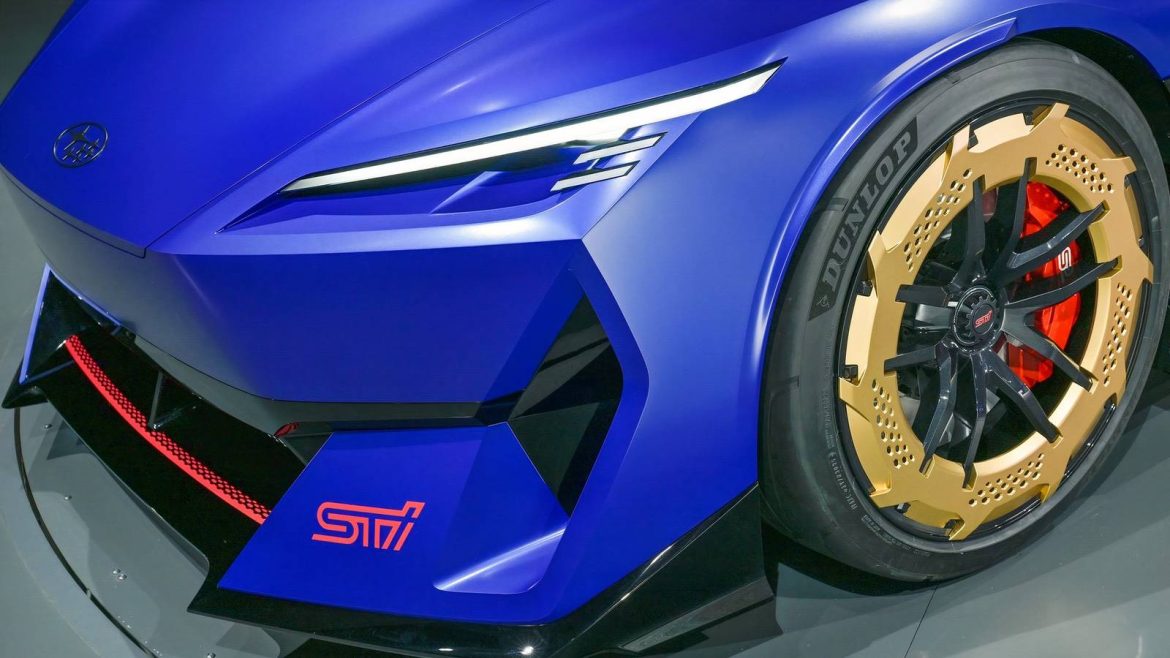
One of the most recent attempts at building a turbine engine may come from Subaru. CarBuzz recently discovered the company filed two patents for a powertrain of this nature. However, unlike other automakers in the past, Subaru has taken the idea of the turbine engine and adapted it to the modern world, imagining a potential use for it as a range extender in an EV.
Subaru has a very loose connection to the world of turbine engines thanks to its links with the aviation industry. Its parent company, Subaru Corporation (formerly known as Fuji Heavy Industries), does not build turbine engines, but it does build helicopters through its aerospace division.

One of the patents outlines a quicker start-up process for the turbine, mitigating one of the issues we previously mentioned that prevented turbine engines from catching on. The second patent, on the other hand, involves a device that allows the turbine to start after a loss of power, thanks to the vehicle’s generator, the high-voltage battery, or even the 12V battery.
All these ideas are, for the time being, just words and diagrams on a page, as Subaru has not expressed any intention of building any of these systems in real life and fitting them to a vehicle.
Before Subaru: The Chrysler Turbine Car And Its Many Siblings

|
Chrysler Turbine Car |
|
|
Engine |
A-831 Turbine Engine |
|
Power |
130 hp |
|
Torque |
425 lb-ft |
|
Transmission |
3-speed automatic |
|
0-60 mph |
~12 seconds |
|
Top Speed |
120 mph |
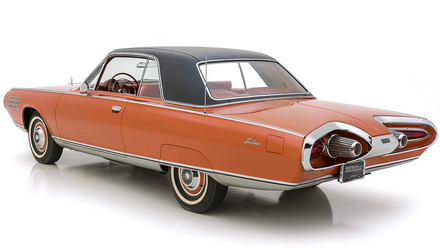
Of all the automakers that have experimented with turbine power across the decades, Chrysler is the one that held onto the idea for the longest. The company built a large series of turbine-powered cars across its history, the most famous being the Chrysler Turbine Car, created in the early 60s.
Most prototypes in the Chrysler turbine family were based on existing production models. The Turbine Car, however, was designed from scratch, with some help from legendary Italian design firm Ghia. Ghia built the bodywork and upholstered the interior, while Chrysler added the powertrain and other mechanical elements.
The engine at the heart of the Turbine Car was called the A-831, and produced 130 horsepower (its peak power output, produced at 36,000 rpm). The A-831 was extremely different from any traditional combustion engine, with no pistons, crankshaft, radiator, connecting rods, cooling system, or radiator.

The Turbine Car had been preceded by three other turbine-powered vehicles, all built by fitting a turbine engine in an existing Chrysler model. The very first was the CR1, built in the early 1950s and based on the Plymouth Belvedere. Its engine produced 100 hp, an output that was doubled with the CR1’s successor, the CR2. The third member of the series was the CR2A, unveiled just a few years before the Turbine Car arrived on the scene.
Every Time Chrysler Tried To Build A Turbine-Powered Car
The turbine engine was meant to be the automotive propulsion method of the future. Things, however, didn’t quite work out that way for Chrysler.
Although the Turbine Car did not make it to production, Chrysler was undeterred in its quest to build turbine-powered vehicles. Three further prototypes followed: the A-875 engine, installed in a Plymouth Fury, was similar to the A-831 but had larger regenerators. Next up was the sixth-gen engine, installed in two Dodge cars (a Charger and a Coronet 500). The Coronet got quite close to having its own production run, but ultimately Chrysler decided not to go through with it.
The last generation of the Chrysler turbine series was the seventh, introduced in the mid-70s. This engine produced 104 hp and was installed in two Dodge Aspens and a Chrysler LeBaron. Soon afterward, Chrysler abandoned the turbine project, and these innovative prototypes were consigned to the archives of automotive history.
GM’s Attempt: Is It A Bird? Is It A Plane? No, It’s The Firebird Concept Cars

Chrysler’s attempt at building a turbine car may be the most well-known, but it’s not the only one. GM also had a few unique prototypes equipped with a turbine engine: the Firebird series. These cars were built between the early 50s and the early 60s, and were introduced to the world at GM’s Motorama auto shows.
The first car in the series was the Firebird I. Introduced in 1953, it was initially called the Firebird XP-21 before moving onto its final name. The Firebird I was heavily inspired by the world of aviation, not just in its powertrain but also in its design. It looked somewhat like a plane on wheels, complete with wings and a tail. It was equipped with an engine called the Whirlfire Turbo Power, with a power output of 370 hp.
Its successor, the Firebird II, looked a lot more like a conventional car, but was still ahead of its time in terms of design. It was fitted with a version of the Whirlfire engine that only produced 200 hp but incorporated a regenerator which dramatically improved its efficiency. The Firebird II also had an upgraded braking system with disc brakes on all four wheels, and a fully independent suspension.

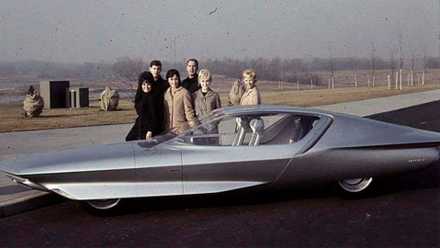
In 1959, the Firebird III arrived with yet another version of the Whirlfire, which produced 225 hp. This model was a two-seater sports car, with individual canopies for each occupant taking the place of a roof and windshield. The car was fitted with air conditioning, cruise control, and anti-lock brakes.
GM’s Firebird Concepts Showed How Obsessed Americans Were With Space
If spaceships had wheels, they would look like this
The last member of the Firebird series was the Firebird IV, which arrived in 1964. This car did not have an engine on board; it was created as more of a design exercise and was only used for display purposes. It was destroyed around two decades later, in the 1980s. None of the Firebird cars resulted in a production model, but they remain as evidence of GM’s approach to innovation and engineering of the era.
Sources: Chrysler, Subaru, General Motors
