
Shortly after WWII, the brown tree snake (Boiga irregularis) – originally native to Australia and Papua New Guinea – hitched a ride to Guam in the western Pacific Ocean on a military cargo ship. Since then, its population on the island has reached millions, exceeding the island’s carrying capacity and taking a serious toll on both its natural environment and economy.
The snake itself looks unassuming. It’s a slender, medium-sized species, typically 0.9–1.8m long (3–6ft), though some individuals can reach up to 3m (10ft). Its reddish-brown, sometimes yellowish-brown skin is marked with darker crossbands, helping it blend seamlessly into tree bark and forest floors.
Brown tree snakes are mildly venomous – their bite isn’t deadly to humans, though it can cause swelling and discomfort. They are a much larger threat to birds and small mammals, which they predate upon.
Part of what makes the brown tree snake such a proficient hunter is its remarkable climbing ability, a behaviour that was first documented in a 2021 study, which identified a never-before-seen mode of snake movement: lasso locomotion. Before this discovery, all snake movement had been grouped into four modes for nearly a century: rectilinear, lateral undulation, sidewinding and concertina.
Lasso locomotion works like this: the snake forms a single loop around a pole, securing itself by hooking its tail around its own body, then makes small bends within the loop and shifts them upward, essentially rising like a slow elevator.

No predators
The brown tree snake’s rapid spread across Guam comes down to one key factor: it has virtually no natural predators on the island, apart from the native Mariana monitor lizard and feral pigs. Largely free from predation, the snakes spread quickly, feeding on native birds, small mammals, reptiles and even food left out by residents.
The impact on Guam’s once vibrant birdlife has been devastating. Out of the 12 native forest bird species Guam was home to, 10 have vanished completely – among them the Mariana fruit dove, the Guam flycatcher, the Micronesian rufous fantail and the Micronesian myzomela.
The knock-on effects have been equally damaging. With vital pollinators such as native birds and fruit bats in sharp decline, plant diversity has fallen too. Insects and arachnids now thrive in Guam’s forests – a study found that Guam has up to 40 times more spiders than nearby islands that have avoided the snake’s introduction.
And there’s more – a 2024 study found that brown tree snakes are not very good at estimating the size of their prey and often kill birds too large for them to swallow.
“Around half of the birds that are getting killed by snakes are not actually eaten by them,” said Martin Kastner, one of the researchers involved in the study.
Economic damage
It’s not just the fauna and flora of Guam that has been affected by the spread of the brown tree snake – the island’s economy has taken a hit too, especially the energy sector.
Due to their impressive climbing ability, brown tree snakes often climb power lines by wrapping themselves around them, causing dangerous and expensive outages for thousands of residents. According to the Guam Power Authority, the island experienced 44 brown tree snake-caused power outages in 2025. The most affected was the village Piti, located on the central west coast of Guam, which experienced a total of 14 outages.
Control efforts
There is, however, cause for optimism. Efforts to control the brown tree snake population and restore lost bird species have been underway for years.
Within War in the Pacific National Historical Park, Asan Beach Park – a small triangular peninsula extending into the ocean – has been identified as an ideal site for snake eradication and bird reintroduction.
A volunteer programme launched in 2021 has already made meaningful progress. According to a presentation at the Mariana Islands Conservation Conference in March 2026, over 1,000 participants have conducted 163 snake searches to date.
One capture even involved a female snake carrying developing eggs, highlighting the urgency of suppression efforts.
“We want to go for full eradication,” said OIympia Terral of Friends of Islan Dano, the volunteer group dedicated to brown tree snake eradication. “If we could get birds again… that’s a double plus for me.”
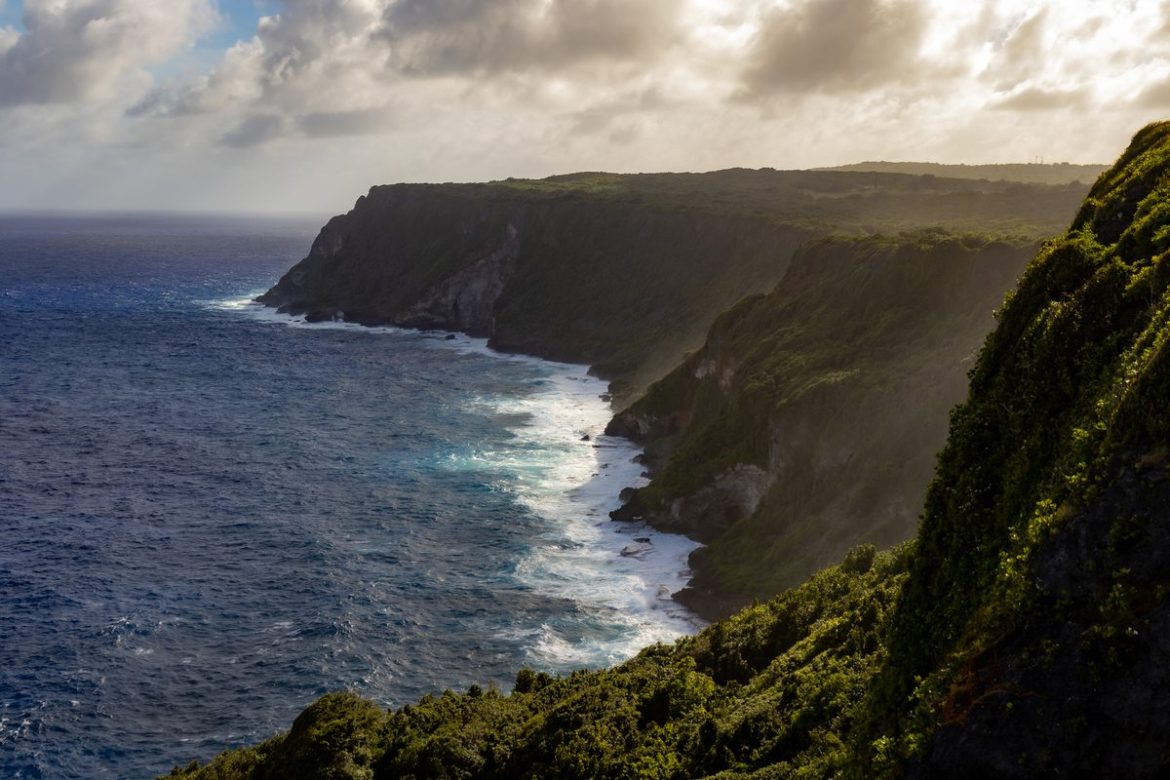
Top image: The coastline of Guam on a windy day, pushing the waves against the shoreline. Credit: Jacob Polk/Getty Images
