
In a Broadway season notable for the strength of its musical revivals, there has been some concern that the best new musical Tony Award category might be particularly scrawny this year.
The shows that left the biggest impression on me — “Cats: The Jellicle Ball,” “Ragtime” and “Chess” — are well-known properties. But these warhorses have been rejuvenated in startling ways.
“Chess” returned to Broadway with a puckish new book and thunderous star power, “Cats” came back in a radically queer form and “Ragtime” reemerged with such operatic force that it seems to speak directly to our fractious political moment.
The past was more than prologue even for the more prominent new musicals. Parody has become the highest form of flattery on Broadway, to judge by the enthusiasm for “Schmigadoon!,” a cheeky love letter to the golden age of Broadway, and “Titanique,” a dementedly campy embrace of the movie “Titanic.” And even “The Lost Boys,” perhaps the most ambitious new musical of the season, takes its inspiration from a cult genre film that serves as a time capsule of the wicked 1980s.
As the Greek tragedians and Shakespeare understood, it’s not the origin of a play that matters but how successfully the material has been transformed. One can decry Broadway’s fearful economic dependence on the familiar while still recognizing, as this sampling of the spring musical season illustrates, that all art is fundamentally an act of reinvention.
‘Cats: The Jellicle Ball’

From top, Leiomy Maldonado as “Macavity,” Kya Azeen as “Etcetera” and Dava Huesca as “Rumpleteazer” in “Cats: The Jellicle Ball.”
(Matthew Murphy and Evan Zimmerman for MurphyMade)
Hell has apparently frozen over, because “Cats” has somehow become fashionable on Broadway.
This Andrew Lloyd Webber juggernaut, which launched a wave of British mega-musicals in the 1980s, had a long and lucrative reign. But it was never one of the cool kids. In Tony Kushner’s “Angels in America,” Roy M. Cohn, trying to assuage an angry client he can’t get off the phone, offers theater tickets to a show he knows that this annoying rube will like. (“Cats! It’s about cats. Singing cats, you’ll love it.”)
Once tourist fodder, the musical has remained a byword for hokey commercialism. The 2019 screen fiasco, which found countless ways to humiliate a cast that included Taylor Swift and Judi Dench, gave kitsch a bad name.
“Cats: The Jellicle Ball,” somehow distancing itself from this history, has become one of the hottest tickets of the Broadway season. It didn’t take a miracle, only a complete conceptual overhaul.
The production, co-directed by Zhailon Levingston and Bill Rauch, jettisons the animal masquerade for a different kind of drag extravaganza. This fearless update takes its inspiration from the Harlem drag balls that provided a showcase for LGBTQ+ fabulosity.
Imagine “Cats” thrown into a Cuisinart with the 1990 documentary “Paris is Burning” and the TV series “Pose.” The result is a raucous, interactive, sensory overload. The Broadhurst Theatre might not be a natural place for runway battles, but the venue has been transformed by the pulsating energy of the company and the creative daring of a revival that was originally designed not for Broadway but for the Perelman Performing Arts Center in Lower Manhattan in 2024.

Sydney James Harcourt as “Rumtumtugger.”
(Matthew Murphy and Evan Zimmerman for MurphyMade)
The musical turns out to be as spryly flexible as any of its whiskered characters. Based on some light verse by T.S. Eliot, “Cats” has narrative lines but more or less unfolds as a revue. This new version isn’t hemmed in by the traditional structures of a book musical, allowing it to play fast and loose with the theatrical context without having to throw out the story or the score.
The production begins with a DJ (Ken Ard) rifling through a crate of vinyl records. Favorites by Diana Ross and Beyoncé are held up to the roar of the crowd before pixie dust is released from the musical’s original Broadway cast album.
Lloyd Webber still exerts artistic control through the score, which is treated too reverently. Fewer songs would have made the update more lithe and ebullient. The production becomes a bit of an endurance test. Lyrics drown in the murk of excessive amplification. Not that I’m caterwauling about lost Lloyd Webber rhymes, but the musical numbers start to pile up.
There’s no Betty Buckley in the cast to catapult “Memory,” the show’s indelible power ballad, to the Heaviside Layer, the land of rebirth for one lucky chosen cat. Yet there are more than enough compensating pleasures.
First among these is the production’s dynamically worked-out thematic concept. The choreography by Omari Wiles and Arturo Lyons is exhilarating in the way it sets in motion a wide range of body types, gender expressions and physical abilities, to say nothing of flamboyant hair styles and finger-snapping fashions. Difference in ways still not always appreciated is fiercely celebrated.
The costumes by Qween Jean have an extravagant splendor that make it impossible to not want to strike a pose. Some of the outfits seem to confer the power of flight, though that illusion is fostered by the delirious energy of human forms liberated from conformity.
André De Shields, Tony-winning royalty, presides over this Jellicle Ball in the role of Old Deuteronomy. With his gray-and-white mane sleekly accentuating his black and lavender ensemble, he struts with an eminence that had me picturing Eartha Kitt in a Bob Fosse spectacular. His grand entrance alone is worth the price of admission.
“Cats: The Jellicle Ball” didn’t make me rethink my opinion of the musical, though this hoary cat really might have nine lives.
‘The Lost Boys’

Maria Wirries and LJ Benet in “The Lost Boys.”
(Matthew Murphy)
“The Lost Boys,” a musical spun from Joel Schumacher’s 1987 horror comedy, won me over despite my antipathy to vampire schlock. Maybe I just grew out of my youthful interest in the genre, but the most terrifying aspect of the movie for me wasn’t the threat of bloodsucking ghouls but the absolute nightmare of reliving 1980s mullets and trench coats.
Michael Arden, who won a Tony for directing last year’s best musical winner, “Maybe Happy Ending,” infuses his visually spectacular production of “The Lost Boys” with a refreshing 21st century sensitivity. Beginning with a clip of Ronald Reagan addressing the nation on the subject of “family values,” the show exposes the cramped view of such political propaganda with an inclusive sensibility that recognizes the moral power of found families.
The musical, featuring a book by David Hornsby and Chris Hoch and a score by the Rescues that dispenses with the movie’s cover-heavy soundtrack, is undeniably overstuffed. There are more impulses and ideas than can be dramatically metabolized. The second act not only has some dead wood, but the last 20 minutes feels like a race to the finish line. For all the staging prowess, the final battle scene leaves one more agog on screen. And an unnecessary coda that comes after the curtain call never should have made it out of rehearsals.
But Arden and his team make “The Lost Boys” about so much more than violent thrills. The ultimate showdown is between sleek vampire conformity and nerdy yet heroic individuality. The staging is a marvel of special effects, but the most spectacular coup is the injection of emotionally resonant meaning.
I had never heard of the Rescues, an L.A. indie rock band able to adapt to the narrative demands of the stage. Particularly memorable are the romantic numbers between Michael (LJ Benet), the elder Emerson boy who moved to California from Arizona with their mother, and Star (Maria Wirries), the goth girl trying to protect Michael from David (Ali Louis Bourzgui), the glam-rock vampire band leader who has already sunk his fangs into her.

LJ Benet and Ali Louis Bourzgui in “The Lost Boys.”
(Matthew Murphy)
Benet and Wirries, galvanic talents with stadium-worthy voices, make the song “Now, Forever,” an instant classic. And, of course, anything that Shoshana Bean sings as Lucy, the Emerson boys’ mother, is gold, even if the book-writing can’t quite keep up with the emotional depth she brings to the role.
Benjamin Pajak’s Sam, Michael’s younger brother, discovers over time that what other people call “queer” is actually the source of his “superpower” — an insight that erupts in a musical number staged with comic book gleefulness. Sam has teamed up with a pair of sibling vampire hunters known as the Frog Brothers (Miguel Gil and Jennifer Duka), and together these outcasts band together to take on the bad guys.
Arden isn’t afraid to let weirdos be weirdos in a musical that has a healthy suspicion of surface perfection. Bourzgui’s David has all the hallmarks of a rock idol — sultry looks, a sinister smile and talent to burn. Benet’s Michael doesn’t immediately leave us starstuck, but over the course of the musical he steals the show with his vocal prowess and brooding sincerity. (Both Bourzgui and Benet are making electric Broadway debuts, and “The Lost Boys” benefits from their different ways of commanding the stage.)
Wirries’ Star does more than flirt with the dark side, but in resisting the temptation to become part of the vampire pack she becomes worthy of Michael’s obsessive love. Paul Alexander Nolan’s Max, the owner of a boardwalk video store who crashes into the lives of the Emerson family, puts on a Clark Kent facade to conceal his nefarious alter ego. Bean’s Lucy is taken in but defends her family when the monster reveals himself.
Recognizing evil isn’t always so easy. Pajak’s Sam must drive home the lesson that the real vampires are those creatures who try to steal your true soul — your individuality.
The production, full of sensational aerial maneuvers and fog-strewn scenic thrills, is mesmerizing. But unlike “Stranger Things: The First Shadow,” spectacle isn’t allowed to overshadow the story. Something preciously human survives the supernatural barrage, and it’s this tender quality that rescues “The Lost Boys” from the jaws of vampire musical defeat.
‘Titanique’

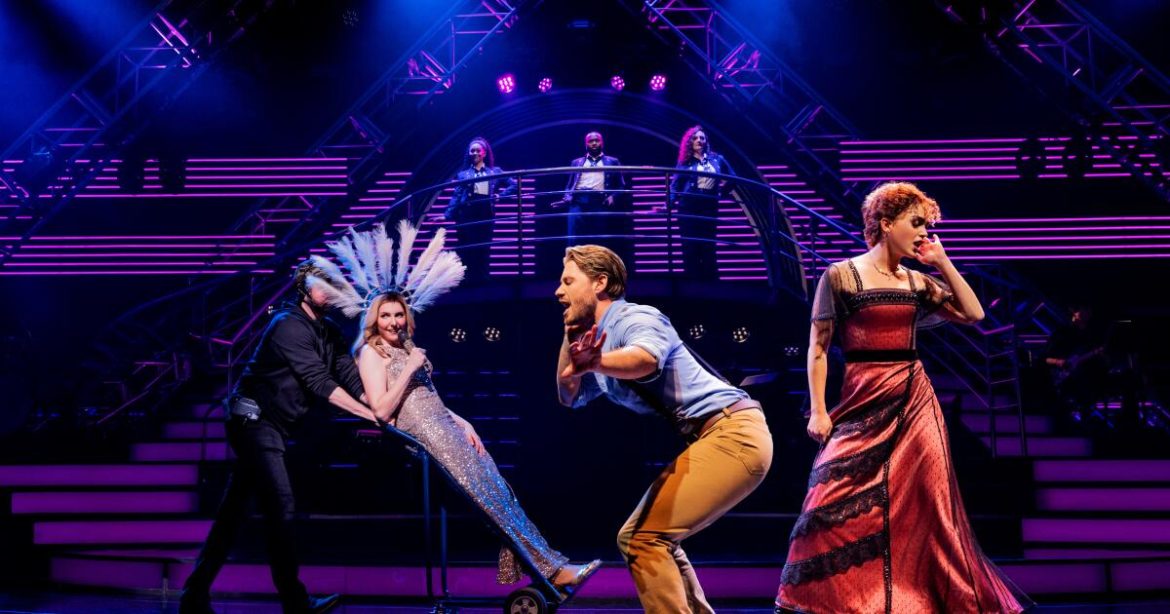
Marla Mindelle and the cast of “Titanique” on Broadway.
(Evan Zimmerman for MurphyMade)
All aboard the SS “Titanique,” a Broadway pleasure cruise traveling through some notoriously icy waterways.
Celine Dion (Marla Mindelle) assumes the role of tour guide in this campy send-up of the movie “Titanic,” but don’t be alarmed that her main qualification is the song “My Heart Will Go On.” The number, shamelessly teased, does indeed serve as her passport.
But as Celine fulsomely explains in her charmingly thick Québécois accent, she was actually a passenger on the Titanic. Don’t worry about the math! She knows what — or should I say who? — really went down on that disastrous maiden voyage.
A long-running hit off-Broadway, “Titanique” has been upgraded for Broadway passage at the St. James Theatre. Jim Parsons, who plays hard-up maternal terror Ruth DeWitt Bukater in matronly drag topped off with a bird-themed hair ornament, and R&B star Deborah Cox, who takes on the role of Molly Brown that Kathy Bates made her own, add some uptown pizzazz to the cast.

Deborah Cox as Unsinkable Molly Brown in “Titanique.”
(Evan Zimmerman for MurphyMade)
Celine Dion is lovingly lampooned in all her sentimental goofiness, along with the fervid plot of James Cameron’s blockbuster. The skewering, set to a selection of musical hits borrowed from Dion’s back catalog and personal playlist, is as bawdy as it is zany.
The musical, brimming over with Broadway in-jokes and phallic humor, doesn’t build so much as whip itself into a frenzy. The organizing principle of the score eluded me, but the book by Mindelle, Constantine Rousouli and Tye Blue (who gamely directs all this horseplay) follows the romantic shenanigans of Rose DeWitt Bukater (Melissa Barrera) and Jack Dawson (Rousouli), the musical’s knockabout version of Kate Winslet and Leonardo DiCaprio, whose love affair is driving Cal Hockley (John Riddle), Rose’s wealthy fiancé, into a jealous tizzy, at least when his Grindr app isn’t blowing up.
I was ready to jump ship long before the emergence of the deadly iceberg (incarnated by Layton Williams in the form of an equally formidable force of nature, Tina Turner). But theatergoers around me couldn’t seem to get enough, no matter how repetitive the naughty humor became. Broadway is a pricey place for this kind of burlesque, but the need for comic relief these days is palpable. And this bawdy crowd-pleaser at least has the courage of its crackpot convictions.
