
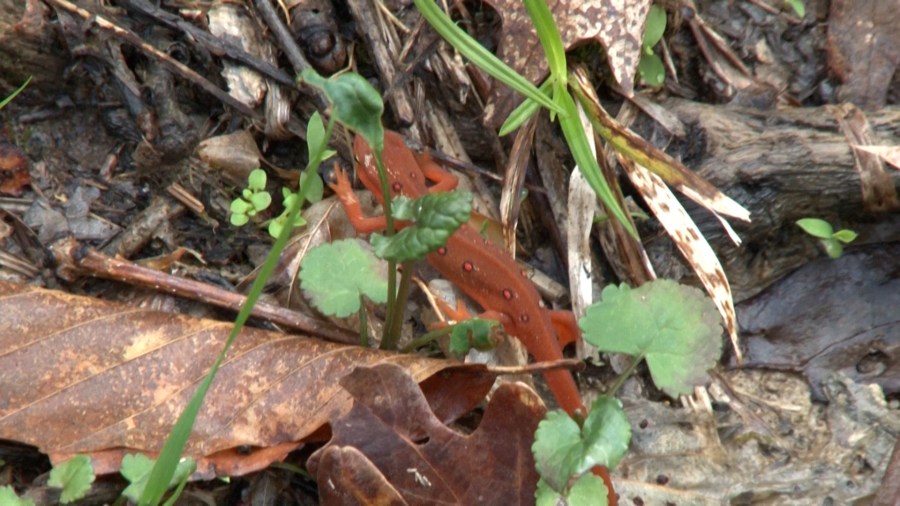
ELKINS, W.Va. (WBOY) — If you see a little orange guy crawling in the woods in West Virginia, it’s probably an eastern newt, the Mountain State’s own amphibian, and officials say they need your help.
The West Virginia Division of Natural Resources (WVDNR) says that the eastern newt is in danger and that the public can help. 12 News spoke with WVDNR Amphibian and Reptile Program Leader Kevin Oxenrider, who answered our questions about newts and this issue.
The biology of newts
According to Oxenrider, newts have three life phases: a larval phase, an adolescent phase on the land (or the red eft phase), and an adult aquatic phase. Both the larval and adult phases are spent in the water. During their adolescent phase, they have their distinctive orange or red coloring that they grow out of once they reach the water and become more green with red spots.
They can live up to 15 years and adults generally eat small worms and insects, while younger newts eat plankton.

Adolescent eastern newt or red enf. Credit: Tom Walsch, Wikimedia Commons

Adult and aquatic eastern newt. Credit: US Geological Service.
Salem’s rugby program marks growth of the sport in north central West Virginia
Why are newts so brightly colored?
Because they are poisonous.
“The most interesting thing about newts is that, the reason that the eft is so bright red is because they are toxic. So they do have a poison. And don’t eat newts,” Oxenrider said.
Oxenrider also said to make sure to wash your hands if you do pick up newts.
Why do biologists care about newts?
For both land and water, newts. can say a lot about the ecosystem.
“We care a lot about newts because they are a fantastic bioindicator. Because they’re amphibians, they absorb things through their skin. So they really can be very telling as to what’s going on in the ecosystem,” Oxenrider said.
Why are newts in danger?
An invasive fungal disease known as bsal was first reported in salamanders in Europe. The WVDNR expects it will make its way to the Appalachian region and cause a decline in the newt population. As a result, WVDNR is doing a preemptive study to better understand the current status of the newt population and where they are.
The public is encouraged to report their newt sightings through this survey on their phones.
Where can you find newts?
Oxenrider said that people are most likely to see newts on forest floors, especially when it is damp out. Their aquatic forms can be found in ponds and vernal pools.
Copyright 2026 Nexstar Media, Inc. All rights reserved. This material may not be published, broadcast, rewritten, or redistributed.
For the latest news, weather, sports, and streaming video, head to WBOY.com.
