
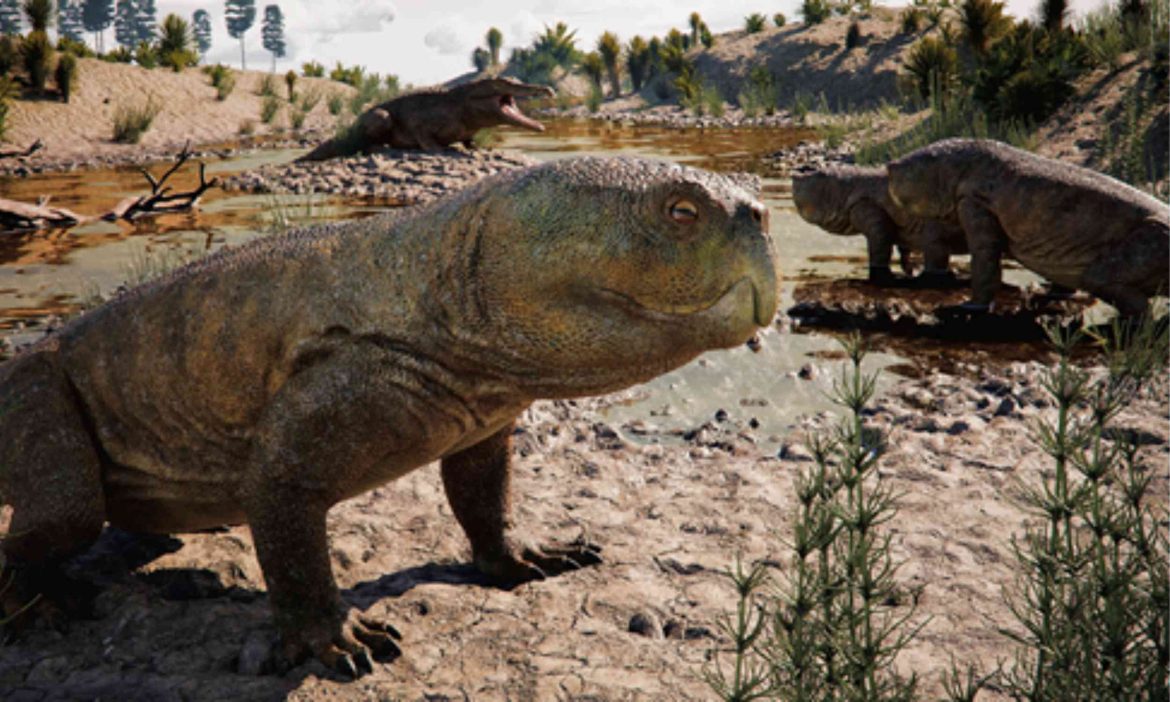
Scientists have identified a 230 million-year-old reptile with a sharp, parrot-like beak that sliced and processed plants with unusual precision.
That discovery adds a new kind of plant eater to a crowded prehistoric landscape just before dinosaurs began to dominate life on land.
A skull changes count

A fossil skull recovered from southern Brazil preserved the animal’s jaws, revealing a cutting beak paired with tightly packed grinding teeth.
By examining those features, Jeung Hee Schiefelbein at Universidade Federal de Santa Maria (UFSM) showed the specimen belonged to a previously unknown species.
Distinct tooth rows and jaw proportions separated it from other known relatives, even those found in the same rock layers.
That clear anatomical break raises new questions about how many different plant-eating reptiles shared the same environment and how they divided resources.
A beak with teeth
Named Isodapedon varzealis, the reptile probably reached about five feet (1.5 meters) long and moved low on four sturdy limbs.
A toothless front beak sliced plants first, while rows of fused teeth crushed food farther back in the mouth.
Fine grooves on the front bones likely held keratin, the tough material that strengthens bird beaks today.
That mix of cutting and grinding points to an animal built for tough vegetation, not fast-moving prey.
Plant-eating machinery
On the upper jaw, the maxilla, a tooth-bearing skull bone, carried two matching grinding surfaces instead of one.
Each side held three lengthwise tooth rows, giving both halves a balanced arrangement rarely seen in close relatives.
Most related animals show one wider side, so this equal layout marked more than common individual variation.
Feeding differences may have let several herbivores share the same landscape without using plants the same way in daily feeding.
A rare jaw pattern
Below that upper jaw, the dentary – the main lower jaw bone – carried its own unusual shelf. This feature offered a clue to its bite.
Small teeth stood close together on that shelf, helping the lower blade meet the upper groove as the animal chewed.
Other Brazilian species had wider shelves, missing teeth, or extra grooves, leaving a different bite pattern through the mouth.
Those contrasts gave the fossil a clear identity, even though scientists had only part of the skull from incomplete bones.
Careful fossil preparation
Fragile fossils rarely reveal their details quickly, and this skull demanded months of patient preparation before scientists could read it clearly.
Technicians removed sediment slowly because one rushed move could break tooth-bearing areas needed for species identification without destroying evidence.
“The tooth region, which is very important for rhynchosaurs, contains the characteristics necessary for identification at the species level,” said Schiefelbein.
That slow work turned buried bone into readable evidence, especially where bite mechanics carried the species signal rather than just its outline.
Fossils guide rock dating
Beyond naming one animal, the find helps paleontologists line up rock layers across southern Brazil where direct rock dates are scarce.
That work is biostratigraphy, matching rocks by fossils, and rhynchosaurs make especially useful markers across scattered outcrops.
When the same jaw patterns appear at separate sites, researchers can compare beds that lack datable volcanic ash across the basin.
For Isodapedon, that work remains cautious because several matching fragments from Brazil’s collections still need fuller study before names settle.
Brazil and Scotland
Family-tree tests placed the new reptile near Scottish forms rather than beside known South American species in the team’s tests.
Shared jaw traits tied Brazil, Argentina, Scotland, and possibly Zimbabwe into a wider Late Triassic herbivore story on ancient land.
Continents then formed Pangaea, one supercontinent, so related animals could spread across connected land more easily over many generations.
That connection makes the Brazilian fossil part of a pattern larger than one local discovery in one quarry.
Life before dinosaurs
During that tense ecological moment, early dinosaurs existed in Brazil but had not yet taken over ecosystems.
Large herbivores still included rhynchosaurs and mammal cousins, while small early dinosaur relatives moved through the same food webs alongside them.
Climate stress during the Carnian Pluvial Episode, a wetter interval in the Late Triassic, reshaped many ecosystems across land and sea.
Against that changing backdrop, different plant eaters may have survived by dividing food resources more finely than their rivals did.
Rarity keeps questions
Even after formal naming, the fossil record still leaves gaps around this animal’s range through time.
A few isolated jaws from other Brazilian sites look similar, but fossil fragments can mislead careful researchers.
Age, wear, and growth can alter tooth rows, making young animals resemble separate species in collections without warning.
More complete skulls will test whether those fragments belong to Isodapedon or another hidden branch within the group.
What the fossil reveals
A beaked skull, balanced tooth rows, and careful preparation turn one fragile fossil into a sharper picture of Triassic life in detail.
Future finds can show how many herbivore strategies filled southern Brazil before dinosaurs became the dominant plant eaters over millions of years.
The study is published in Royal Society Open Science.
—–
Like what you read? Subscribe to our newsletter for engaging articles, exclusive content, and the latest updates.
Check us out on EarthSnap, a free app brought to you by Eric Ralls and Earth.com.
—–
