
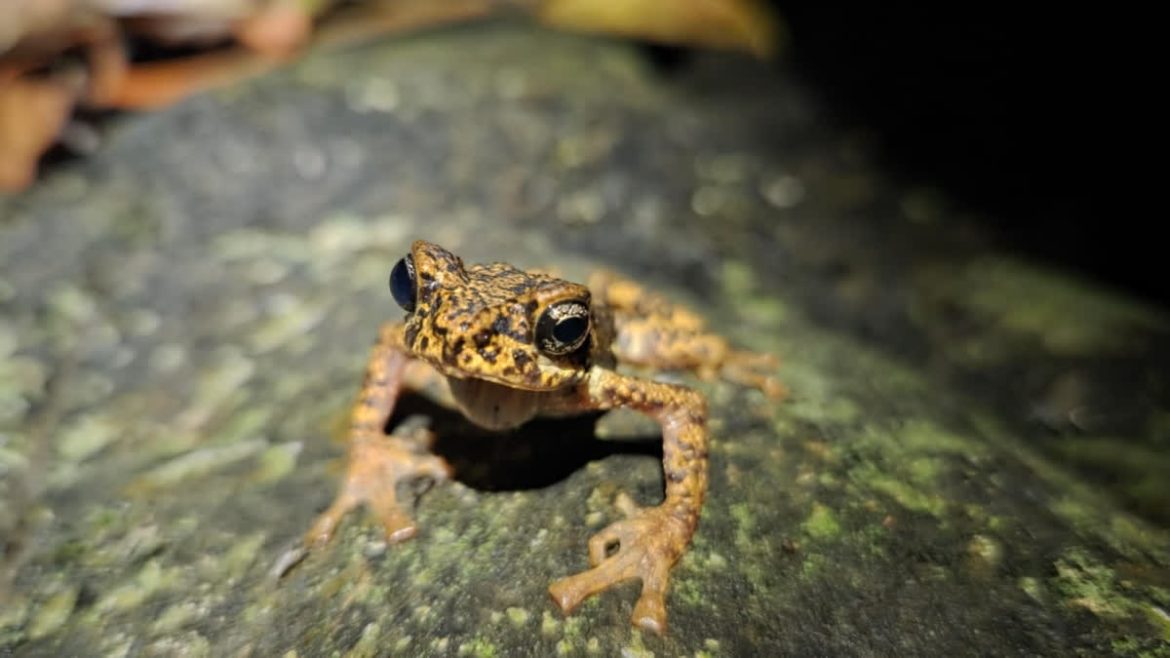
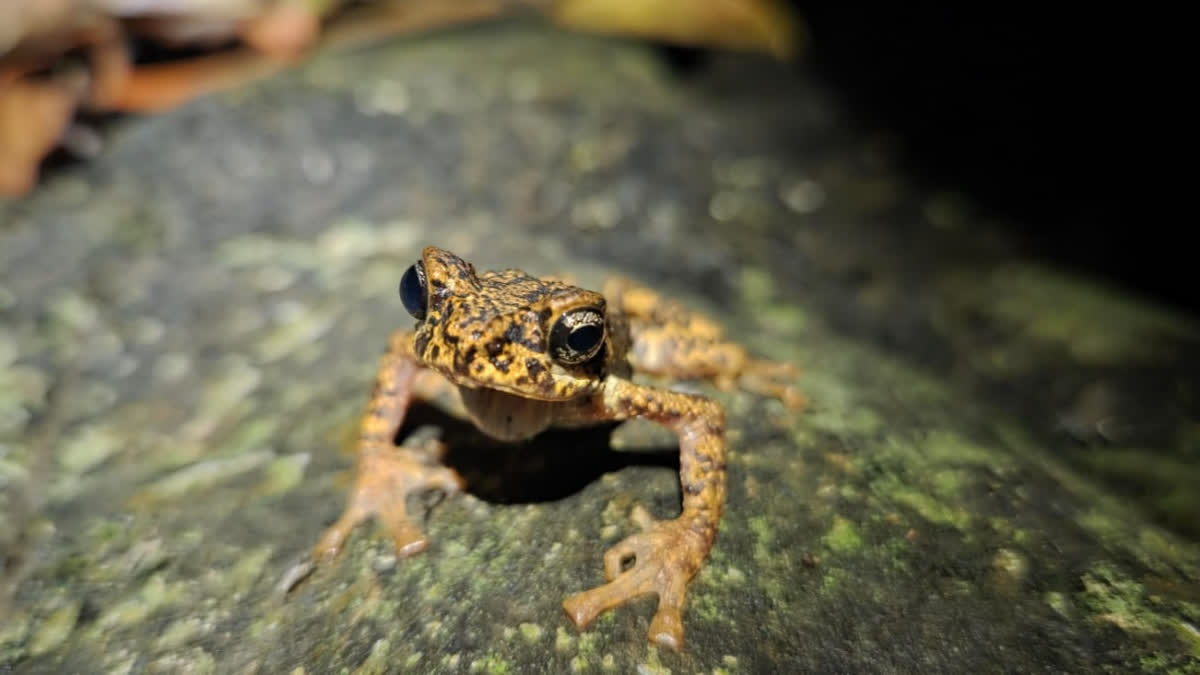
Malabar tree toad (Special arrangement)
Bengaluru: Experts believe that Karnataka government’s decision to designate the Indian honeybee (Apis cerana, locally known as Tudave Jenu) as the state insect and the Malabar tree toad (Pedostibes tuberculosus) as the state frog, will help in strengthening biodiversity conservation.
The decision was announced by Forest and Ecology Minister Eshwar Khandre in Bengaluru on International Biodiversity Day on May 22, noting that it aligns with global efforts to recognise ecologically significant species. The Karnataka Biodiversity Board had recommended the two species in 2020–21 after consultations with experts from the University of Agricultural Sciences, IISc ecologists, batrachologists, and officials from the horticulture and home departments.
Speaking to ETV Bharat, experts said the move could help shift conservation attention towards lesser-known but ecologically significant species.
“Recognising lesser-known and often-overlooked species such as the Malabar tree toad or the honeybee highlights the importance of conserving all forms of biodiversity. It also has wider implications for research, education and public attention, along with awareness. Such action would help shift conservation efforts from charismatic species such as elephants, tigers, and leopards to lesser-known species and their habitats,” stated Prof. K.V. Gururaja of the Srishti Manipal Institute of Art, Design and Technology, Manipal Academy of Higher Education, Bengaluru.
Prof. Gururaja first proposed to the Karnataka Government that the Malabar tree toad be designated as the state’s official frog. The Malabar tree toad, an arboreal amphibian first recorded in 1875-76, had long disappeared from scientific records before being rediscovered in Kerala in 1960 and later documented in Karnataka’s Western Ghats.
“It becomes important for people to pay close attention to microhabitats, aquatic conditions, and land uses. This will make it easy to evaluate the ecological impact on conservation and effective biodiversity management. Government recognition can bring greater visibility to such species, encourage scientific study, and help integrate their conservation into policy discussions,” he said.
Why the Malabar Tree Toad Was Proposed as Karnataka’s State Amphibian?
Prof. Gururaja said that the amphibian has unique biology and ecology properties and, in scientific terms, is the only known species of its genus, thus making it exceptional. The difference from common toads is the fact that it’s an arboreal frog that can climb trees and is found near perennial streams. It also has distinctive reproductive biology since it deposits eggs in foam nests instead of egg strings and breeds before the monsoon. Also, it’s not a tiny species limited to a particular place and is found all across the Western Ghats, namely Karnataka, Thiruvananthapuram, Amboli, and many other areas.
Honeybee as a Symbol of Pollinator Conservation
Likewise, Apis cerana is the preferred domesticated bee in Karnataka and is used in agricultural and horticultural fields to enhance crop yields through pollination. However, a single species cannot meet the full pollination needs of all crops and wild plants. “Native wild bees, including diverse stingless and solitary species, are equally important and must be conserved. In this sense, Apis cerana represents the broader ecosystem service of pollination, which is essential for biodiversity and food security,” stated Professor Renee M. Borges, the Centre for Ecological Sciences (CES), Indian Institute of Science (IISc).
On the importance of the move, she stated, “Identifying state animals brings the issue of biodiversity conservation into sharp public focus so that public policies impacting conservation are highlighted, and the implementation or amendment of those policies can occur.”
Growing Recognition of Native Pollinators
In terms of the conservation value that lesser-highlighted species such as the honeybee and Malabar tree toad bring, Prof. Renee explained that the Indian honeybee (Apis cerana) highlights the critical role of pollinators in sustaining biodiversity and agriculture. Besides the production of honey, bees act as natural pollinators, which is beneficial for fruits, nuts, pulses, and vegetables. The increasing worry about the dwindling number of pollinators has made it clear how crucial it is to preserve local species. Previously, the European honey bee (Apis mellifera) was imported into India for the production of honey since the Indian honey bee (Apis cerana) was susceptible to diseases common in that period of time. The European honeybee requires more intensive management, while native honeybees are generally better adapted to local conditions and more resilient to climate change.
However, current understanding and growing awareness of the importance of native bees in the pollination of agricultural and horticultural crops recognise Apis cerana as better adapted in India for pollination, honey production, and domestication. Globally, initiatives such as World Bee Day (May 20) and Peru’s recent move to grant legal rights to stingless bees underline the increasing recognition of pollinators as vital to ecosystems, livelihoods, and food security, she added.
Climate Change and Habitat Threats
Experts have flagged declining honeybee populations due to habitat loss, climate change, and disease. In the latest findings, the biggest danger posed to the Apis cerana species is the increasing temperature associated with climate change. Prof. Borges highlighted the fact that some studies show that Apis cerana workers avoid foraging outside their hives when the temperature rises beyond 37˚C due to the small size of their bodies, which causes them to lose more water because of their unfavourable surface-to-volume ratio. Globally, small-sized insects face increasing risks posed by rising temperatures. Therefore, there is a need for prompt conservation strategies with a focus on improving farm microclimates by providing shade and reliable water sources to support bee survival, she said.
In the same way, according to Prof. Gururaja, the most serious threat that this Malabar tree toad faces is the modification of the habitats of perennial streams, which are necessary for breeding purposes. Though this amphibian is an arboreal creature, it has the habit of coming down to the streams to breed. Activities such as dam construction, water diversion, or other modifications to these habitats can significantly affect their survival. He said changing rainfall patterns linked to climate change could affect the species’ breeding cycle and future distribution, although further field research is needed.
As stated by Prof. Gururaja, while it is known that the Malabar Tree Toad inhabits the evergreen forests connected to perennial water sources, there is not enough scientific information regarding the habitat needs of the species. Further research needs to be conducted to recommend necessary conservation measures. Until then, it is important to protect the species’ habitats and their waterbodies. He went on to say that, like most amphibians, the species was highly sensitive to changes in the environment and could act as an indicator of ecosystem health in the forests.
Citizen Participation and Conservation
For this initiative to create a measurable conservation impact, both experts stressed that public awareness will determine whether the recognition translates into meaningful conservation outcomes. They noted that citizen participation has already contributed to a better understanding of the Malabar tree toad’s distribution and can play a crucial role in biodiversity conservation.
Prof. Gururaja said the real impact of recognising the Malabar tree toad as the state amphibian lies in encouraging people and local communities to engage with conservation in their own landscapes. The species is particularly significant because it was believed to be rare for decades before citizen observations helped reveal its wider distribution. As a result, its conservation status was revised from Endangered to Least Concern.
Beyond Symbolism: What Karnataka Must Do Next
Reflecting on the state’s decision, Prof. Gururaja found it to be an important first step towards the conservation of these species and hopes that policymakers, together with the public, will place the same importance on these less popular species also. According to him, the key to conservation is the valuation and appreciation of biodiversity in our surroundings, and such recognition can strengthen support for the protection of biodiversity.
Responding to beyond symbolic recognition, what concrete scientific, policy or habitat-restoration interventions should Karnataka prioritise to ensure the long-term survival of the Indian honeybee? Prof. Borges noted that Karnataka must prioritise scientific and policy measures that create bee-friendly microclimates. Habitat patches that provide microclimate refugia should be conserved and connected, as widely separated sites limit bee movement and weaken ecosystem services. With rapid urban expansion encroaching on natural and rural areas, urban planning must also integrate pollinator-friendly vegetation, along with adequate shade and water sources. Ensuring suitable microclimates for bees in both rural and urban landscapes is essential for their long-term survival.
Highlighting the specific changes in land-use or pesticide practices Karnataka urgently needs, Prof. Borges said that globally, land-use change and pesticide overuse are major threats to honeybees. She emphasised the need to shift towards pesticide reduction and adopt alternatives such as pheromone traps and mating disruption to control pests instead of pesticide applications or spraying.
India is also beginning to invest in semiochemical-based pest management, which uses natural chemicals produced by the pests or by the attacked plants to counter pests. These chemical ecology approaches are reflected in the amended Pesticide Bill before Parliament, which promotes safer alternatives to conventional pesticides.
Such measures are critical, not only for pollinator conservation but also for ensuring agricultural produce meets international trade standards by reducing pesticide residues. Alongside this, micro-habitat augmentation remains essential for sustaining bee populations.
Speaking on how such recognitions can help draw attention to larger ecosystem challenges in the region, Professor Gururaja remarked, “After being recognised as the state amphibian, this species can become a key consideration in environmental impact assessment studies. Projects like tunnelling projects, or damming or development projects in the range where these species are present would be scrutinised better, and this will motivate the planners to come up with solutions that do less harm to the habitat. Such an initiative can become an inspiration for similar efforts elsewhere and strengthen overlooked biodiversity. A national species designation may also emerge in the future.”
Both experts agreed that while state recognition is significant, its success will depend on sustained habitat protection, scientific research, public awareness, citizen participation, and effective government policies to address the growing threats posed by climate change and land-use change.
Also Read:
New Spider Species Mogrus Shushka Discovered In Rajasthan’s Desert National Park
