
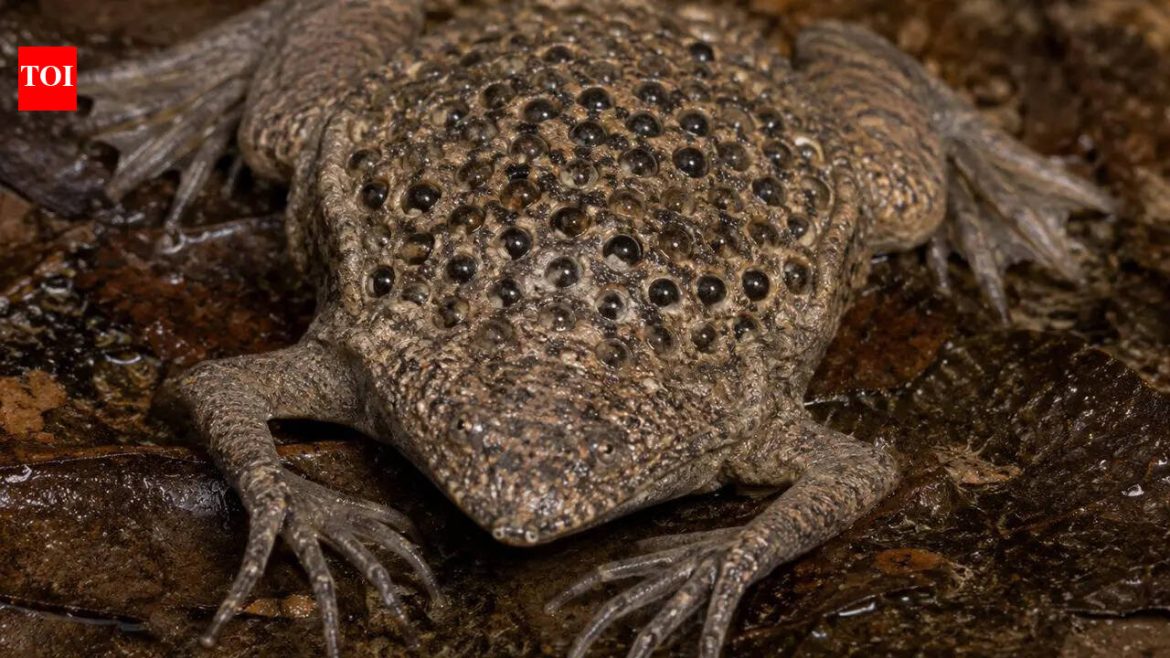
Most frogs are recognised by a familiar set of features: bulging eyes, powerful legs and a life divided between water and land. The Surinam toad seems determined to ignore almost all of those expectations. Found in the still, murky waters of northern South America, this unusual amphibian spends virtually its entire life underwater and is so well adapted to that environment that it often resembles a piece of submerged debris more than an animal.Its broad, flattened body blends into leaf litter at the bottom of ponds, flooded forests and slow-moving waterways. The species rarely attracts attention until its remarkable breeding habits come into view. For many people, that is the moment when curiosity turns into fascination. Beneath its strange appearance lies one of the most distinctive reproductive strategies known among amphibians, a trait that has made the Surinam toad a subject of interest for decades.
Surinam Toad reproduction: How eggs develop inside the female’s back
Breeding begins with the male producing a series of clicking sounds underwater. These calls differ from the familiar croaks associated with many frog species. When a receptive female is located, the pair enters amplexus, the mating embrace used by frogs and toads.What follows is unlike the reproductive cycle of most amphibians. During repeated underwater manoeuvres, the female releases eggs while the male fertilises them. According to the study titled “An update on the Surinam Toad (Pipa pipa) (Linnaeus 1758) in Trinidad, West Indies”, the eggs are transferred onto the female’s back, where they become attached to the skin. Over the following hours, the skin begins to grow around each egg, creating individual chambers.As development continues, each embryo remains protected within its own pocket beneath the female’s skin. Rather than hatching into free-swimming tadpoles, the young complete their transformation while still enclosed on their mother’s back. This process can last several months. During that time, the developing offspring remain sheltered from many of the hazards that typically threaten amphibian eggs and larvae in open water.
How do baby Surinam Toads emerge from their mother’s back
The final stage is perhaps the aspect of the Surinam toad that has attracted the most attention. As development nears completion, the chambers on the female’s back become increasingly visible. Fully formed young frogs eventually break free from their individual compartments and enter the water.They emerge not as tadpoles but as miniature versions of the adults. Although small, they are already capable of feeding and behaving independently. The Animal Diversity Web notes that the young begin snapping at food soon after emergence and gradually develop the swimming ability characteristic of mature individuals.For the female, the event coincides with the shedding of skin that has supported the developing brood. Once the young have dispersed, the adults return to their largely solitary existence in the dark waters they inhabit.The Surinam toad belongs to an ancient family of frogs known as Pipidae, a lineage with roots stretching deep into amphibian history. Its flattened body, sensory adaptations and remarkable approach to parental care set it apart from almost every other frog species. While many amphibians rely on large numbers of eggs to ensure survival, the Surinam toad invests heavily in protecting each developing offspring, creating one of the most distinctive life cycles found in the animal kingdom.
Surinam Toad habitat : Where this South American frog lives
The Surinam toad (Pipa pipa) inhabits parts of the Amazon Basin and neighbouring regions, including Trinidad. Unlike many amphibians that divide their time between land and water, this species is almost entirely aquatic, preferring muddy ponds, swamps and slow-flowing streams where visibility is often poor. Reportedly, it spends much of its time resting on the bottom and surfaces periodically to breathe.Its body shape reflects that lifestyle. The head forms a shallow triangle that merges into a broad, flattened torso. Tiny eyes sit near the top of the head, while large webbed hind feet provide propulsion through the water. The forelimbs are much shorter and end in distinctive star-shaped fingertips. These unusual structures are highly sensitive and help the animal locate food in environments where sight is of limited use.Colouration tends to be understated. Most individuals are shades of brown with darker markings that mirror the appearance of decomposing leaves and sediment. In still water, a motionless Surinam toad can be remarkably difficult to spot.
The Surinam Toad’s unique hunting strategy
Many frogs rely on quick tongue strikes to capture prey. The Surinam toad takes a different approach because it lacks a tongue entirely. Instead, it searches the bottom of its habitat using its sensitive forelimbs, probing through debris for potential food.Its diet includes aquatic invertebrates, worms, crustaceans and small fish. Once prey comes within range, the frog uses a rapid suction-feeding technique. By suddenly expanding its mouth cavity, it creates a rush of water that pulls prey inward. The movement happens in a fraction of a second and allows the animal to feed effectively even in dark, sediment-filled water.The specialised fingertips play another role during feeding. They help manipulate food towards the mouth and may assist in detecting movement or vibrations produced by nearby prey. This combination of touch and suction makes the Surinam toad highly effective in habitats where visual hunting would be difficult.
