

Listen to this article
Estimated 4 minutes
The audio version of this article is generated by AI-based technology. Mispronunciations can occur. We are working with our partners to continually review and improve the results.
Frogs the size of a dinner plate. Tadpoles the size of a baseball.
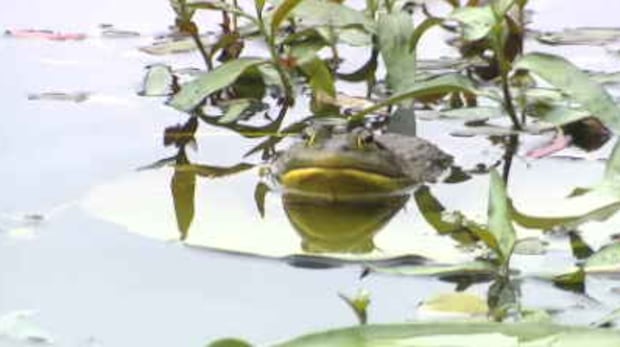
The American bullfrog – a notoriously invasive species that will eat almost anything it can fit into its mouth – is alive and well in Vancouver’s Stanley Park.
The Vancouver Park Board doesn’t have a mitigation plan in place to deal with them.
The predator frogs eat everything from salamanders young turtles and other frogs, to small rodents, insects, fish and garter snakes, according to the Invasive Species Council of B.C. (ISCBC).
And on a hot spring day, the large, loud amphibians both young and old can be spotted swimming at Stanley Park’s Beaver Lake.
“Around this time of year, it’s very common to see American bullfrog tadpoles. They can be a bit awe inspiring or shocking to see the volume of them in, you know, a wetland or a pond … because there can be a lot of them,” said Marisa Bischoff, conservation projects manager with Stanley Park Ecology.
Bullfrogs were imported to B.C. in the 1930s from their native region of eastern North America. The plan was to farm them for their meat (e.g. frog legs), and although that didn’t last, the frogs made their way into the wild, said Nicholas Wong, manager of science and research at ISCBC.
Bullfrogs are now well established in the Lower Mainland, on Vancouver Island and in the Kootenays.
“Unfortunately, they’re in the environment now,” he said.
Those who spend time in Stanley Park know the bullfrogs well.
“They’re really fierce competitors with our native frogs for, you know, resources and habitat and space,” Bischoff said.
The frogs aren’t known to go after humans.
“For humans, the scariest thing is the effect they have on our native ecosystems and native species here,” she said.
“They have few natural predators coming after them here. When they grow up to full adult size, they’re basically scot-free, except maybe great blue herons might go after them once in a while.”
The Vancouver Park Board doesn’t currently have a plan to deal with them, but said it’s “developing” a plan to address them.
There are three frog species in the park – the other two being the invasive green frog and the native tree frog, Bischoff said. But there’s no documentation of the first sighting of the American bullfrog in the park, Bischoff adds, making it difficult to know precisely how they have affected the park’s ecosystem over time.
Wong said that over time bullfrogs alter local food webs and cause ecosystems to get out of balance.
“Invasive species are a pretty severe threat to a lot of our biodiversity,” he said.
The most cost-effective and ecological way to deal with invasive species, he said, is to prevent them, which includes not moving any existing bullfrogs to new areas.
Gail Wallin, executive director of ISCBC, added that it’s illegal to capture tadpoles or mature American bullfrogs and take them into a new area.
But experts agree that where the bullfrogs are well-established, it’s likely impossible to eradicate them.
“It would be so costly and resource intensive to, you know, approach it as a goal to complete eradication [in Stanley Park],” Bischoff said.
Nevertheless, ISCBC said it’s worthwhile to try and mitigate the population of bullfrogs across the province. This can include scooping out masses of eggs from the water before they hatch, and trapping, removing and euthanizing tadpoles and adults.
Already, others in B.C. are taking action. In the Comox Valley, for example, a conservation group is teaching locals how to trap and remove tadpoles from lakes.
But Stanley Park Ecology, which focuses on education and conservation, said its mandate includes removing invasive plants, and it doesn’t extend to managing the frogs.
“Controlling animals becomes a lot more complicated … That’s more the park board area,” Bischoff said.
