
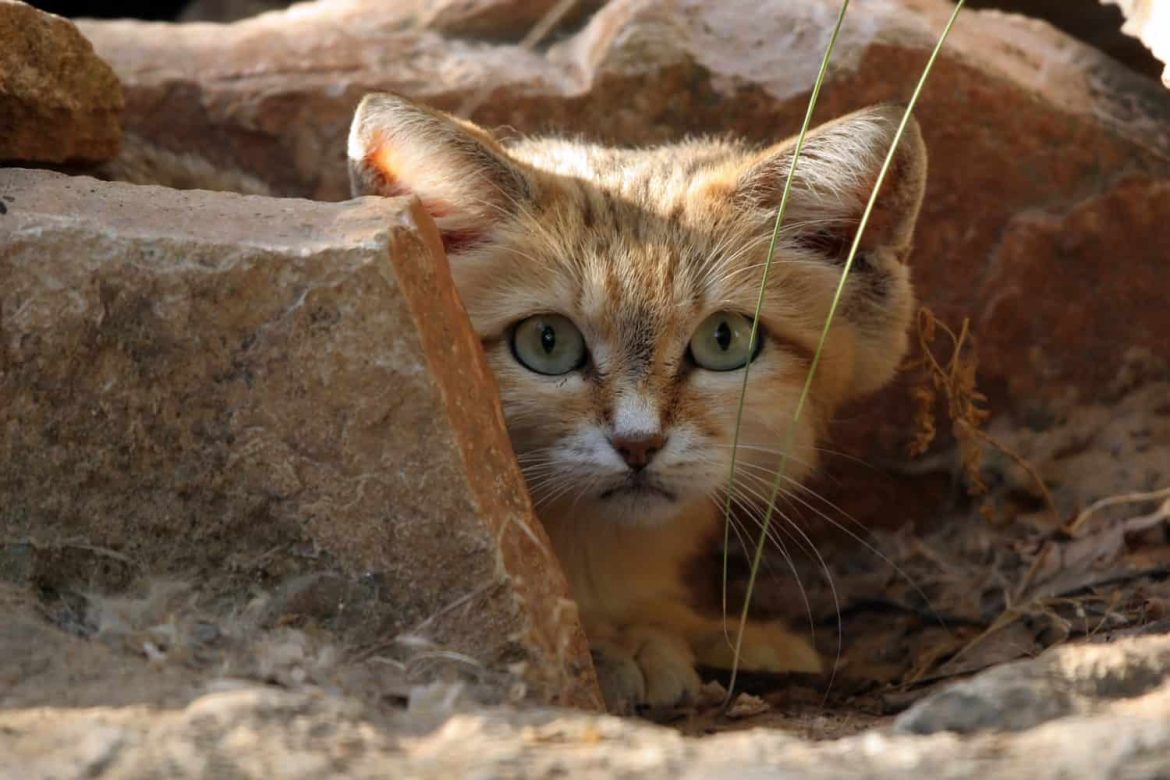
- Sand cats have evolved one bizarre trick that makes them nearly invisible even to researchers actively searching for them at night. See the stealth adaptations →
- Everything scientists assumed about where sand cats prefer to live turns out to be wrong. Discover the habitat surprise →
- After three years and thousands of camera-trap nights, every single sand cat sighting happened in exactly one place, a pattern that tells researchers something concerning. See the survey results →
- The cameras didn’t just confirm the cats are still there; they caught something far more significant than a simple sighting. Meet the breeding female →
For generations, the deserts of Qatar held a frustrating mystery: did the elusive sand cat (Felis margarita) still survive there, or had it quietly disappeared?
Now, we finally have an answer. A landmark three-year study published by Nawaz et al. (2026) used 85 motion-triggered camera traps across Qatar, providing the first definitive, systematic proof that sand cats still inhabit the country. Even more encouragingly, the cameras caught a female traveling with two cubs, confirming that the population is actively breeding.
This discovery is exceptional because few animals are better equipped to remain hidden than the sand cat. Weighing only about 6 pounds, this small wild feline is perfectly adapted to survive in one of the world’s harshest environments — enduring desert temperatures that plunge below freezing at night and soar to 126 degrees Fahrenheit during the day.
The study’s findings not only confirm that sand cats still roam Qatar’s deserts but reveal that these masters of camouflage are quietly raising families in a habitat they were once thought to have abandoned.
The Anatomy of a Desert Ghost
The sand cat’s pale, sandy coat helps it blend seamlessly into the landscape. The dense fur on the soles of its feet acts like built-in snowshoes for the desert. This fur protects against scorching hot sand, prevents sinking, and leaves nearly untraceable footprints. Its large, low-set ears help it detect prey moving underground, while its flattened profile lets it slip through sparse vegetation unnoticed.
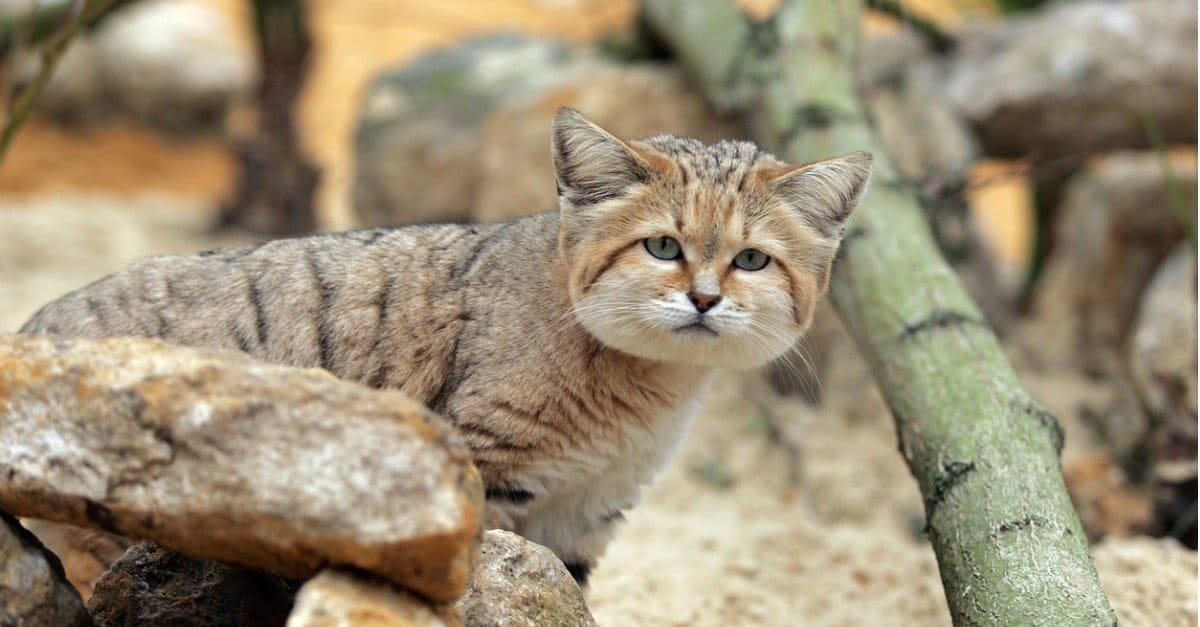
Sand cats typically only weigh between 3 to 7.5 pounds.
©iStock.com/slowmotiongli
This rarely seen cat is so elusive that it has even evolved a unique trick to avoid bright lights. Instead of producing a bright eye-shine at night, sand cats crouch low and partially close their dark-lined eyelids. This clever adaptation makes them incredibly difficult for researchers to spot at night. These adaptations, along with their low numbers and nocturnal habits, make sand cats true “ghosts of the desert” that can remain invisible even when they are right next to you.
9,444 Nights Searching for Proof
To uncover if these desert ghosts still roamed Qatar, researchers launched an extensive camera-trapping survey from February 2022 through January 2025. The camera network racked up 9,444 trap nights over 713 days of active surveying. This massive effort was the most thorough search for sand cats ever conducted in the country.
This immense effort paid off. Researchers caught sand cats on camera 106 times across 16 different locations. These sightings provide the first systematic proof that the species is still in Qatar. However, the findings also showed that the cats live in a surprisingly limited area. Every single sand cat sighting occurred within the protected Al-Ureiq Reserve. Not a single cat was photographed outside its borders.
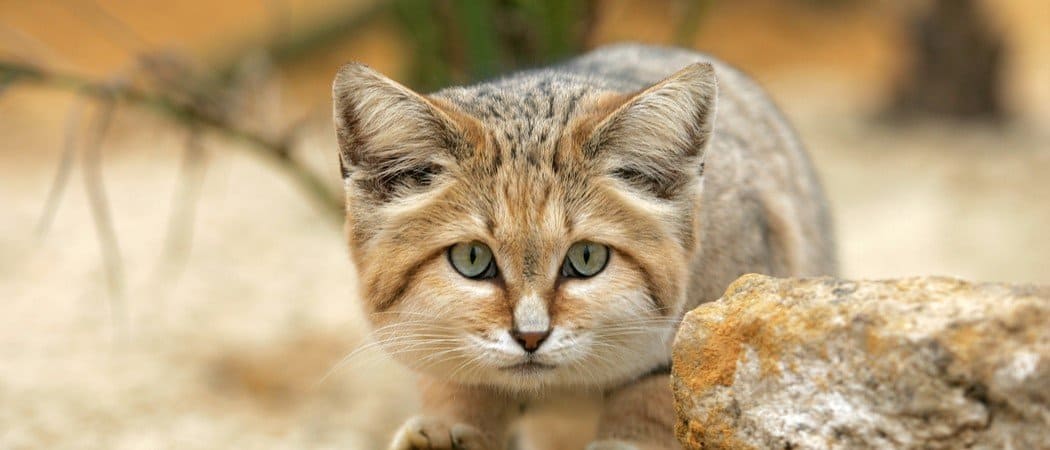
Sand cats are native to Asia and Africa.
©slowmotiongli/Shutterstock.com
The cameras also captured one of the study’s most exciting discoveries: a female sand cat with two cubs. These images provide clear evidence that Qatar’s sand cats are not just passing through the reserve. They are actively breeding and raising families there.
Challenging Assumptions About Sand Cat Habitats
The study also challenged a common assumption about where sand cats prefer to live. While people often think of them roaming vast, empty dunes, the researchers found that the cats were actually more likely to live in areas with more plants and bushes. In fact, statistical analysis showed that the presence of vegetation was one of the strongest predictors of where sand cats would be found.
Rather than favoring barren stretches of desert, the cats appeared to prefer dunes and plains scattered with shrubs and greenery. These areas likely give them several advantages. The plants support the rodents that sand cats eat, offer shelter from extreme daytime heat, and provide extra hiding spots from predators and human disturbance.
Camera traps recorded sand cats throughout the year, indicating that these habitats support them in every season.
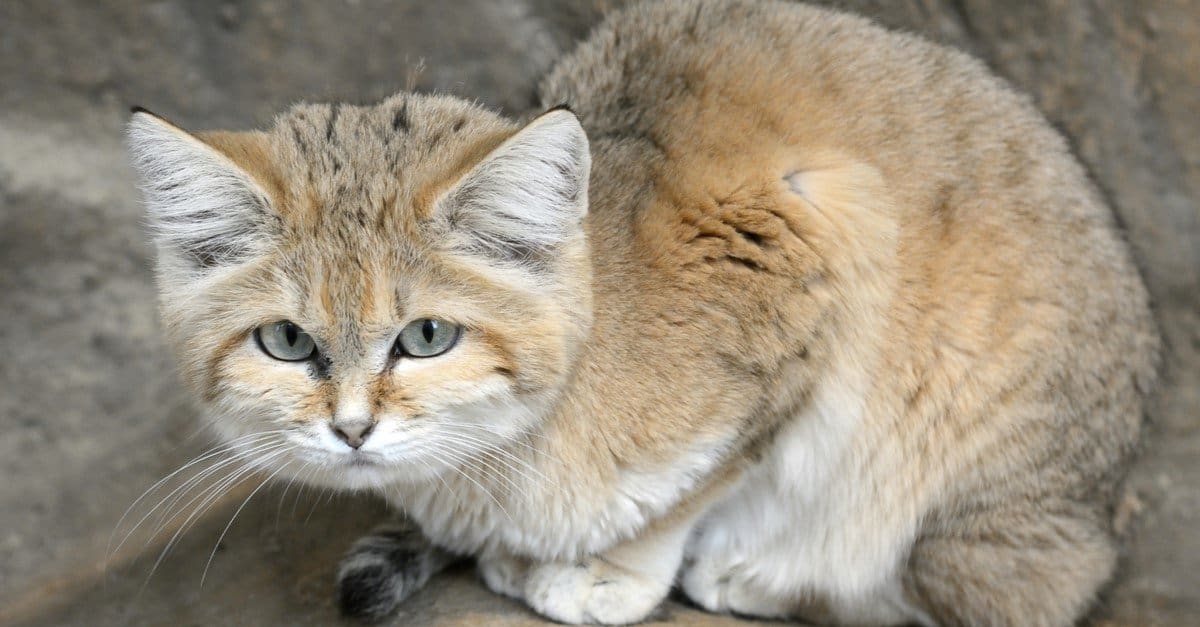
In various regions, sand cats are listed as endangered, near threatened, and even critically endangered.
©Alexandr Junek Imaging/Shutterstock.com
A Fragile Future for Qatar’s Hidden Felines
While the study confirms that sand cats still survive in Qatar, it also highlights just how vulnerable the population may be. Because researchers only found the species within the Al-Ureiq Reserve, it underscores how critical protected areas are for preventing local extinction. Across the Arabian Peninsula, sand cats face growing pressure from habitat loss, fewer prey animals, free-roaming domestic cats, diseases, and other human-related threats.
To better protect the species, the researchers recommend expanding camera-trap surveys across Qatar and the wider Arabian Peninsula to find other populations and travel corridors. They also call for future studies to look into population density, movement patterns, breeding success, and diet.
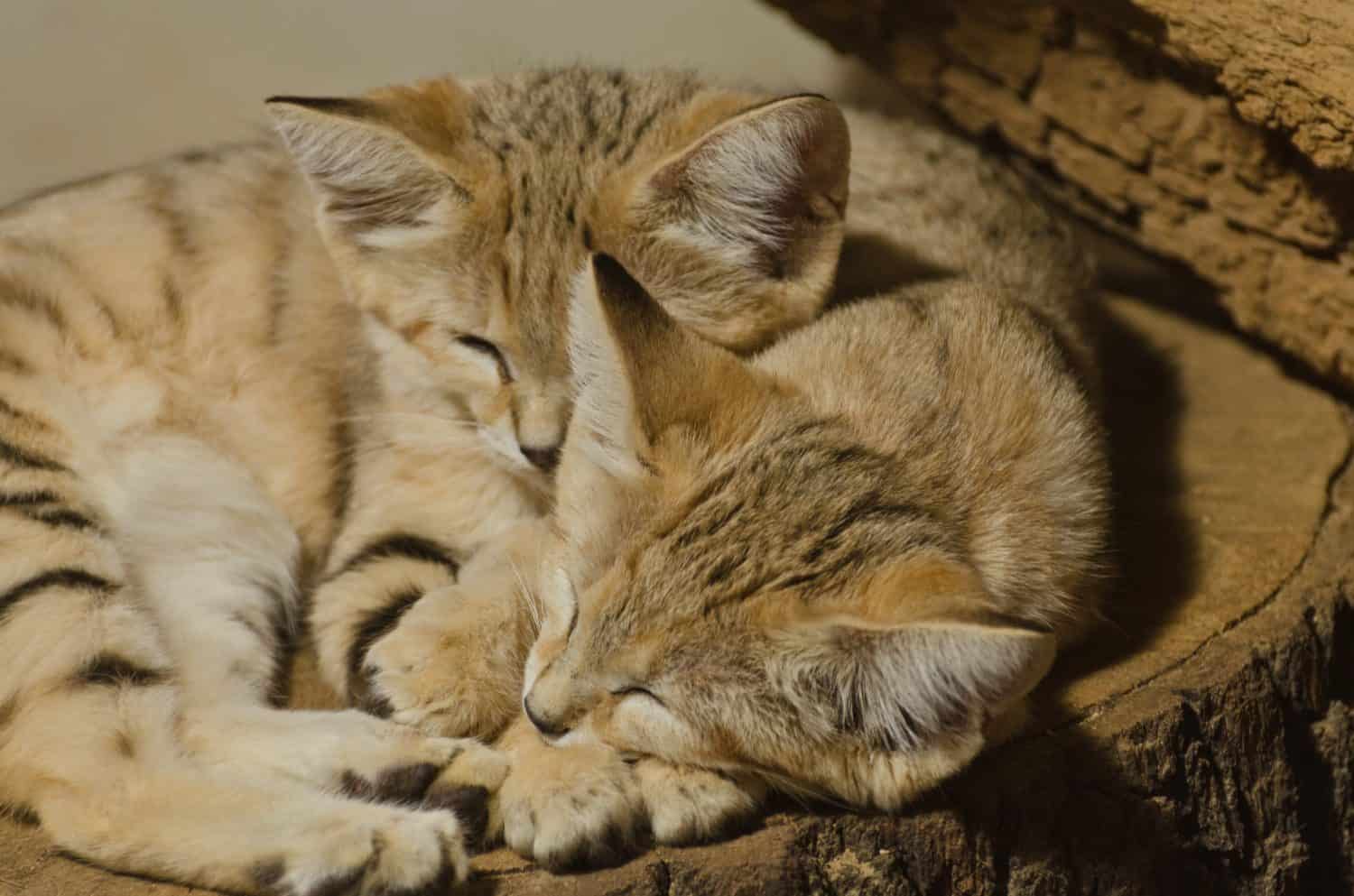
Female sand cats typically give birth to two to four kittens.
©JWKS Photomancy/Shutterstock.com
For now, the study answers a question that lingered for decades. Qatar’s sand cats weren’t gone after all. They had simply been doing what they do best: surviving unnoticed in a landscape where they are perfectly designed to disappear.

About the Author
Kellianne Matthews
Kellianne Matthews is a writer at A-Z Animals where her primary focus is on anthrozoology, conservation, human-animal relationships, and animal behavior. Kellianne has been researching and writing about animals and the environment for over ten years and has decades of hands-on experience working with a variety of species. She holds a Master’s Degree from Brigham Young University, which she earned in 2017.
A resident of Utah, Kellianne enjoys sewing and design, animal rescue, volunteering with Arctic Rescue, and going on adventures with her husky.
Thank you for reading! Have some feedback for us?
Thank you for your feedback!
We appreciate your help in improving our content.
Our editorial team will review your suggestions and make any necessary updates.
There was an error submitting your feedback. Please try again.
