
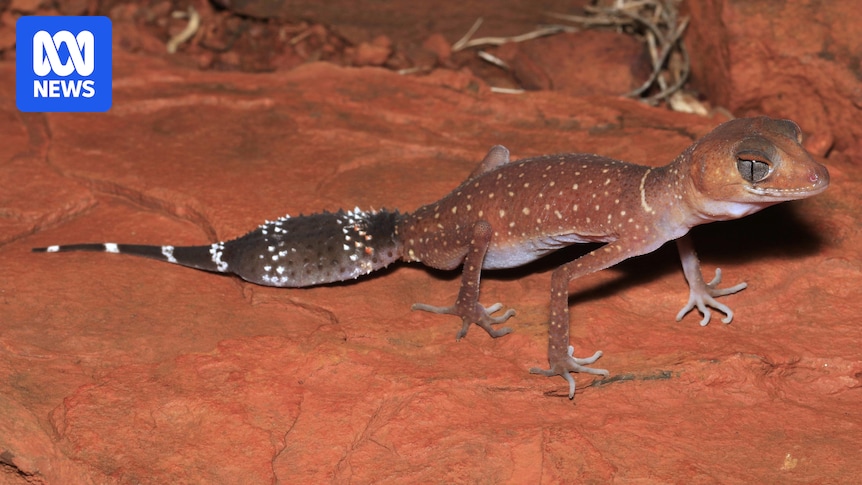
The Pilbara barking gecko and Bungle Bungle robust slider, two of Australia’s least-studied reptile species, could soon be facing extinction due to the rapidly warming climate.
Researchers at Monash University, which recently conducted separate studies on each species, want the reptiles to be classified as endangered, saying sightings in the wild are declining.
Pilbara barking geckos prefer higher altitudes and cooler temperatures. (Supplied: Robert Audcent)
Monash University herpetology researcher Robert Audcent said the study was the first of its kind on the Pilbara barking gecko, named for the dog-like bark that it emits when threatened.
It prefers the higher elevations and cooler temperatures of the Hamersley Range, about 1,400 kilometres north of Perth, but its habitat is under threat.
“There is a potential it could go extinct under a warming scenario, which is very likely given the trajectories for climate change,” Mr Audcent said.
He said the species would try to disperse up the mountains to access cooler habitats as the climate warmed.
“Once it gets too hot, then they will experience stress, increased disease accessibility and there is that chance they can go locally extinct and the whole population might suffer serious declines,”
he said.
Mr Audcent said researchers had to utilise spotlighting, a technique that involved using a head torch at night to see the reflective eyes of the gecko, to find the reptiles.
Spotlighting was used to find the evasive gecko. (Supplied: Robert Audcent)
Before the study, there were only 55 confirmed sightings of the reptile.
Mining impact
Monash University senior research officer Jules Farquhar said the reptiles were also under threat from the expanding mining operations in the Pilbara region.
“One thing they can do to be sympathetic of the geckos is to know where they do and don’t occur and employ ecologists and experts on the species to do thorough surveys before they are deciding where to mine,” he said.
The Bungle Bungle robust slider is facing the threat of extinction. (Supplied: Jules Farquhar)
Mr Farquhar said the recent studies would help raise more awareness about conservation for the reptiles.
“These species are on the radar of these companies, especially now that there is this research done and we are calling for its conservation status to be elevated,” he said.
Slider’s struggle to survive
There were only three recorded sightings of the Bungle Bungle robust slider, named after its habitat in Purnululu National Park, before the researchers began looking into the species.
They found 21 new individual sliders across eight sites in the area.
The Bungle Bungle robust slider was seen only in Purnululu National Park. (Supplied: Jules Farquhar)
Mr Farquhar said the findings proved the rarity of this species and its exclusivity to the Bungle Bungle ranges in WA’s north-west.
He said the restricted habitat increased the slider’s vulnerability.
“One of our key findings was it seemed to be affected by fire and the region is quite prone to fires,” Mr Farquhar said.
“This species seems to only live in sheltered gorges.”
More conservation efforts needed
Under the WA Biodiversity Conservation Act 2016, both species are listed as being “data deficient”, which means there is not enough information about them.
After conducting the studies, the Monash University researchers have put forward the Pilbara barking gecko to be listed as endangered.
A DBCA spokesperson said the department had received the nomination and would present it to the WA Threatened Species Scientific Committee at its 2026 meeting.
