
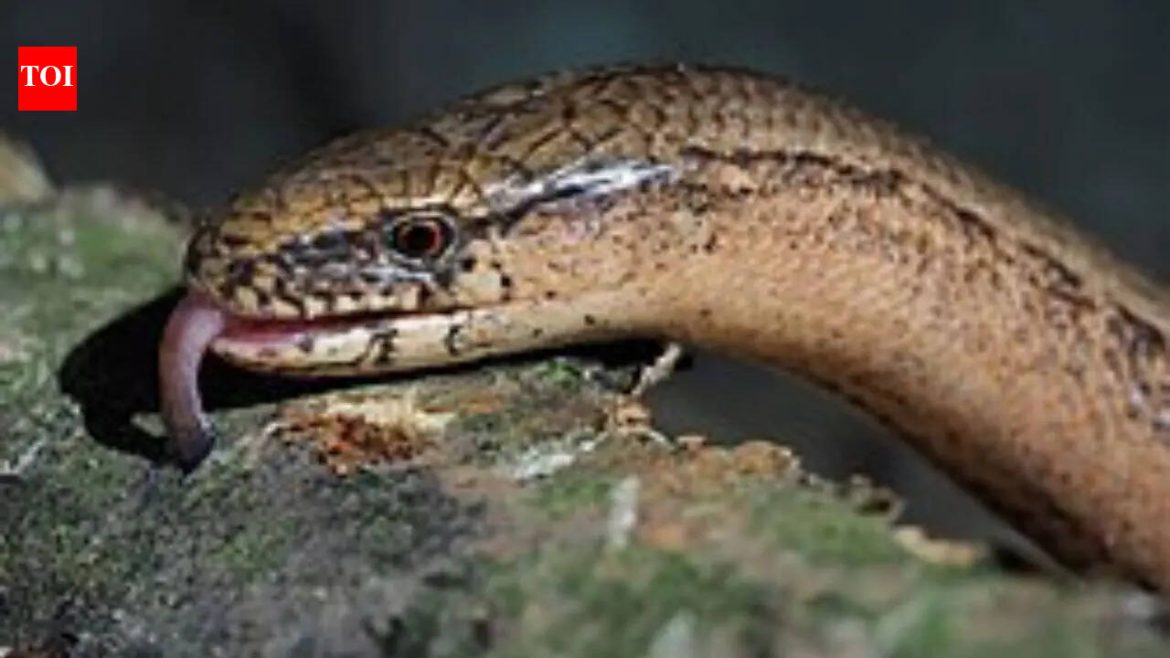
People often mistake slow worms for small snakes. The shape encourages it. They move through long grass with the same gliding motion, disappear quickly into dense cover and spend much of their time hidden from view. Yet the confusion breaks down the moment one looks closely at the head. Slow worms blink.That small detail says quite a lot about what they really are. Despite their snake-like appearance, slow worms belong to a group of legless lizards found across much of Britain and parts of Europe. They carry features snakes do not, including eyelids and external ear openings, though both are easy to miss without handling the animal carefully. In gardens, allotments and rough grassland, they often remain unnoticed for years because of their quiet habits and preference for shelter beneath stones, compost heaps and old timber.
Why this fork-tongued reptile is often mistaken for a snake
The absence of legs tends to dominate first impressions, although the slow worm’s body structure differs from snakes in several less obvious ways. According to the study by the Natural History Museum, slow worms have movable eyelids, which means they can blink and close their eyes fully. Snakes cannot do this because their eyes are covered by a transparent scale instead.The body itself is fairly rigid compared with many snakes. Adult slow worms usually appear smoother and more cylindrical, with a blunt tail and a less distinct neck. Their movement can look slightly stiff at times, especially on cooler days when temperatures slow them down further.Colour varies more than many people expect. Males are often plain grey or brown, while females commonly carry darker flanks and a thin stripe running along the spine. Juveniles look quite different again, sometimes appearing silver or gold with sharply contrasting markings.
Gardens become important habitats for slow worms
Even in places where slow worms are common, sightings are irregular. They avoid exposure where possible and usually stay close to a cover that holds warmth and moisture. Old paving slabs, sheets of metal, rotting logs and compost piles can all provide suitable shelter.According to a study published in Froglife, gardens have become increasingly important habitats for slow worms in parts of Britain, particularly where rough vegetation and undisturbed corners remain intact. A tidy lawn offers little protection. Dense borders, long grass and leaf litter tend to support more insect and slug activity, which suits them better. They feed slowly and without much aggression. Slugs form a large part of the diet, along with worms, woodlice and soft-bodied invertebrates found at ground level. Their teeth are small but curved backwards, helping them grip prey that might otherwise slip away. Warm weather brings them closer to the surface during mornings and evenings, though prolonged heat can drive them back underground. In colder months, they disappear almost entirely from view.
The unusual defence mechanism that helps slow worms survive
Slow worms rely more on avoidance than confrontation. When disturbed, they often freeze before trying to retreat into nearby cover. If grabbed by the tail, however, they can detach part of it.The detached section continues twitching after separation, drawing attention away from the animal itself. According to the report of the Amphibian and Reptile Conservation Trust, this defence mechanism is common among certain lizard species, though regrown tails never fully return to their original form. The replacement is usually shorter and smoother. Because of this, many older slow worms carry visible tail damage. Some have blunt regenerated ends, while others appear slightly misshapen where healing occurred years earlier. It does not necessarily prevent survival, although losing stored fat reserves can make colder seasons harder.
How slow worms protect themselves from predators
Their lifespan surprises many people. Slow worms can live for decades under stable conditions, which is unusually long for a small reptile living in Britain’s climate. Much of that life passes unnoticed beneath vegetation or underground chambers.Breeding takes place in spring, shortly after emergence from winter shelter. Males sometimes compete with one another by twisting and wrestling rather than biting seriously. Females do not lay eggs in the conventional sense. Instead, the young develop internally and are born enclosed in thin membranes that split soon after birth. This makes encounters with juveniles especially brief. Newly born slow worms are small enough to vanish beneath grass stems or loose soil within seconds. Their decline in some areas has less to do with predators than with gradual habitat loss. Removing piles of logs, replacing rough ground with paving and frequent heavy mowing all reduce the sheltered conditions they depend upon. Domestic cats also kill considerable numbers around gardens and allotments. Even so, slow worms continue to survive in unexpected places. Railway embankments, suburban gardens, abandoned plots and compost heaps often support populations unnoticed by the people living nearby. Most remain hidden unless the ground beneath an old board or flowerpot happens to shift at the right moment.
