
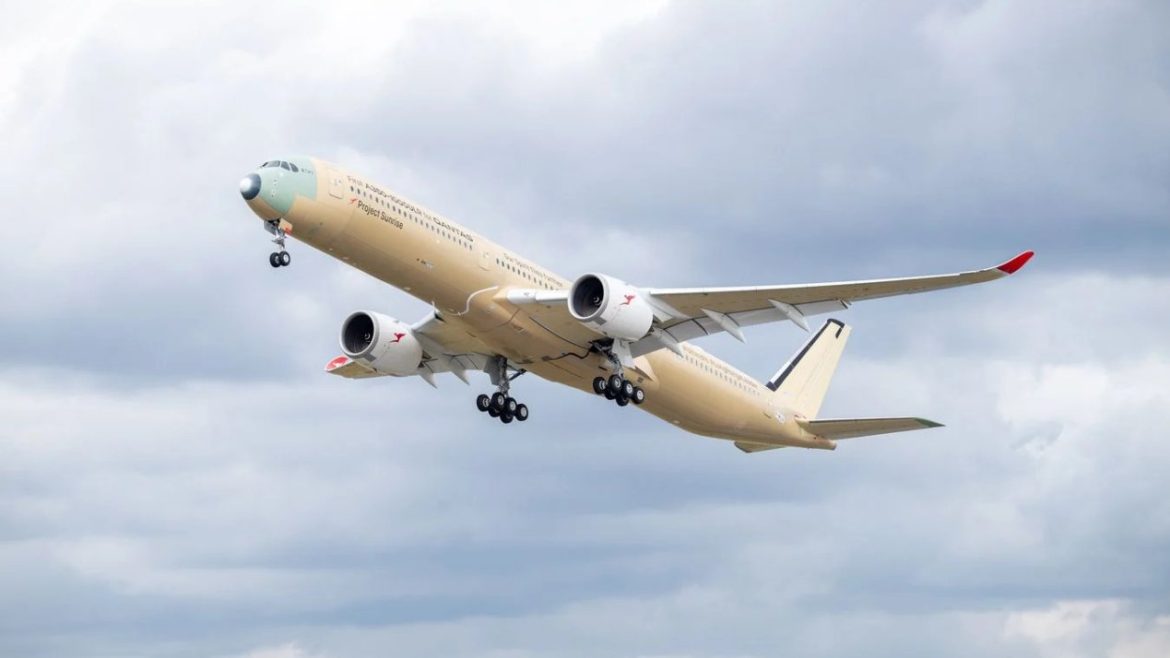
Airbus has begun the flight-test campaign for its new ultra-long-range passenger aircraft, the A350-1000ULR, following the successful completion of its maiden flight from the company’s headquarters in Toulouse, France.
The aircraft, registered as manufacturer serial number (MSN) 707, is the first of 12 units ordered by Australian flag carrier Qantas Airways under its long-haul development initiative, Project Sunrise.
Initial Flight and Test Objectives
During its inaugural flight, MSN 707 remained airborne for three hours and 43 minutes, reaching an altitude of more than 41,000 feet. The aircraft was equipped with dedicated flight-test instrumentation rather than a commercial cabin configuration.
The flight was conducted by an Airbus experimental flight-test crew consisting of:
- Experimental Test Pilots: Thomas Wilhelm and Anthony Flynn
- Test Flight Engineer: Laurent Rossignol
- Lead Flight Test Engineers: Tuan Do and Alexia Plumet
- Ground Test Engineer: Vincent Frayssinet
The flight marked the start of a two-month certification campaign. Airbus engineers used the initial sortie to evaluate overall aircraft performance and verify the operation of the aircraft’s newly developed fuel system architecture.
Structural and Mechanical Modifications
The A350-1000ULR is designed to support nonstop commercial flights of nearly 10,000 nautical miles, with projected flight durations of up to 22 hours.
To achieve a range extension of approximately 1,000 nautical miles over the standard A350-1000, Airbus modified the airframe by incorporating a permanent Rear Centre Tank (RCT).
The modification adds 20,000 liters of fuel capacity, providing the volume required for ultra-long-range operations while maintaining regulatory reserve fuel requirements. The aircraft is powered by two Rolls-Royce Trent XWB-97 engines and benefits from an increased maximum takeoff weight (MTOW).
The ongoing certification campaign focuses primarily on validating the RCT and its integrated systems. Upcoming tests will assess fuel pumps, gauges and pressure-control mechanisms, while also verifying the automated fuel-transfer sequences managed by the onboard Fuel Quantity Management System (FQMS).
Cabin Systems and Weight Reduction Technologies
The test program also includes evaluations of cabin environmental systems, including ventilation and multi-zone temperature controls.
The A350-1000ULR serves as the launch platform for Airbus’ new New Galley Air Cooling (NGAC) system.
The NGAC architecture incorporates lighter, redesigned refrigeration units intended to improve efficiency during extended flight operations. According to Airbus, the system reduces aircraft weight by approximately 300 kg. Once certified on MSN 707, NGAC will become standard equipment across the broader A350 family.
Fleet Status and Commercial Configuration
Following completion of the certification program, MSN 707 will return to the assembly facility to be converted from its current test configuration into Qantas’ commercial cabin layout.
A second aircraft destined for Qantas is already in the final stages of assembly and has entered the paint shop for application of the airline’s livery. The aircraft will subsequently undergo engine installation and cabin completion before entering service.
This second airframe is expected to become the first aircraft delivered to Qantas, with delivery scheduled for April 2027.
Qantas has selected a premium-focused cabin layout accommodating 238 passengers, significantly fewer than standard A350-1000 configurations. The cabin will feature:
- 6 First Class suites
- 52 Business Class suites
- 40 Premium Economy seats
- 140 Economy Class seats with a 33-inch seat pitch
The aircraft will also include a dedicated passenger wellbeing zone, providing space for stretching and movement during ultra-long-haul flights.
Program Origins and Market Context
Qantas launched Project Sunrise in 2017 as a challenge to aircraft manufacturers to develop aircraft capable of operating nonstop flights from Sydney to London and New York.
The project takes its name from World War II-era Qantas operations, when Catalina flying boats maintained air links between Western Australia and Sri Lanka following the fall of Singapore. Those historic flights carried only three passengers and 70 kg of essential mail, lasted up to 33 hours and required crews to witness two consecutive sunrises.
The A350-1000ULR becomes the fourth passenger variant in the A350 family, joining the A350-900, A350-900ULR and the standard A350-1000.
According to Airbus, the A350 family delivers approximately 25% lower fuel consumption and carbon emissions than previous-generation long-haul aircraft. The manufacturer is also expanding the platform with the A350F freighter, which is expected to conduct its maiden flight later this year.
