
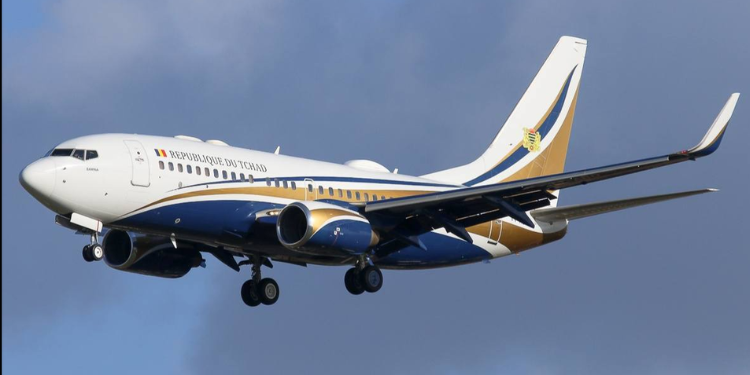
African Heads of State arrived in Nairobi for the Africa Forward Summit aboard high-end presidential and corporate jets.
Presidential aircraft are suited for long-distance state travel, offering secure communications and fully customized cabins designed for leadership and diplomatic work in the air.
The aircraft range from Boeing Business Jets to Airbus Corporate Jets and long-range VIP airliners, each configured with private offices, bedrooms, secure communications, and extended intercontinental range.
Presidential Jets Built for Efficiency and Comfort
The President of Chad arrived in a Boeing 737-74Q Business Jet (BBJ), with registration TT-ABD, a VIP-configured version of the Boeing 737 designed for long-range executive travel.
BBJs are designed to offer unmatched comfort and superior range for global travel needs and cost $120 million, depending on customization.
Governments use Boeing Business Jets because they combine commercial aircraft reliability with customized interiors, including meeting rooms, lounges, and secure communication suites.
Senegal’s president, Bassirou Diomaye Faye, arrived in an Airbus A320-251N Corporate Jet (ACJ320neo), valued at $110 million.
Also Read: Nairobi’s Luxury Hotels Hosting Presidents and Global VIPs
The aircraft is part of Airbus’s modern corporate jet family, which has customizable cabins and intercontinental range.
ACJ aircraft are designed as a “governmental tool” to help leaders move securely and efficiently between global destinations.
The ACJ320neo can fly about 11,100 km non-stop, depending on configuration, and carries around 25 passengers in VIP layout.

Nigeria’s President Bola Tinubu arrived aboard a Nigerian Air Force-operated Airbus A320-200, estimated at $100 million, fitted for presidential use with secure communications and executive seating for official travel.
Egypt’s president, Abdel Fattah el-Sisi, arrived in a Boeing 747-8 VIP, usually referred to as the “Queen of the Sky,” valued at approximately $500 million.
The Boeing 747-8 is the largest and most advanced version of the 747 family, originally designed for long-haul commercial service.
The aircraft is known for its spacious cabin, which accommodates private bedrooms, conference rooms, lounges, and secure command centers.
Also Read: Harambee One: Details of Ruto’s Jet That Has Flown Four Presidents
The Boeing 747-8 is considered one of the most powerful VIP aircraft in the world due to its range, size, and ability to accommodate multiple functional zones within a single cabin.
President Félix Tshisekedi of the Democratic Republic of the Congo used a chartered Airbus A320-232 ACJ sourced from Global Jet Aruba in the Netherlands.
The aircraft, which is operated by the Emir of Qatar. Hiring an Airbus A320 costs between $15,000 and $20,000 per flight hour.
Kenya’s Presidential Aircraft System
President William Ruto uses the official state aircraft, Harambee One, a Fokker 70 operated by the Kenya Air Force, with tail number ‘KAF 308.’
Since it was purchased in 1990, it has cost between $ 15 million and $25 million before being customized in the Netherlands.
Its exterior is white, with stripes of the national flag. The jet bears the official coat of arms to communicate the presence of the commander-in-chief.
Despite having an original capacity of 70 passengers, the aircraft was modified to accommodate only 26 passengers and fitted with additional fuel tanks to increase its range.
The Fokker 70 has been used by Kenyan presidents, including Daniel Moi, Mwai Kibaki, Uhuru Kenyatta, and now William Ruto.

