
After removing the publicly posted list of charter operators and aircraft that complied with Part 135 regulations in February, the Federal Aviation Administration has restored it.
The FAA removed the list after a series of errors, including listing thousands of charter aircraft under a small Louisiana seaplane operator.
Like the previous list, the file is available in a spreadsheet that can be downloaded from the FAA website.
The FAA has promoted the list as a way for the public to ensure they are being flown on an aircraft that is legally operated and compliant with the regulations governing charter flights.
The agency and trade groups have identified illegal charter flights as a safety concern.
At the time the list was removed, an FAA spokesperson said, “We take the integrity of the data seriously and therefore have decided to deactivate the spreadsheet until we resolve the issues temporarily.”
The spokesperson continued, “We are working on a solution to ensure the data is current and accurate.”
Not Fixed?
However, the new list still may have issues.
One example is Verijet.
The latest FAA list shows it has two Cirrus SF50 Vision Jets as legal for charter flights.

Verijet filed for Chapter 7 bankruptcy last October and ceased operations.
Its founder and CEO, Richard Kane, died in September 2025.
A separate list of operators, a new feature on the current FAA website, shows Verijet, Inc., as being current with the FAA.
It also lists Kane as chief executive officer (below).
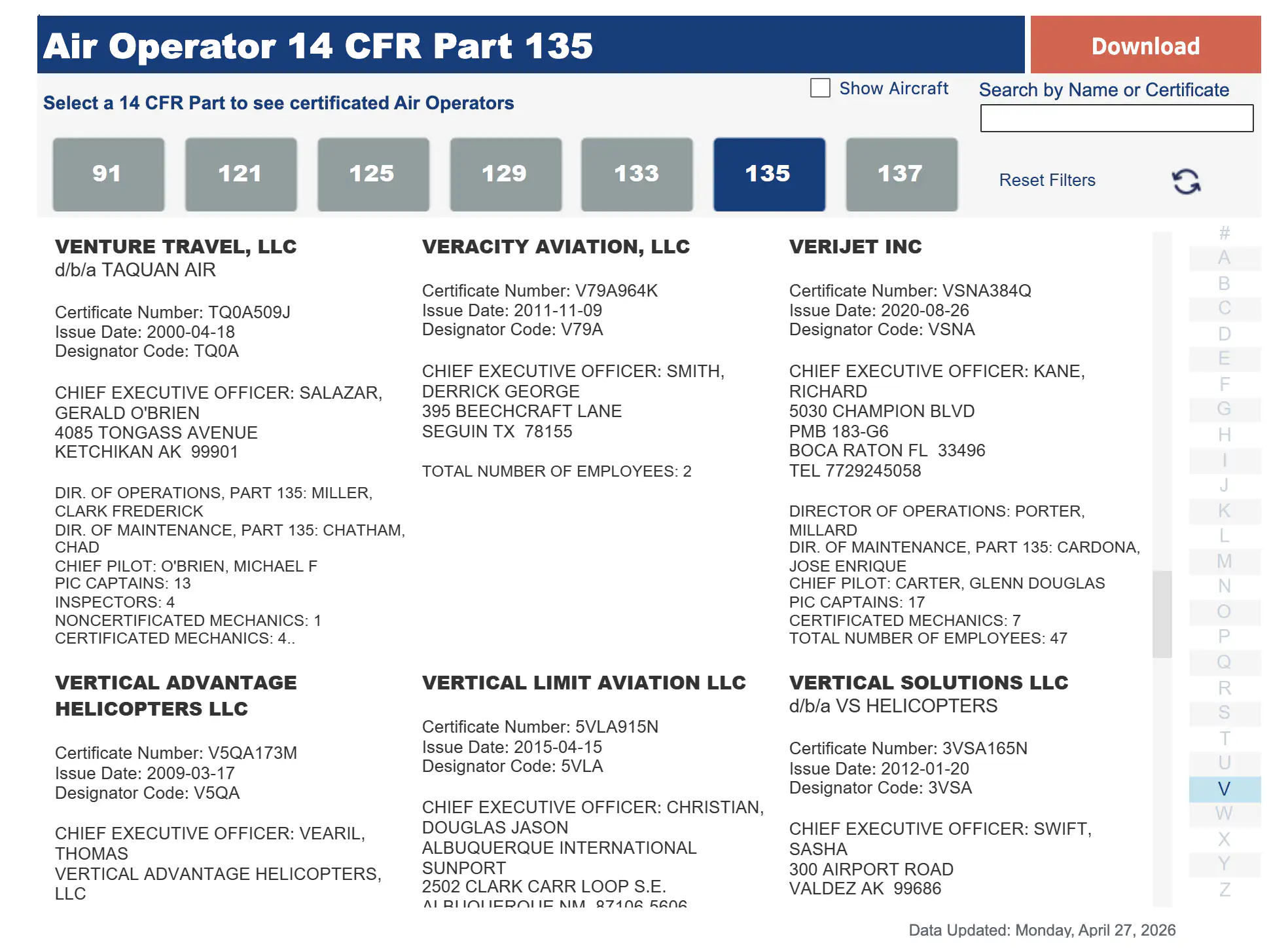
The FAA says the data was updated on April 27, 2026.
Kane died on Sept. 13, 2025.
It does appear that major operators are listed.
In one error-filled try, the FAA omitted numerous companies, including NetJets, the largest operator in the country.
Of the operators that ranked in the top five based on charter and fractional flight hours in 2025, NetJets and Flexjet dominate.
The U.S. unit of NetJets currently has 725 aircraft on its certificate per the FAA.
Flexjet has 323 aircraft on the list.
Vista America, which includes two certificates, lists 91 aircraft.
Wheels Up had 80 aircraft on the list.
FlyExclusive lists 82 aircraft.
READ: FAA Part 135 private jet charter list contains many mistakes
What The List Means
Being on the list implies that the operator is currently certificated under 14 CFR Part 135 rules to conduct commercial on-demand flights.
The layman’s translation is that it’s the authorization needed to operate commercial flights that support on-demand charters, jet cards, some shared flights, and even fractional operators.
The list, which the FAA had been publishing monthly since early 2020, combined with another list of aircraft.
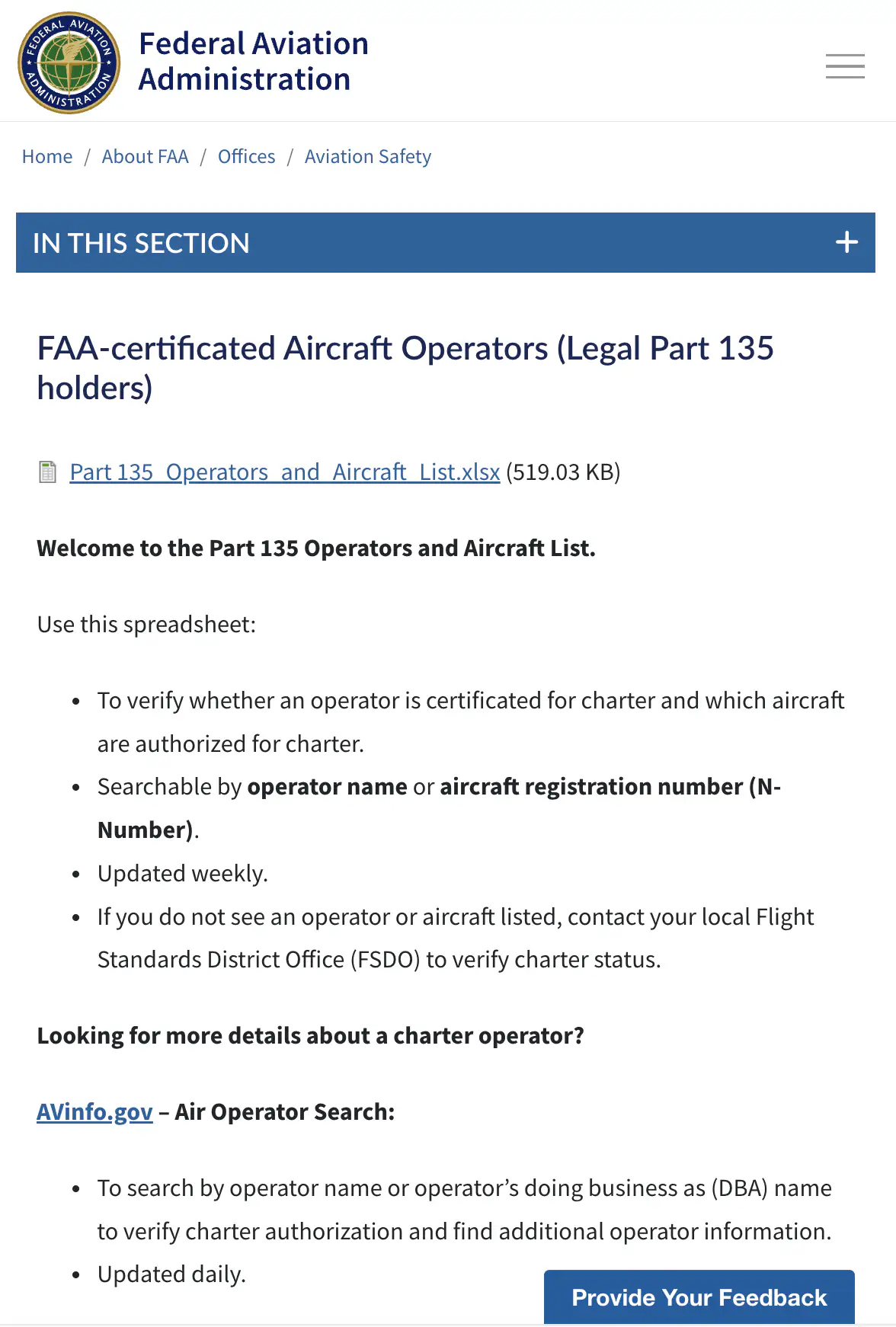
That list, the D-085, was the Part 135 operator’s list of aircraft that complied with the regulations.
Only aircraft on the D-085 can be used to sell charter flights.
Operators typically manage aircraft that fly under both the vastly different Part 135 and Part 91 rules.
In other words, not all of the aircraft a Part 135 operator manages are necessarily certificated for charter flights.
Part 135 vs. Part 91
Part 135 – and Part 91K, the certification of fractional operators, have much more stringent regulations governing operators than Part 91.
The Part 91 rules govern a person or company that owns and operates their aircraft for non-commercial use.
Writing in Business Jet Traveler, comparing the different standards, Jeff Wieand explains, “Under Part 91, your caffeine-swilling pilots can fly your aircraft around for days without ever taking a break. Part 135 (and Part 91 subpart K, which applies to fractional programs), on the other hand, has specific flight-duty-time and rest requirements.”
The more stringent Part 135 and 91K rules extend to drug and alcohol testing, maintenance, training, pilot experience, required runway length, insurance, liability, operational control, and more.
Public Resource
The list, in Excel spreadsheet form, was published by the FAA on its website in the first few days of each month.
It was the only free public resource that enabled consumers to verify if the operator and the specific aircraft they were flying on were certificated to operate their charter flight.
Illegal charter – selling flights operated by aircraft not on the list – is considered a major safety issue.
In fact, the FAA issued a warning to consumers about illegal charter flights before the recent Super Bowl.
It cited the high-profile death of soccer star Emiliano Sala in 2019.
On its website, the FAA outlines nearly two dozen enforcement actions it has initiated against individuals and companies for alleged illegal charter operations since 2019.
FAA Lapses and Mistakes
After keeping its monthly routine, the FAA failed to post an updated list over the summer of 2025.
It was attributed to a move to a new centralized database.
On Sept. 17, 2025, the FAA posted an update to the data.
That list reflected what should have been accurate as of the end of August.
There was then nothing until early February 2026.
That delay could have been in part due to the government shutdown last year.
That shutdown began Oct. 1, 2025.
It lasted 43 days.
However, the first update in February, which carried a 10, implying it was the list that should have been published in early October, carried massive errors.
It omitted major operators such as NetJets and FlyExclusive, along with their entire fleets.
Another Try
On Feb. 18, 2025, the FAA posted a second update.
It was numbered to reflect that it was the list that should have been published in early December.
The number of spreadsheet rows, each representing an aircraft, more than doubled.
There were fewer than 200 duplicates.
And while the actual aircraft from major operators returned, a small operator, Southern Seaplane (see below), was instead listed as the operator for over 21,000 of the 23,000 listings.
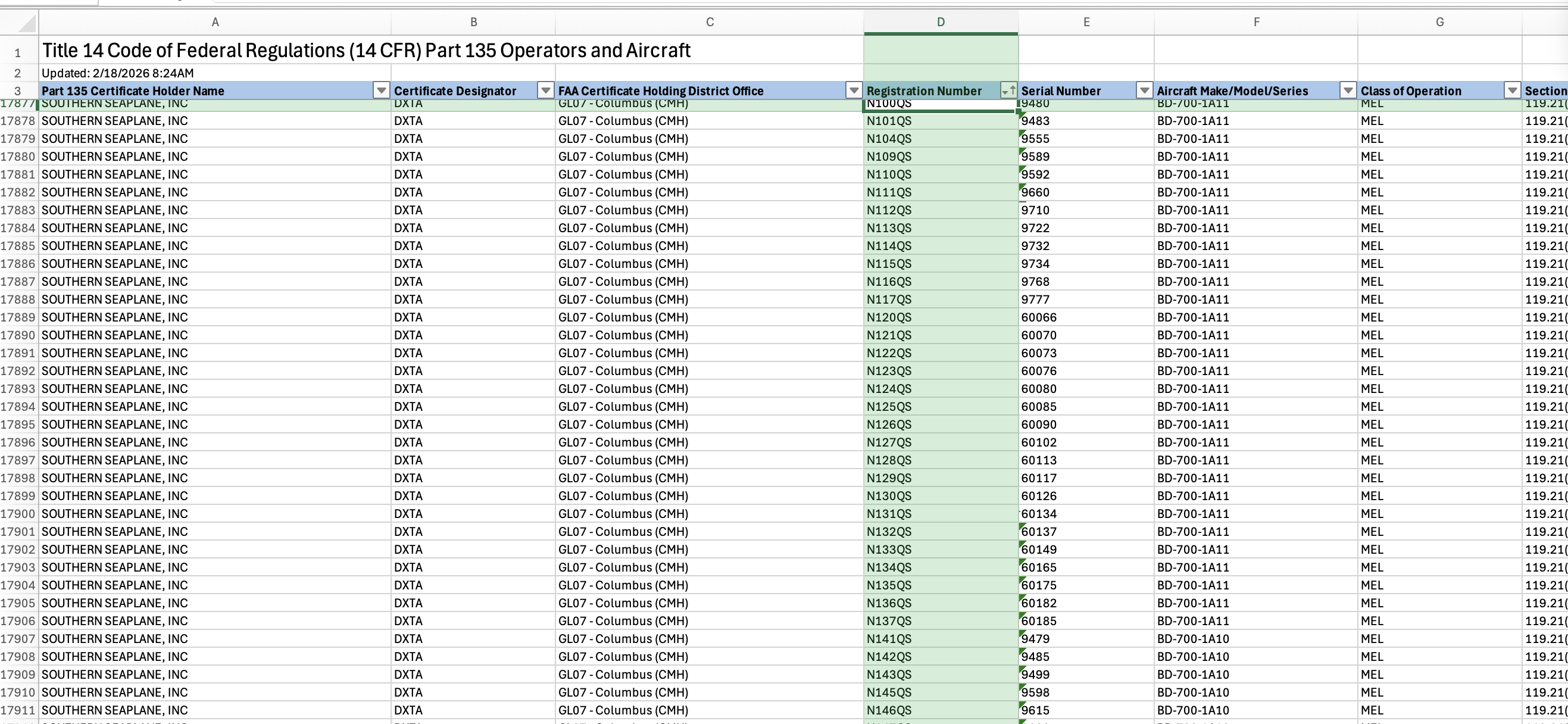
That included the NetJets fleet, which can be identified by the QS in their registration or tail numbers.
The FAA next appeared to have restored the list’s overall integrity, with NetJets, Wheels Up, FlyExclusive, Jet Linx, and others now appearing alongside the aircraft on their D-085.
However, with an apparent mistake still on the list, the FAA decided to hit the pause button.
The list published Friday has 11,465 aircraft.
Why It Matters
An Aviation International News analysis found that between 2010 and 2020, there were no fatal accidents involving U.S.-registered private jets operating under Part 91K, and just three involving Part 135 operations.
By contrast, Part 91 operations accounted for 31 fatal accidents over the 10 years.
The death of former NASCAR driver Greg Biffle in a December crash was a Part 91 operation.
So was the Challenger 650 that crashed on takeoff from Bangor, Maine.
When it came to turboprops, Part 91K fractional operations again had zero fatal accidents during the decade.
U.S.-registered charter turboprops had 15 fatal accidents.
Part 91 operations accounted for 82 fatal turboprop accidents over the 10 years.
The crashes that killed four people on a night approach to Steamboat Springs aboard an Epic E1000 earlier this year and the crash in Wyoming that killed three members of the gospel group The Nelons in July 2024 were both on turboprops operating under Part 91 rules.
