
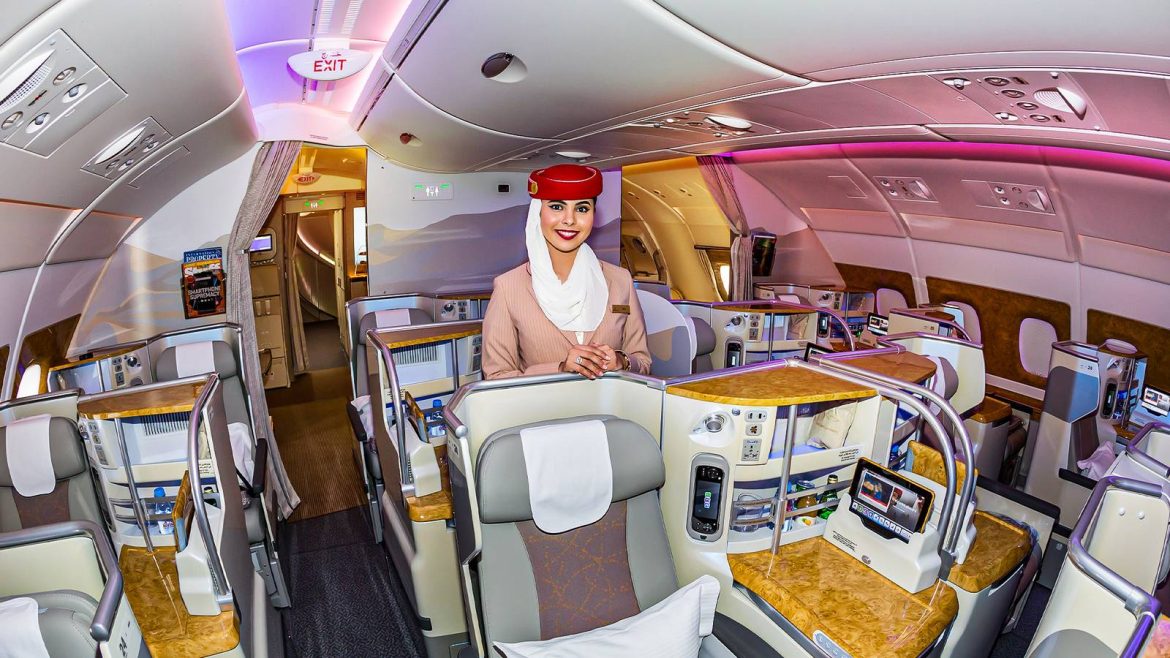
The Airbus A380 is often portrayed as the ultimate symbol of commercial aviation excess, a double-decker giant complete with onboard bars, shower spas, and hundreds of passengers crossing continents in a single flight. Yet for Emirates, the world’s largest A380 operator, the aircraft is less a luxury showcase than a carefully calibrated revenue machine. Behind every cabin door lies a financial calculation, with each section of the aircraft expected to generate returns proportional to the amount of space it occupies. Emirates sells multiple versions of the same journey to vastly different customers at vastly different price points.
That approach helps explain why the airline continues to invest billions in the superjumbo even as many competitors have retired theirs. On flagship routes such as Dubai International Airport (DXB) to London Heathrow (LHR) and John F. Kennedy International Airport (JFK), round-trip economy fares often range between $700 and $1,000, while business-class tickets can command $3,000 to $6,000 and first-class fares regularly exceed $8,000, sometimes reaching $15,000 or more. Despite representing only around 15% of total seats, first and business classes are estimated to generate roughly 45% to 50% of passenger revenue. The result is a deliberately engineered four-cabin revenue architecture in which every square foot is priced differently.
Emirates Is Optimizing Revenue, Not Passenger Numbers

For much of the A380 era, airlines viewed larger aircraft primarily as tools for maximizing capacity. Emirates embraced this philosophy more aggressively than almost anyone else, deploying high-density A380 configurations capable of transporting enormous numbers of passengers between Dubai and major global destinations. The logic was straightforward: more seats created more revenue opportunities, particularly on routes where demand consistently filled hundreds of seats. At its peak, the strategy culminated in Emirates operating ultra-dense 615-seat A380s that prioritized passenger volume over premium space.
Over time, however, the airline’s priorities evolved. Rather than asking how many passengers an A380 could carry, Emirates increasingly focused on how much revenue each section of the aircraft could produce. This shift became visible when the airline quietly retired its 615-seat two-class configuration in favor of layouts carrying approximately 569 passengers with a greater emphasis on premium products.
The transition is now being reinforced through Emirates’ $4 billion fleet retrofit program covering 219 aircraft. The investment is not simply about refreshing cabins; it is a fleet-wide effort to optimize revenue generation through expanded premium economy cabins, upgraded business class products, and a more profitable cabin mix. By the end of 2026, approximately 110 active A380s are expected to feature the new configuration, underscoring Emirates’ confidence that the aircraft’s future lies in maximizing yield rather than maximizing capacity.
The A380 Is Essentially Flying Commercial Real Estate

The easiest way to understand Emirates’ A380 strategy is to imagine the aircraft as a flying shopping mall. The 5,920 sq ft (550 sq m) passenger deck is divided into premium ‘real estate’ zones, and each zone is sold to a different type of customer at a different price point. Economy passengers occupy the equivalent of high-volume retail space: dense, efficient, and designed to move large numbers of people. Business and first class occupy luxury storefronts, where fewer customers pay dramatically higher prices for more space, privacy, and service.
Economy passengers occupy the largest portion of the aircraft and provide the volume necessary to fill hundreds of seats. On many long-haul routes, these travelers generate between $700 and $1,000 per seat in round-trip revenue. While the yield per passenger is relatively low, economy remains essential because it spreads fixed operating costs across a large customer base and helps maintain high load factors.
At the other end of the spectrum are premium travelers who pay dramatically higher fares for more space, privacy, and service. The challenge for Emirates is determining how much of the aircraft should be devoted to each group. Every square foot allocated to a premium suite cannot simultaneously be used for additional economy seating. The airline’s entire cabin strategy revolves around finding the optimal balance between density and yield, ensuring that every section of the aircraft contributes appropriately to total flight revenue.
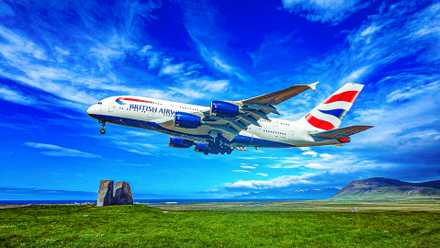
Largest Non-Emirates A380 Fleets In 2026: The Top Airlines And Routes
The superjumbo will see plenty of action in the first quarter of next year, even away from its top operator.
The Revenue Pyramid Hidden Inside Every Flight

One reason the A380 remains economically viable for Emirates is the extraordinary spread between fares across its four cabins. Although every passenger arrives at the same destination, they often pay radically different amounts for the journey. This creates a layered revenue pyramid that allows the airline to monetize the same flight multiple ways.
At the base sits economy class, where fares typically range from $700 to $1,000 on major long-haul routes. Premium economy occupies the next tier and generally sells for two to three times the price of a standard economy ticket. Above that sits business class, where fares frequently range between $3,000 and $6,000 round-trip. At the top of the pyramid is first class, where passengers can spend anywhere from $8,000 to more than $15,000 for a round-trip itinerary.
Simple Flying Quiz
Think you really know Emirates?
Answer 10 questions and put your knowledge to the test
Think you really know Emirates?
Answer 10 questions and put your knowledge to the test
Easy (15s)Medium (10s)Hard (5s)
The importance of this pricing structure becomes clear when examining revenue contribution. Industry estimates suggest that first and business class together account for roughly 45% to 50% of passenger revenue despite representing only around 15% of total seats. Put differently, a small minority of passengers generate nearly half of the money earned on many A380 flights. That imbalance explains why Emirates places so much emphasis on attracting premium travelers despite the aircraft’s enormous economy-class capacity.
Business Class Is The True Profit Engine

First class may attract headlines, but business class is arguably the most important cabin on the entire aircraft. Emirates’ A380 business-class cabins typically contain between 70 and 76 seats, creating a substantial pool of high-yield inventory that can be sold at several multiples of economy fares. The combination of relatively strong density and premium pricing makes business class exceptionally valuable.
Unlike first class, business seats do not consume excessive amounts of floor space. Emirates can fit dozens of lie-flat seats onto the upper deck while still preserving an attractive passenger experience. This allows the airline to collect fares that are often three to six times higher than economy without sacrificing as much seating capacity as it would with large private suites.
Business class also benefits from broader demand. Corporate travelers, affluent leisure passengers, airline upgrades, and loyalty-program redemptions all contribute to filling the cabin. Because the product appeals to a much larger audience than first class, Emirates can consistently generate high occupancy rates while maintaining premium pricing. In many respects, business class is the airline’s primary profit engine, generating a significant share of the premium revenue that makes the A380’s economics work.
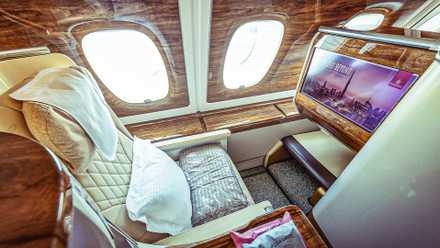
What Are The Benefits Of Flying Emirates Business Class?
The benefits extend beyond the cabin and begin well before boarding.
Why First Class Must Constantly Justify Its Existence

The economics of first class are significantly more demanding than they appear. Emirates’ enclosed suites, shower spas, and personalized service create one of the most recognizable premium products in commercial aviation, but luxury alone does not justify the cabin’s existence. The real question is whether first class generates more value than the alternative uses of the space it occupies.
A single  Emirates A380 first-class suite consumes roughly the same floor area as two to three business-class seats. That means the airline must earn substantially more revenue from each suite than it could earn from the business-class seats that might otherwise occupy the same space. In practical terms, first class often needs to achieve three to four times the yield per square foot that business class could generate to remain economically viable.
This requirement explains why Emirates focuses on first-class service on routes capable of supporting exceptionally high fares. Round-trip first-class tickets can exceed $15,000, while upgrades, partner redemptions, and loyalty-program bookings help fill remaining inventory. Beyond direct revenue, the cabin serves as a powerful marketing tool that reinforces Emirates’ premium brand image across the entire network. Ultimately, first class survives because the airline believes the combination of revenue generation and brand value outweighs the opportunity cost of the space it occupies.
Premium Economy May Be The Smartest Cabin On The Aircraft

While first class captures attention and business class drives much of the revenue, premium economy may represent the most efficient use of space anywhere on the A380. The product was introduced to target passengers seeking greater comfort than economy without the substantial expense of business class, creating a new revenue stream between the airline’s traditional cabin categories.
The numbers behind the cabin are particularly attractive. Premium economy generally sells for two to three times the price of a standard economy ticket while requiring only about 1.4 times the floor space. Few areas of the aircraft can match that balance between yield and density. Unlike business class, which requires large seats and extensive personal space, premium economy preserves much of the seat-count advantage of economy while generating significantly higher revenue per passenger.
These economics are a major reason Emirates has made premium economy a centerpiece of its fleet modernization strategy. The airline sees the cabin as an opportunity to capture incremental revenue from travelers willing to spend more but unwilling to purchase a business-class ticket. In a world where airlines constantly seek higher returns from finite cabin space, premium economy may be the most efficient square footage on the entire aircraft.
