
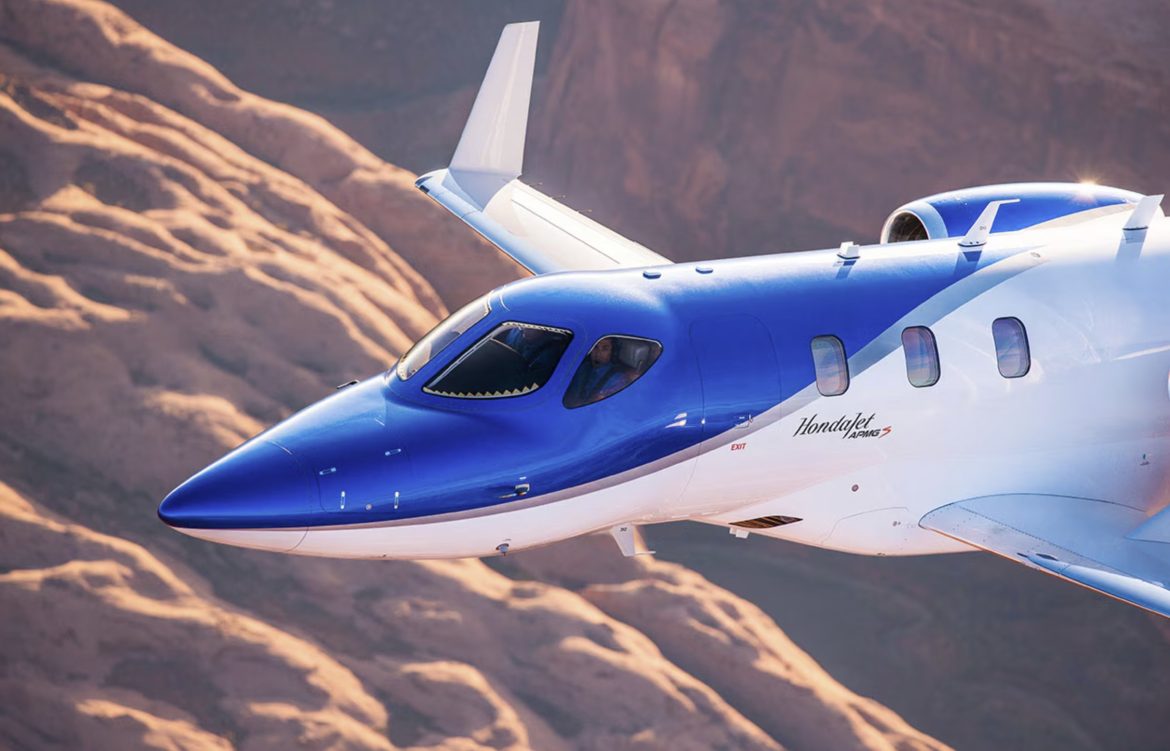
Without disguising its pride, American-based Honda Aircraft Company announced back in October that its HondaJet has become the first twin-turbine very light business jet to fly on 100 percent sustainable aviation fuels (SAF), meaning fuel made from renewable sources, including used cooking oils, waste materials, and captured carbon. And now comes another development that should make the plane’s operators happy.
The development targets specifically the HondaJet Classic, the original model that was in production from 2015 to 2018, and aims to give it some of the capabilities of the most recent and advanced iteration, the HondaJet Elite S.
Honda calls this effort the Advanced Performance Modification Group S (APMG S) program and manifests it as an upgrade package that should gift the planes with features and capabilities they didn’t originally have.
The package includes upgraded avionics software and hardware meant to give the plane’s operators access to faster processing speeds, but also the option to upgrade the jet even further, as soon as more advancements come to light.
The Advanced Steering Augmentation System (ASAS) deployed on the Elite S is also part of the deal, bringing along better handling precision and expanded crosswind capability. Topping everything off is a series of interior refurbishment options that have not been detailed.
The jet’s original maximum takeoff weight (MTOW) grows a bit as well, adding an extra 300 pounds (136 kg) over the capability of the standard plane. To go with that are new graphical weight and balance features, which should allow pilots to input loading and fuel data to estimate takeoff and landing weights in an easier fashion.

Photo: Honda
Honda says the APMG S package has been certified by the Federal Aviation Administration (FAA), and as such, it is clear for use on the planes registered in the United States – in fact, we’re told some planes have already been modified to the new specifications. When it comes to the jets usually flying abroad, certification will take a while longer.
The announcement of the upgrade package for the HondaJet Classic comes just as the aircraft maker is preparing to perform the first flight of a new version of the airplane. Called HondaJet Echelon, it was presented two years ago at the 2023 National Business Aviation Convention and Exhibition (NBAA-BACE) in Las Vegas.
The Echelon will be sold by Honda alongside the existing Elite II, and it too is a light business jet by trade. Ok, maybe not just a light business jet, but the most advanced of its kind yet, if we are to trust what the people making it say about it.
The plane will be powered by a pair of Williams International engines (unlike the Elite, which uses the HF120, a product of GE Honda Aero, a joint venture between Honda and General Electric), which will give the plane the ability to fly at speeds of up to 833 mph (1,340 kph, faster than the Elite) and to reach distances of over 3,000 miles (4,828 km).
That’s roughly the greatest distance between two mainland points in the U.S.: 2,892 miles (4,654 km) in a straight line from Point Arena, California, to West Quoddy Head, Maine. And this makes the Echelon the world’s only transcontinental single-pilot light jet.

Photo: Honda
It’s likely the plane’s engines will be tailored in such a way that they’ll be able to use SAF as well – although, to be fair, not many changes are needed for that. That’s because Honda has already announced plans to decarbonize its business activities by the middle of the century.
The plane maker will offer the Echelon in two configurations, one crew and ten passengers, or two crew and nine passengers. No matter what the configuration is, when it comes to performance levels, the jet will “outperform conventional light jets on typical missions by up to 20% and mid-sized jets by over 40%,” but we’re still a bit unclear of what Honda means by that.
From a pilot’s perspective, the Echelon will incorporate the most advanced of technologies, including automation systems and the Garmin G3000 avionics suite. In the passenger cabin, we’re promised “an experience typically reserved for larger aircraft.”
Honda has not yet flown the new jet, but it plans to do so as soon as next year. If that goes according to plan, type certification is expected two years after that, in 2028.
The arrival of the Echelon, and the fact that it should sell alongside the Elite, should really give Honda Aircraft Company a boost, even if that’s not necessarily required – last year alone, no less than 250 Hondajets were delivered worldwide.
For reference, the HondaJet Elite S that forms the basis of the APMG S upgrade package for the Classic presently sells for around $6 million. It’s too early to say how much Honda will ask for the Echelon, but chances are the price tag will not be too far off.
Editor’s note: Gallery also shows the HondaJet Echelon.
