
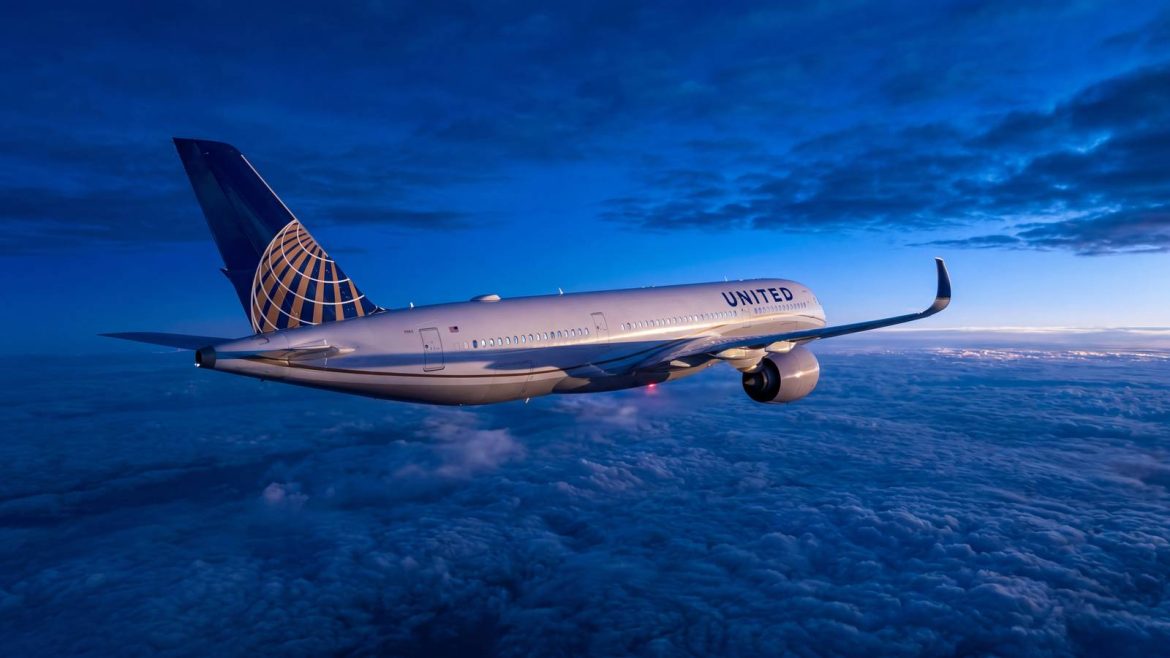
It was a good day for Airbus in 2009 when  United Airlines, under CEO Glen Tilton, announced a split order consisting of 25 Boeing 787-8s and 25 examples of the Airbus A350-900. Despite the split, it was a major win for Airbus, which had long been trying to build up market share in the US, with increasing success.
The A350-900 would have served to replace the carrier’s Boeing 747-400 fleet, and United had joined US Airways and Hawaiian Airlines as North America’s first A350 customers. Today, however, US Airways is no longer: it was merged into American Airlines, and the carrier canceled the A350 order. Meanwhile, Hawaiian Airlines switched to the A330neo and then to the 787.
The A350 has been subsequently ordered by Delta and Air Canada, while United Airlines still has the A350 order on the books, but does not appear to have any intention of actually taking them. 17 years after the carrier placed the order, it deferred the order multiple times, switched to the A350-1000 variant before going back to the A350-900. Most recently, it has removed any deliveries from internal planning.
Changes To The Airbus A350 Order

The original 2009 order was made when United was struggling and not only aiming to rid itself of aging, inefficient aircraft, but to shrink as well. In 2013, under CEO Jeff Smisek, United decided that the A350-900 was too small to replace the 747, and it instead switched to the A350-1000, while adding ten more orders. The first deliveries were pushed back from 2016 to 2018 due to the A350-1000’s later entry into service, but as it turned out, this became problematic.
The 747-400 fleet required an expensive fuel tank modification that was due at the end of 2017, and the fleet was also aging and unreliable. Boeing, meanwhile, offered United near-term delivery slots for the Boeing 777-300ER at an extremely attractive price, and so United ordered 14 examples to serve as the 747-400 replacement, later bumping its orders up to 22 units.
The 777-300ERs started arriving in 2016, and the 747-400 fleet was retired in 2017. The A350-1000 no longer served any purpose, leading United to change the order to 45 A350-900s for delivery in 2022. United Airlines would end up pushing back its delivery date to 2027, and then again to 2030, 21 years after the order was originally placed.
More recently, in February 2026, United removed all A350 deliveries from internal planning as published in its SEC-10K filing, essentially killing off the order. The order technically remains on the books, but it appears as though it’s the end of the line for United’s A350 order, and to top it all off, the carrier is now engaged in a legal dispute with Rolls-Royce regarding the engines.
The Battle Between United Airlines & Rolls-Royce

In the same SEC filing where United removed the delivery timeline for the A350s, the company also revealed that it was in a legal dispute with Rolls-Royce. It’s been suggested that United Airlines has discussed with Rolls-Royce on finalizing terms regarding the plane’s Trent XWB engines, which is where the disconnect began. The A350 and its engines are both excellent, but they’re also correspondingly expensive.
As the years have passed, United’s terms from 2009 have become extremely attractive. This may have prompted United to actually go through with the order. Rolls-Royce likely wasn’t willing to honor the original contract with the carrier, as the carrier has repeatedly pushed back an order from nearly two decades ago with no confirmed plans to take the planes.
Instead, the engine maker would have wanted to draft up a new contract that reflects its current, higher pricing for the Trent XWB. United Airlines wasn’t willing to proceed, instead requesting in December 2025 that Rolls-Royce refund a $175 million deposit that United had previously placed in 2017. Rolls-Royce refused to do so, stating that United was in breach of the contract.
|
United Airlines A350 Order Timeline |
Event |
|---|---|
|
2009 |
Order placed for 25 A350-900s, deliveries to commence in 2016 |
|
2013 |
Order changed to 35 A350-1000s, deliveries to commence in 2018 |
|
2017 |
Order changed to 45 A350-900s, deliveries to commence in 2022 |
|
2019 |
Order deferred to 2027 |
|
2022 |
Order deferred to 2030 |
|
2025 |
Requested a refund on Trent XWB deposits, denied |
It’s unclear what will come out of the ongoing court dispute, but what is certain is that after discussions with Rolls-Royce, United Airlines wanted its money back. The two parties may be able to come to a new agreement regarding engines, especially if the carrier decides to take another look at the A350-1000.
However, what’s more likely is that United wants out of the A350 agreement. This is especially likely given that the A350s were removed from long-term fleet planning, reflecting that the parties involved are simply waiting on the legal dispute being solved before formally canceling the order.
United Airlines Wouldn’t Be A Major Boeing 787 Operator If It Weren’t For This Airline
How the carrier became the biggest customer for the Boeing 787 Dreamliner, and why the 787 works so well.
Why United Airlines May Not Want The A350

United Airlines flies more long-haul and ultra-long-haul routes than its peers, which makes the A350 an ideal fit on paper. The Airbus A350-900 is more capable than the Boeing 787 while burning only slightly more fuel, and it’s also larger than the 787-9. The A350-900 is therefore ideally suited to serve as a replacement for the Boeing 777, of which United Airlines has 96 examples.
74 of these need to be replaced promptly, and 51 of them are used on long-haul operations. However, United has built a robust network using the 787 and has centered its fleet around the Dreamliner as well as the 777. Adding another fleet would be extremely costly from a parts and integration standpoint, especially because the A350’s Trent XWB engines have no commonality to anything else in United’s fleet.
|
Current Engine Models |
Future Engine Models |
|---|---|
|
CFM56 (737NG) |
CFM56 (737NG) |
|
CFM LEAP (737 MAX) |
CFM LEAP (A321neo/737 MAX) |
|
General Electric CF6 (767-400ER) |
General Electric GE90 (777-300ER) |
|
General Electric GE90 (777-200ER/300ER) |
General Electric GEnx (787-8/9/10) |
|
General Electric GEnx (787-8/9/10) |
Pratt & Whitney PW1000G (A321neo) |
|
IAE V2500 (A319/A320) |
Possibly Rolls-Royce Trent XWB (A350) |
|
Pratt & Whitney PW1000G (A321neo) |
|
|
Pratt & Whitney PW4000 (767-300ER/777-200/777-200ER) |
|
|
Rolls-Royce RB211 (757-200/300) |
Airlines are typically more willing to operate small fleets of different widebodies, as they tend to offer different capabilities, whereas an Airbus A320 is essentially the same as a Boeing 737, but United has been resistant to this. CEO Scott Kirby has repeatedly stated that, if United were to acquire the A350, it would need to buy close to 100 examples to allow the carrier to benefit from economies of scale.
United would need to maintain parts for the A350 at every hub, while also operating a separate pilot group. Running over 200 787s, an aircraft type that the carrier has operated for over a decade, is a far easier proposition, and the economics of adding around 100 A350s also become difficult when considering that the plane and its engines are generally fairly expensive.
United’s Future Fleet Trajectory

United’s removal of the A350 from internal planning doesn’t indicate that it’s abandoning the aircraft on its own. After all, the airline also removed the Boeing 737 MAX 10 from internal planning, and it was one of the variant’s first customers. However, given the circumstances, chances are lower than United will ever fly the A350 in its current iteration, especially because the A350 has proven remarkably popular.
This means that neither Airbus nor Rolls-Royce is eager to offer attractive terms to a long-time Boeing loyalist to win market share: in short, the two firms don’t need the United order. United’s fleet strategy has become all about the Boeing 787. The carrier ordered 100 787s with 100 options in 2022, and later exercised 50 of those options. The remaining options can easily substitute for the canceled A350 order.
As it stands, the current 787 orders are enough to fully replace United’s 767 fleet as well as its first-generation 777 fleet, with a significant amount of network growth as well. In addition, United has been heavily focused on upgauging throughout its network, and the 787-10 is therefore better suited to replace the 777-200ER as it’s larger than the A350-900.
United’s primary transpacific hub in San Francisco is also heavily constrained, and the carrier therefore deploys nearly its entire Boeing 777-300ER fleet out of this hub. However, it’s also been suggested that United may be looking to grow its fleet of large flagship widebodies, and with the A350 order seemingly on the chopping block, this leaves room for the Boeing 777-9.
United executives have previously stated that the plane is too expensive, but Boeing’s market position with the 777X is not as strong as Airbus’s with the A350, and United continues to be constrained in San Francisco as well as in Newark. A 777-9 order is hardly certain or even likely for United, but given United’s current position with the A350 and Boeing’s position with the 777X, now would be as good a time as ever for Boeing to make an attractive offer to United for some 777-9s.
Why In The World Does United Airlines Fly The Boeing 787-10 And Not The Airbus A350-1000?
United flies the 787 but not the A350 because the A350 order has not yet been fulfilled. Meanwhile, it inherited a Continental Airlines order.
Airbus & Rolls-Royce’s Positions Of Strength

For a carrier like United, which operates a large long-haul network with multiple routes on which the A350 would work well, the decision is almost entirely driven by pricing. The Airbus of old would have ensured that United was already flying its A350s, but Airbus is now the world’s largest aircraft manufacturer, focused much more on earning a profit from its aircraft sales rather than building market share.
In any case, the A350 has proven extraordinarily popular. Within North America, Airbus has already sold 79 A350s to Delta Air Lines as well as eight A350-1000s to Air Canada. Worldwide, Airbus has sold nearly 1,600 A350s and is generally selling the aircraft at high margins. In addition, the A350 has been well-received by its operators, meaning that Airbus is certain to receive future business from existing customers.
Regarding United, the manufacturer doesn’t need its A350 order, but United has also ordered over 200 Airbus A321neos, which is Airbus’s most profitable aircraft. The manufacturer would be more than happy to switch the A350 order for more A321neos, and this is the route that United is most likely to take.
