
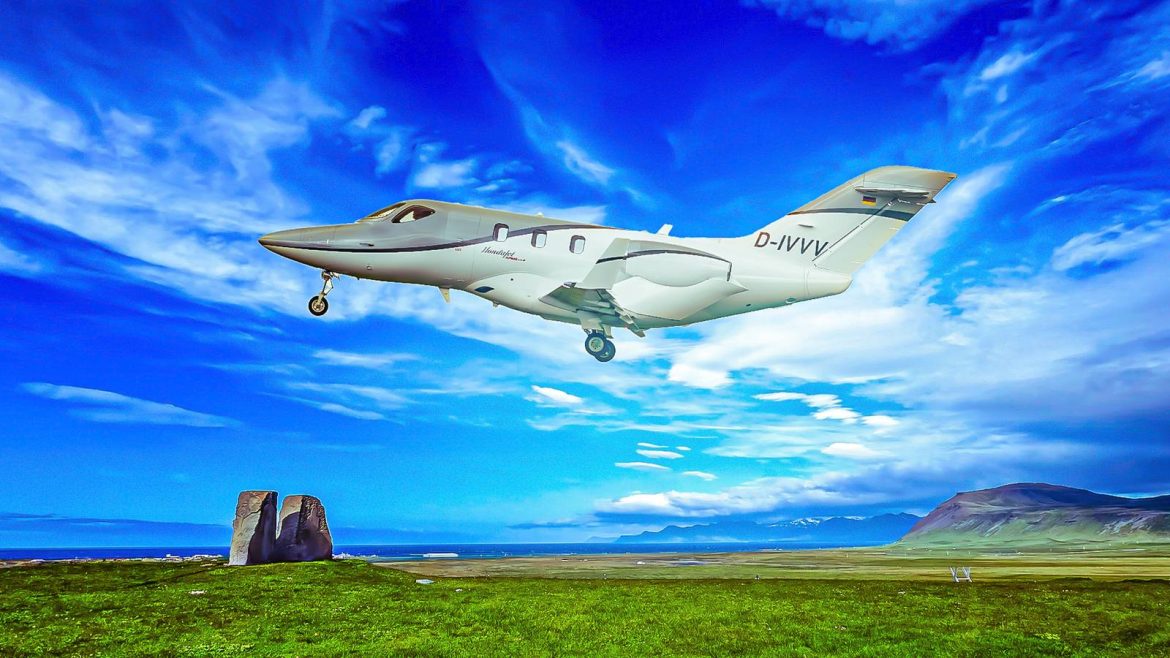
The HondaJet is a light business jet designed and produced by Honda Aircraft Company in the United States. Since the jet’s first delivery in December 2015, Honda has moved more than 250 jets out of its assembly line to worldwide customers.
The jet’s unique design, performance, and operational reliability have made it one of the most popular light jets on the market. Known in the private jet industry for its innovative over-the-wing engine design and custom exterior colors, the company is making its way to the top through various models. This article explores some unique design and performance characteristics that make HondaJet stand out from the competition.
The HA-420 HondaJet
Aircraft exterior dimensions
- Exterior Height: 14 ft 10 in
- Wing Span: 39 ft 8 in
- Length: 42 ft 7 in
- External Baggage: 66 cu ft
Aircraft interior dimensions
- Cabin Height: 4 ft 10 In
- Cabin Width: 5 ft
- Cabin Length: 17 ft 10 In
Aircraft capacity
- Crew: One or two
- Passengers: Five or six
The iconic HondaJet design has become popular among private aviation consumers thanks to its unique over-the-wing engine mount (OTWEM) configuration. On one fine night in 1997, Michimasa Fujino sketched this configuration on a piece of paper torn from a wall calendar. The design was approved internally, resulting in the creation of a large prototype aircraft to be tested for design feasibility and performance testing.

It was a brand-new concept in business aviation, offering a unique edge to HondaJet and its future line of light aircraft. According to HondaJet,
“In late 2003, an experimental HondaJet equipped with Honda HF118 engines successfully completed its initial flight test at the Piedmont-Triad International Airport in Greensboro, North Carolina. Subsequent tests confirm the performance and operational safety of the aircraft.”
The aircraft made its public debut in 2005 at the Experimental Aircraft Association (EAA) AirVenture in Oshkosh, Wisconsin. Receiving an overwhelming response from the aviation industry, the manufacturers formally established the company.
As the jet’s mass production was streamlined, it also entered the certification phase. The first aircraft built according to the Federal Aviation Administration (FAA) standards took flight in 2010, marking the beginning of the certification test campaign.
The most delivered aircraft in its class
Design characteristics
- Maximum Takeoff Weight (MTOW): 10,600 lbs
- Empty weight: 7,200 lbs
- Fuel capacity: 2,850 lbs
- Payload useful: 3,400 lb
- Max payload: 1,400 lb
HondaJet’s fuel economics and in-flight performance have made it one of the highest-selling light aircraft. The manufacturer has spent years researching and developing the jet and continues to make design and performance improvements in its upcoming variants. According to the Honda Aircraft Company,
“The HondaJet is a very light business jet with excellent fuel efficiency, high flight performance and a spacious cabin. Due to these and other features, The HondaJet became the most delivered aircraft in its category for the fifth consecutive year since 2017.”

Performance characteristics
- Normal operational range: 1,050 NM
- Maximum operational range: 1,225 NM
- Service ceiling: 43,000 ft
- Takeoff distance: 4,000 ft
- Balanced field length: 4,000 ft
- Landing distance: 3,000 ft
- Rate of climb: 3,990 fpm
- Max speed: 422 kts
- Normal cruise: 420 kts
- Economy (fuel-efficient) cruise: 368 kts
The jet is powered by two GE Honda HF120 engines, each producing 2,050 lbf (9.1 kN) thrust at takeoff. The engines offer technological innovations in design, materials, and efficient cooling of hot sections, enabling higher fuel efficiency. According to Honda Aircraft,
“We developed new aviation technologies to ensure our aircraft achieve higher fuel efficiency through better aerodynamic performance. Each HondaJet emits less CO2 without compromising performance. This combination of uncompromised efficiency at lower operating costs helps to extend the benefits of private aviation to a wider audience.”
Updates to the maintenance program
This year, the manufacturer implemented a number of upgrades to its HA-420 HondaJet Maintenance Program to enhance the aircraft’s dispatch reliability, operational efficiency, and in-flight performance. With the help of feedback from owners and operators, the manufacturer utilized time studies to improve the ownership experience, particularly in the maintenance department.
Known as Revision J of the Airworthiness Limitation and Inspection Manual (ALIM), the improved process reduces the maintenance labor hours required at the 600-hour maintenance interval, a key maintenance milestone for owners and operators. According to the Director of the Customer Service Division at Honda Aircraft Company, Luis Jimenez,
“The release of Revision J of the Airworthiness Limitation and Inspection Manual (ALIM) reflects our ongoing commitment to enhancing the customer experience for HondaJet owners and operators. Our dedicated team continues to develop improvements that enhance the maintainability, reliability, and capabilities of the HondaJet.”
