
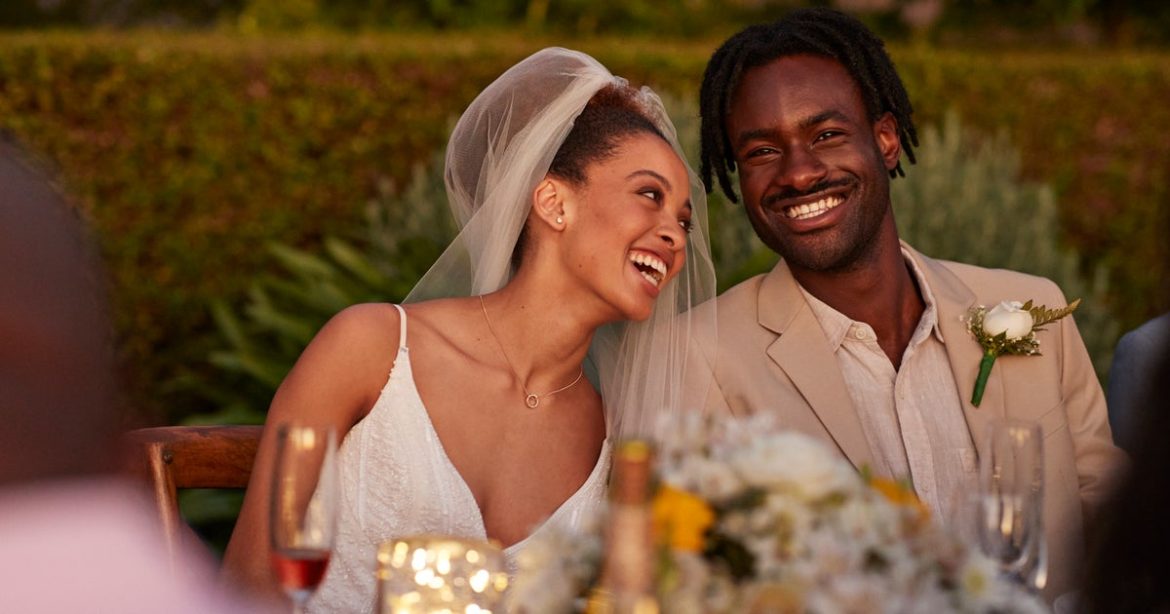
Weddings have long been steeped in tradition, but today’s couples are increasingly rewriting the script. Rather than following a rigid set of rules, many are prioritizing what feels meaningful and true to their relationship.
“While tradition continues to hold a beautiful place in weddings, today’s celebrations are far more personalized,” said Jackie Vernon-Thompson, the founder of From the Inside-Out School of Etiquette. “Couples are thoughtfully curating experiences that reflect their values, preferences and unique journey. And that is entirely appropriate and acceptable.”
The goal is a memorable experience where the couple feels genuinely honored and celebrated.
Of course, that doesn’t mean we throw all traditional etiquette out the window, but there are certain nuptial formalities and practices that are no longer requirements. Below, experts break down 12 outdated wedding etiquette rules they believe we can leave behind.
You can’t wear black to a wedding.
People clad in black were typically in deep mourning and should not be attending a festive occasion, she explained.
“Therefore, someone wearing black was considered to be making a critical commentary of the couple,” Smith said. “Nowadays, black is considered to be very chic, especially for formal events.”
The bride’s family pays for everything.
“The idea that the bride’s family pays for everything is definitely tied to a specific historical arrangement that (hopefully) no longer exists,” said Nick Leighton, an etiquette expert and host of the “Were You Raised by Wolves?” podcast. “Today, who pays depends on who has money, who wants to contribute and what the couple can afford.”
Nowadays, many couples pay for the majority or even entirety of their wedding events. And family on both sides may contribute some amount based on their budgets ― reflecting a more balanced and thoughtful approach.
“One of the most outdated wedding expectations is the belief that the bride’s parents are responsible for funding the entire celebration,” Vernon-Thompson said. “That tradition has largely evolved, particularly as weddings today have become far more elaborate and financially significant. As a result, placing the full financial responsibility on the bride’s parents is no longer considered appropriate or considerate.”
You should bring a gift to the wedding.
With the rise of online registries and easy delivery right to the couple’s door, the concept of bringing a wrapped gift to a wedding is no longer the expectation.
“While still practiced in some circles where gift attendants are there to watch the table, most couples prefer the gifts be sent in advance,” Smith said. “This has the added benefit of avoiding items being lost, stolen or broken at the wedding or in transit from the wedding to the couple’s home.”
Second weddings should be quiet and small, and the bride can’t wear white.
The type of marital celebration you throw is between you and your partner ― not subject to societal expectations and judgment around previous relationships.
“A wedding is a wedding, so if you want it big, have at it,” Leighton said. “If you want to wear white? No problem. All those rules that used to govern second weddings were built on outdated assumptions about divorce and widowhood. Hopefully we’ve all moved past that!”

Klaus Vedfelt via Getty Images
Requesting a monetary gift is rude.
Vernon-Thompson identified another new approach that reflects the evolving needs of couples today.
“The idea that monetary gifts should not be requested has shifted considerably,” she said. “In modern times, many couples, particularly those who are building their lives, welcome financial contributions. It is now widely accepted to provide guidance through registries, honeymoon funds, or even contributions toward meaningful goals such as a home or future investments.”
Bridesmaids must sport matching dresses.
“Today’s wedding party has fewer traditional rules, and the strict expectation that a bride’s attendants all match has given way to many bridesmaids having the freedom to select a dress that, for example, is not identical but is in the same color family or style as the rest,” said Thomas Farley, aka Mister Manners.
Matching gowns are no longer the expectation, and it’s totally OK for wedding party members to wear different looks (assuming the couple has approved).
“Bridesmaids do not have to be in matching outfits,” Leighton said. “Nor do they need to come in equal pairs to the groomsmen. Nor is a wedding party required at all.”
Wedding parties should be divided by gender.
Even in heterosexual weddings, members of the bridal party and the groom’s party do not have to be divided based on gender.
“Gone are the strict rules that the bride’s attendants all be women and the groom’s all be men,” Farley said. “Today’s bride can ask a male friend or friends to be among her attendants if she so chooses, and a groom may do the same with his female friends.”
Every guest should get a plus-one.
“Another outdated expectation is assuming every guest must receive a plus-one on the invitation,” Vernon-Thompson said. “Current etiquette allows couples to be more intentional. Invitations are often extended based on established relationships, and there is no obligation to include a guest’s casual companion.”
The idea is creating a thoughtful guest list that is aligned with the couple’s capacity and vision.
“It also ensures that the guests are those whom the couples wish to celebrate their priceless moments with,” Vernon-Thompson said.
Use formal names and titles on invitations.
Farley pointed to the tradition of addressing the wedding invitation envelope to husband and wife guests with “Mr. and Mrs. Husband’s First Name + Couple’s Last Name’ ― e.g., Mr. And Mrs. James Schuster.”
“Although this is still common practice and regularly used as a format for wedding invitations in particular, ghosting the woman’s name entirely is increasingly giving way to ‘First Name and First Name Last Name,’ with no set preference on which name appears first ― e.g., Jane and James Schuster or James and Jane Schuster,” he said.
Only certain people can host the bridal shower.
Traditionally, a bridal shower would not be hosted by the mother of the bride to avoid the appearance of soliciting gifts. But modern etiquette is much more flexible.
Etiquette expert Mariah Grumet Humbert noted that the maid of honor and bridal party do not have to be the ones hosting the bridal shower.
“While this differs geographically and culturally, anyone can host a shower for the bride or couple,” Humbert said.
And yes, a shower doesn’t have to just be for the bride or be women-only events. Couples showers are increasingly popular.
The bouquet toss is mandatory.
“While it’s still perfectly fine to toss the bouquet, it is not necessary to toss your foliage, nor to get in the line to catch it if you would prefer not to,” Gottsman said. “It’s a matter of preference.”
The same goes for other traditions like the garter toss, receiving line or big cake-cutting moment.
Wedding dresses must be white.
“Wedding dresses don’t have to be white,” Leighton said. “This is actually a relatively modern tradition. Before Queen Victoria made white popular, wedding dresses came in all sorts of colors.”
So brides should feel free to wear any color they’d like. Ultimately, weddings are about celebrating a special union with friends and family and sharing in the love and joy.
As Leighton noted, “In the end, etiquette evolves, but good manners are timeless.”
