
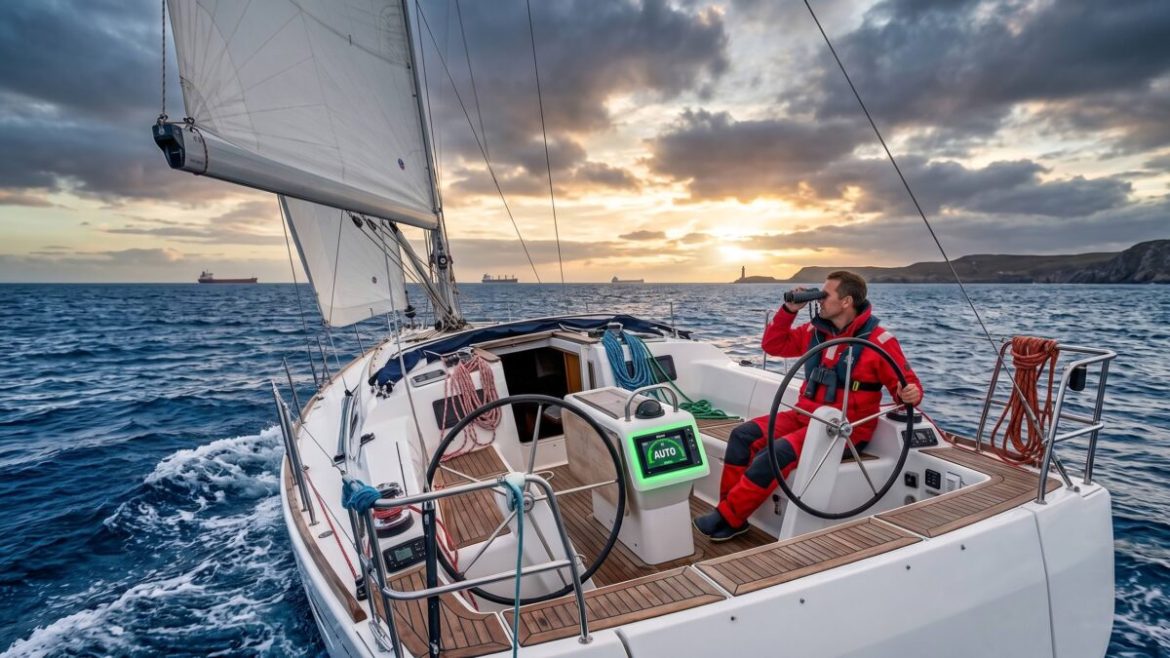
Time and again there are reports of accidents involving yachts where the autopilot was switched on. This raises the question: under what conditions may a sailing yacht be sailed “in autopilot mode” – and is the skipper allowed to go below deck for this, for example, to relieve himself?
Autopilots on sailing yachts are a wonderful thing. The technical steering system keeps the yacht automatically on a preset course, without a person having to be at the helm at all times. At its core, the autopilot takes over the task otherwise performed by the helmsman: it continuously corrects the rudder angle to compensate for deviations from the set course – caused, for example, by wind pressure in the sails, waves, or current.
A modern sailing yacht autopilot typically consists of a steering computer (course computer), sensors (e.g. compass, gyroscope, sometimes wind or GPS data), a drive unit (electric linear drive, hydraulics, or wheel pilot), and a control unit used to set the course and make fine adjustments. The autopilot continuously measures the boat’s current heading and compares it with the set target value. In the event of deviations, it automatically adjusts the rudder.
An autopilot has become almost indispensable on modern cruising yachts today. The advantages of the system are obvious: it enables comfortable single-handed sailing, setting and taking down sails without additional crew (since the course “against the wind” is reliably maintained), and finally, it makes longer watches less exhausting.
Autopilots make sailing easier – but who is liable in the event of a collision?
But how should the situation be assessed if a collision occurs while the autopilot is switched on? Who is responsible, and who is liable for damages? Generally speaking: the use of an autopilot is fundamentally permitted. However, there is a crucial “but”: the autopilot never relieves you of your watchkeeping and duty-of-care obligations. Ultimately, the decisive question is not “autopilot yes or no”, but whether a proper lookout and the ability to intervene immediately are ensured at all times.
Every skipper who uses an autopilot should know COLREG Rule 5 – a central standard when it comes to the use of self-steering systems on board. Rule 5 of the International Regulations for Preventing Collisions at Sea, internationally known as the Convention on the International Regulations for Preventing Collisions at Sea (COLREGs), states in its (simplified) wording:
“Every vessel shall at all times maintain a proper lookout by sight and hearing as well as by all available means appropriate in the prevailing circumstances and conditions so as to make a full appraisal of the situation and of the risk of collision.”
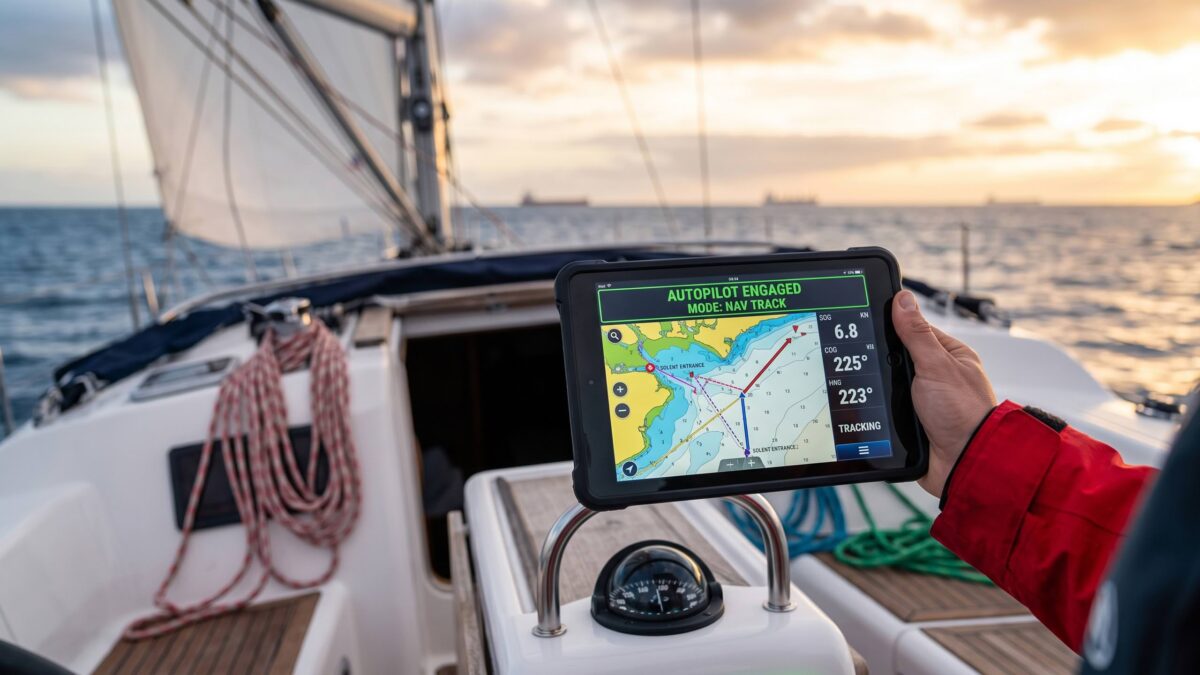
COLREG Rule 5 is one of the most important rules in maritime law – the obligation to maintain a constant, attentive lookout
Its significance in practice is immense; COLREG Rule 5 is one of the most important and most frequently cited rules in maritime law. It obliges every vessel – whether sailing yacht, cargo ship, or motorboat – to maintain a constant, attentive lookout.
Specifically, this means: visual observation (all-round view, binoculars), acoustic perception (engine noise, fog signals), technical means where available (radar, AIS, plotter), situational assessment: recognizing in good time whether there is a risk of collision.
One of the most important consequences: an autopilot does not relieve you of the lookout duty. Even at night, in fog, or when sailing alone, the obligation applies without restriction. “I didn’t see the other vessel” is generally not a valid legal defense. Courts often assess violations of COLREG Rule 5 as a contributing cause in collisions.
Below are 5 concrete situations / case examples relating to the use of autopilots:
1 – You are sailing alone at night under autopilot, and go below deck for 10–15 minutes to check something on the chart plotter
Assessment: Problematic to a clear violation of COLREG Rule 5. Reasoning: an autopilot does not replace a lookout. “At all times” really does mean at all times. Being below deck without visual or auditory contact means: no proper lookout.
Significance for command of the vessel: Single-handed sailing is permitted, but the skipper must organizationally ensure that the lookout is maintained. In practice, this means: the skipper may, if at all, only go below deck very briefly, the companionway must remain open, and a regular 360° check must be possible; AIS / radar may only be used here as a supplement – never as a replacement.
2 – The autopilot is switched on, and at night you rely exclusively on AIS targets on the plotter
Assessment: Violation of COLREG Rule 5.
Reasoning: “all available means” means in addition to, not instead of (as already seen in the first example). This is because not every vessel is equipped with AIS – small fishing boats, wooden boats, and unlit vessels in particular can often be “invisible” on AIS.
Significance: technical means supplement, but do not replace, sight and hearing.
3 – During the day at sea, good visibility, 5 nm distance from all vessels, entire crew below deck, autopilot on
Assessment: legally risky.
Reasoning: even in good visibility, an effective lookout must be maintained, since the situation can change at any time. In practice, brief absences are tolerated, but if an accident occurs, contributory fault is a real risk.
4 – Autopilot on, helmsman wearing noise-cancelling headphones.
Assessment: clear violation.
Reasoning: COLREG Rule 5 explicitly requires “hearing” as well; acoustic signals (fog, warning calls) must be perceivable at all times. Courts regularly assess impaired hearing as negligence.
5 – The classic: collision – “I didn’t see him”
In marine accident investigations, when the autopilot was switched on, it is almost always examined: was an effective lookout assigned? Were there perhaps blind spots? Was someone distracted? Was radar / AIS used? The result is often: contributory cause due to a violation of COLREG Rule 5. In general: the autopilot steers – the human commands. Technology assists – it does not replace.
Important to know: COLREG Rule 5 applies internationally, since the regulations are based on the “Convention on the International Regulations for Preventing Collisions at Sea (COLREGs 1972). This convention was adopted by the International Maritime Organization (IMO) and ratified by a great many states. It therefore applies worldwide on the high seas as well as in the coastal waters of all contracting states; furthermore, national regulations may only supplement the COLREGs, not replace them.
Does COLREG Rule 5 also apply in Croatia?
COLREG Rule 5 therefore also applies in Croatia, since Croatia is a contracting state to the COLREGs – meaning Rule 5 (lookout duty) also applies in Croatian coastal waters, in the Adriatic, and in adjacent international waters. There are no differences regarding COLREG Rule 5 between, for example, Germany and Croatia; only the level of fines, the intensity of enforcement, and national supplementary regulations (e.g. distance from swimmers, speed limits in harbors, etc.) may differ.
Practical consequence for the original scenario (skipper briefly going below deck to use the toilet): this would only be defensible or legally “clean” if another suitable person keeps lookout on deck and is able to steer immediately or switch off the autopilot if necessary.
In general, the rule here is: “alone on board, autopilot running, I’m going below deck” is regularly incompatible with Rule 5 (lookout) in busy waters. When sailing the open sea, where there is hardly any traffic, the risk may be reduced if the skipper only “disappears” below deck very briefly and the relevant alarms etc. are activated – but even here, the “at all times” obligation remains in place.
Example: the collision between a sailing yacht under autopilot and a dredger
A real accident example illustrates precisely this problem: in June 2014, there was a collision between the sailing yacht Orca and the dredger Shoreway in the Solent off the south coast of England, a busy area with narrow channels. The accident was subsequently investigated by the British Marine Accident Investigation Branch (MAIB).
Those involved were the Orca, a sailing yacht with several people on board, underway under sail, and the Shoreway, a large hopper dredger working in the area of the channel with restricted maneuverability. The Orca was sailing within the marked channel of the Solent.
Despite the clearly visible size of the dredger and its navigation lights / signals, a collision occurred: the sailing yacht ran into the bow / forward area of the Shoreway. The yacht suffered considerable material damage; according to the report, no one was killed, but the situation was assessed as “potentially life-threatening”.
Cause of the collision: sailing under autopilot and inadequate lookout
The main causes (according to the MAIB analysis) were, firstly, an inadequate lookout on the sailing yacht; the yacht had at times been steered under autopilot, and the lookout had not been consistently effective. This meant that the approaching danger was not assessed in time and not by all available means, and a clear connection to COLREG Rule 5 was established.
Decisive for the MAIB’s assessment were the Convention on the International Regulations for Preventing Collisions at Sea (COLREGs), in particular Rule 5 (lookout) – constant, proper lookout, Rule 6 (safe speed), Rule 8 (action to avoid collision), Rule 18 – special responsibility toward vessels restricted in their ability to maneuver, and Rule 9 – conduct in narrow channels.
Key findings of the MAIB:
- an autopilot does not replace a lookout
- small vessels must take into account the restrictions of large working vessels
- in busy waters, an early, clear course change is often the safest solution
- technical aids (AIS / radar) supplement, but do not replace, visual and acoustic observation.
Rules of thumb for recreational skippers: “How do I use the autopilot in a legally sound way?”:
- the lookout must actually take place (eyes / ears on deck; not “AIS alarm replaces lookout”; this also applies, for example, to collision-avoidance assistants such as radar or Watchit Eye – see our news on this)
- in areas with traffic / narrow passages / harbors / channels / at night / in fog: autopilot only if watchkeeping / steering capability is guaranteed immediately
- alone on board: going below deck while the boat is underway is particularly risky from a legal / risk perspective (lookout!)
- observe special areas: e.g. the Kiel Canal (NOK): autopilot / self-steering systems are prohibited for recreational craft.
