
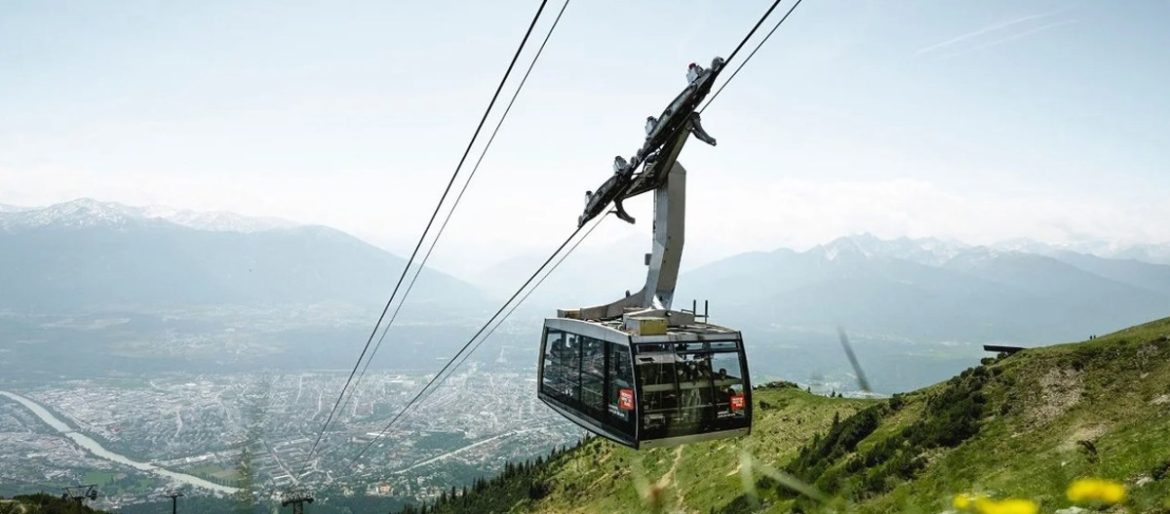
Austria is the much-celebrated land of mountains. The Austrian national anthem embodies this in its opening words, describing the landscape that so characteristically shapes the country. The mountains are not only part of Austrian identity, but also a living, economic, and recreational space for generations of people. They have connected regions, overcome challenges, and simultaneously fostered pioneering technological achievements.
One of the most significant answers to the question of how to access these Alpine regions is the cable car. It is a mode of transport deeply intertwined with Austria and has had a profound and lasting impact on the development of tourism, mobility, and regional economic activity. It has also played a part in film history and helped many people experience a change of perspective and enjoy unobstructed views of the Alps. Today, we celebrate the 100th anniversary of cable cars in Austria. A perfect opportunity to look back on an extraordinary success story – and also to look ahead to the future.
The history of cable cars impressively demonstrates how rapidly technology can develop: from the first funicular and aerial tramways to today’s digitally controlled systems, it spans a century of innovation, encompassing the use of artificial intelligence and sustainable energy technologies. Within just one century, a visionary idea has evolved into a state-of-the-art, sustainable transportation system.
The cradle of alpine mobility
The 100th anniversary we are celebrating today is thanks to the first cable car to the Rax mountain. Contrary to popular belief that the first passenger cable cars originated in the western Alps, the cradle of Austrian cable car history lies in Lower Austria. The opening of the Rax cable car in Hirschwang on June 9, 1926, marked the beginning of a new era in alpine mobility.
As Austria’s first passenger cable car, the Rax cable car represented a pioneering feat of engineering. Building on experience gained from constructing material ropeways, the engineers succeeded in creating a safe and efficient transport system that fundamentally changed the way high alpine regions were accessed. The cable car made the Rax plateau quickly and comfortably accessible to a broad segment of the population for the first time, thus becoming a model for numerous other projects throughout the country.
“When the railway was opened in 1926, it was a visionary project and an extraordinary feat of engineering. Today it is far more than a connection to a popular summit plateau – it is a symbol of the successful development of the Alpine region,” said Mobility Minister Peter Hanke.
The significance of the Rax cable car extends far beyond its technical benefits. It symbolizes the dawn of an era in which innovative transportation solutions opened up new economic and social opportunities. Today, the Rax cable car is considered a major monument to Austrian engineering history. Its 100th anniversary commemorates not only an outstanding feat of engineering but also the beginning of a development that has made Austria one of the world’s leading cable car nations.
Vertical public transport
In Austria, cable cars are treated as railways for legal, safety, and historical reasons. They are subject to the 1957 Railway Act and specific cable car regulations, as they are considered track-guided means of transport.
Today, visitors to Austria have access to 2,536 cable car systems – 1,116 public cable cars and 1,420 ski lifts. These transport around 600 million passengers annually and thus, in a small area, fulfill a similar function to local public transport.
Due to stringent safety standards, cable cars are among the safest forms of mass transit worldwide. The few tragic accidents that do occur therefore receive particularly high media attention. However, they are extremely rare compared to the total number of journeys. The Federal Ministry of the Interior, Mobility, Innovation and Technology (BMIMI) is committed to maintaining these high quality and safety standards, not only at the European level but also within numerous national and international cable car associations.
Throughout this long success story, cable cars have opened up regions, connected living spaces, and created economic opportunities. Austria, in particular, demonstrates how formerly structurally weak mountain areas have been able to develop into thriving tourist regions. New employment opportunities have emerged, emigration has been curbed, and entire valleys have been sustainably strengthened.
Today, the focus in Austria is primarily on modernizing and replacing existing facilities. Modern cable car systems make a significant contribution to inclusive mobility. Even with limited mobility, access to nature experiences in Austria is now much easier, both in winter and summer. This quality feature is being emphasized by the Federal Ministry for the Environment, Nature Conservation, Nuclear Safety and Consumer Protection (BMIMI) in public transport in general and in future cable car projects – both alpine and urban.
Renewables on the mountain
Looking ahead, the pace of innovation remains unbroken. Digital control and monitoring systems enable highly precise, safe, and efficient operation. Sensors, real-time data analysis, and predictive maintenance concepts help to continuously improve system availability and operational safety. Artificial intelligence applications are also increasingly being used, for example, in the analysis of operational data, the optimization of maintenance intervals, and the management of passenger flows. This makes cable cars not only more efficient but also more economical and resource-friendly.
Cable car operators are increasingly relying on sustainable solutions in the area of energy supply. Many already use electricity from renewable energy sources such as hydropower, wind power, or solar energy. Furthermore, station buildings are increasingly being equipped with photovoltaic systems to generate a portion of their energy needs on-site. Due to their comparatively small footprint, low operational emissions, and high transport capacity, cable cars are considered a particularly environmentally friendly mode of transport. They thus make a significant contribution to climate goals and to sustainable mobility and tourism development.
A recent amendment to the cable car regulations issued by the Federal Ministry of the Interior, Building and Community (BMIMI) and a deregulation package from the Federal Government have facilitated the installation of photovoltaic (PV) systems on cable cars, making it easier to construct cable car infrastructure without complex permitting processes. This will significantly simplify the process for operators to adopt renewable energy and future-proof their systems. The focus here, too, will be on utilizing existing infrastructure areas – such as valley and mountain stations or technical facilities – meaning buildings and already sealed surfaces.
One hundred years of cable cars are therefore far more than just a cause for celebration. They are a strong signal for progress, innovation, and the future of mobility in the land of mountains.
Historical cable car data
-
1892 first funicular railway to Hohensalzburg Fortress
-
1926 first cable car to the Rax
-
1936 first ski lift in Ebensee
-
1947 first chairlift in Wildschönau
-
1972 first triple chairlift in Zürs
-
1972 first single-cable gondola lift with four-seater cabins in Mellau
-
1976 first detachable chairlift in Neukirchen/Großvenediger
-
1981 first single-cable gondola lift with six-seater cabins in Gaschurn
-
1987 first chairlift with conveyor belt entry
-
1989 first group gondola lift in Saalbach
-
1996 first double single-cable gondola lift in Hintertux
-
2004: first three-cable gondola lift in Kitzbühel
-
2005 first combined railway in Abtenau
