
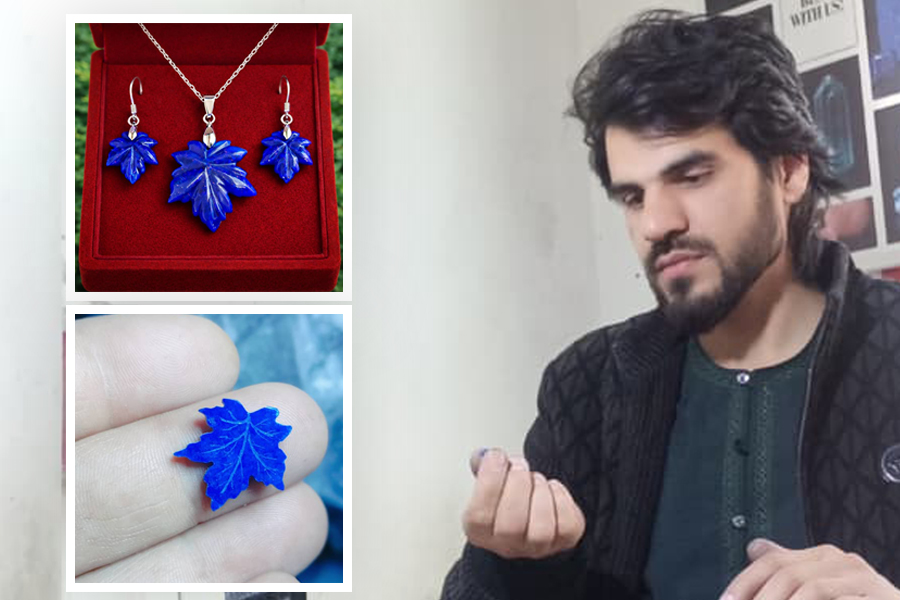
Ahmad Qais Jamali, a Kabuli jeweler, drawing on his family heritage and a childhood passion for jewelry making, produces handmade jewelry using Afghanistan’s precious and semi-precious stones in his small workshop in Kabul. According to him, despite economic constraints, lack of facilities, and market difficulties, this craft continues to endure between tradition and creativity and still has the potential to enter regional and global markets. Designs such as the map of Afghanistan, grape clusters, leaves, and square and triangular patterns are among the motifs he has worked on during this period.
Mr. Jamali says, “I inherited the jewelry-making profession from my father. I started in childhood, when I was about seven years old, from 2002 to 2003. At first, I had no particular motivation, but now this work has turned into my passion and interest.” In his view, the connection with precious stones and jewelry making has become a deep love in his life. He believes that if there is passion in one’s work, an artist can preserve creativity in any condition.
This Kabuli jeweler says that due to the country’s economic situation, he tries to use stones that are accessible to ordinary people. He adds, “The economic situation is not suitable, and people’s financial capacity does not allow us to produce very beautiful and expensive products. Therefore, our production is adjusted according to people’s economic ability.”
Mr. Jamali, speaking about the stones he uses in his jewelry, says: “At present, I mostly use lapis lazuli, because it is a semi-precious stone and is compatible with people’s economic capacity. In addition, I use precious stones such as emerald, ruby, lal-e piyazi, peridot, and kunzite less frequently, all of which are Afghan stones sourced from various provinces of the country.”
The jeweler emphasizes that although he receives orders from outside the country, due to existing restrictions and challenges, he is unable to send them directly. At present, his customers are mostly inside Afghanistan, especially in Kabul and various provinces. However, he believes that if conditions improve, Afghanistan’s jewelry and handmade accessory industry has the capacity to enter regional and global markets.
In his workshop, all stages are carried out by hand. He says that making a simple jewelry set, including earrings, a ring, and a lapis lazuli necklace, takes about three to four hours, and precision at every stage, especially in shaping the stone, is of particular importance.
The young jeweler also considers the lack of domestic production tools and equipment one of the major challenges of this industry. According to him, most equipment is imported from neighboring countries, and trade restrictions and political fluctuations have made access to these tools difficult. He adds: “In the industrial sector, tools and equipment are not produced inside Afghanistan and are mostly supplied from neighboring and regional countries. Recently, due to tensions, access to these tools has become limited, and prices have also increased several times.”
Mr. Jamali also has apprentices working with him in his workshop. He says, “I currently have three apprentices who have been training under my supervision for some time.” In the view of this Kabuli jeweler, the biggest challenges of this profession are the lack of facilities, proper tools, and a sales market. Nevertheless, he remains hopeful that this craft will survive and expand.
He says, “If there is more support and facilities, we can develop a more advanced workshop, train more young people, and produce new designs.”
Despite all limitations, he sees a bright future for the jewelry and gemstone industry in Afghanistan and believes that the country, with its rich natural resources of precious stones, has strong potential in this field.
The jewelry-making and goldsmithing industry in Afghanistan is considered one of the traditional and ancient crafts that, alongside its cultural value, plays an important role in generating income for a number of families. Afghanistan is particularly known for its precious and semi-precious stones such as lapis lazuli, emerald, and ruby, much of which is extracted from various provinces of the country.
Currently, six indigenous artistic styles of jewelry making, including Turkmen, Hazara, Ghazni filigree, Herati, Kabuli, and Kochi goldsmithing, are practiced in Afghanistan and are sold in domestic and international markets.
You can read the Persian version of this report here:
از کارگاه کوچک کابل تا رویای بازارهای جهانی؛ داستان زرگری که با سنگهای افغانستان زیور میسازد
