
The debut of the Airbus A350-1000 first class experience concept at the Aircraft Interiors Expo (AIX) 2026 in Hamburg has likely set a new benchmark for commercial aviation luxury. At the center of this reveal is a 1-1-1 layout that introduces the first-ever master suite specifically designed for two passengers on a twin-engine widebody. This article explores how Airbus has re-engineered the forward fuselage of its flagship aircraft to accommodate features usually reserved for private jets, such as full-size double beds and private lavatories.
First class cabins have been shrinking in favor of ultra-premium business class suites, but the master suite represents a move back toward extreme exclusivity. By moving traditional cabin monuments, the non-revenue-generating structures like lavatories and crew rests, Airbus has liberated critical floor space. This evolution represents a total redesign of the passenger flow and cabin volume that will define the next decade of long-haul travel.
Bringing Biz Jet Luxury To Airlines

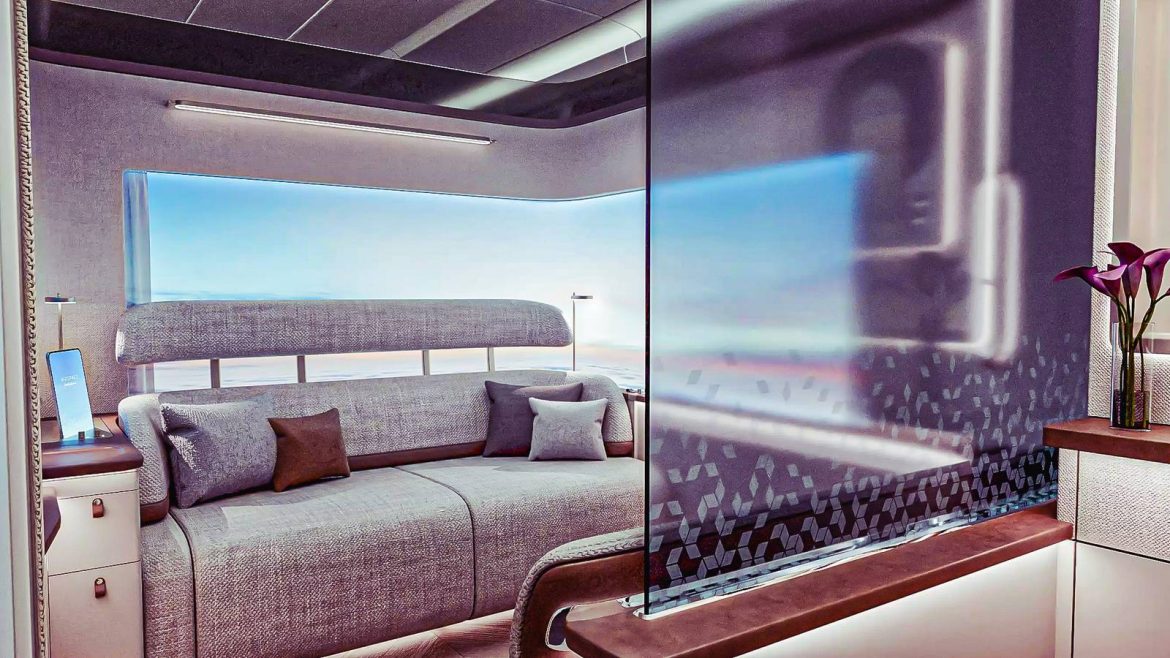
The centerpiece of the new Airbus configuration is the master suite, a sprawling living area positioned in the center of the 1-1-1 cabin. Unlike previous attempts at double beds that required lowering a partition between two separate seats, this is a purpose-built environment for two travelers to share. It features a permanent double bed that does not require the cabin crew to make the bed by joining two individual units.
The suite includes a dedicated dressing area and a private bar, allowing passengers to remain entirely within their own cocoon throughout the flight. The inclusion of a private lavatory located inside the suite perimeter, similar to the famous  Etihad Airways’ Residence on the A380, removes the need for passengers to enter the public aisle. This level of self-contained luxury is designed to capture the top 1% of travelers who are currently migrating toward private charter services for their intercontinental needs.
The suite’s footprint is roughly four times that of a standard business class pod, yet it maintains a sense of airiness by removing overhead bins in the center section. Airbus has utilized the vertical height of the A350 fuselage to its maximum potential, incorporating sculpted ceiling panels that add nearly six inches (15 cm) of perceived headroom. The result is a cabin that is radically different from any previous offering in a commercial sense, setting a new psychological standard for narrow-fuselage comfort that aligns more closely to that of private aircraft.
A Cabin Move Around

To make the master suite a reality, Airbus engineers had to solve the puzzle of where to place the essential cabin monuments that usually occupy the aircraft’s front. Their solution is the center module, a consolidated structure located immediately behind door one, directly opposite the cockpit entrance. Moving the lavatories, storage closets, and the staircase for the forward crew rest compartment (FCRC) into a single, high-density block freed up hundreds of square inches of revenue-generating floor space. This relocation allows a 1-1-1 layout without drastically reducing the aircraft’s total seat count.
This consolidated module also serves a dual purpose, acting as a physical barrier between the flight deck and the passenger cabin and significantly reducing noise and light pollution. In traditional layouts, crew movements to and from the rest area or the cockpit can be a major source of disturbance for first class passengers. By tucking the access stairs into the center module, Airbus has virtually eliminated crew traffic in the aisle adjacent to the suites.
|
Monument Type |
Traditional Location |
New Center Module Location |
Space Efficiency Gain |
|
Lavatories |
Distributed near door one |
Consolidated behind door one |
~15% more floor space |
|
Crew Rest Stairs |
In-aisle or galley-adjacent |
Integrated into center module |
Reduced aisle width loss |
|
Stowage |
Overhead and bulkhead bins |
Centralized storage units |
100% bin removal (Center) |
|
First Class Layout |
1-2-1 (4 across) |
1-1-1 (3 across) |
25% more suite width |
The implementation of the center module also allows for a redesigned welcome area at door one. Instead of walking directly into a galley full of trolleys and steam ovens, passengers are greeted by a clean, architectural space featuring an integrated welcome lighting panel and high-end finishes. This first impression is crucial for establishing the master suite experience before the passenger even reaches their seat. It transforms the boarding process from a functional necessity into a choreographed entry into a luxury environment.
Delta’s New “Suite Spot”: A350-1000 Debut Signals Premium Power Play
Delta’s A350-1000 launch signals a broader push to standardize and elevate premium flying.
What To Do Without A Window

The most significant technological hurdle for the master suite was its central position, which traditionally leaves passengers without a view of the outside world. Airbus has countered this middle-seat disadvantage by installing virtual panoramic windows, high-resolution 4K OLED screens that display a real-time, ultra-low-latency feed from external cameras. These screens are framed to look exactly like standard aircraft windows, complete with motorized blinds and depth-sensing glass that mimics the parallax effect of looking through actual panes of acrylic. This ensures that center-suite passengers never feel trapped or disconnected from their flight path.
This sensory approach extends beyond the visual to include a sophisticated lighting system designed to combat jet lag through circadian rhythm programming. The suite’s lighting can transition through thousands of hues, from a golden hour warm glow for dining to a deep indigo spectrum that stimulates melatonin production for sleep. Unlike standard cabin lighting, the master suite’s system is entirely independent, allowing each passenger to set their own timezone environment without affecting the rest of the cabin. This level of granular control is a key differentiator in the battle for premium passenger loyalty.
The technical lens reveals that these virtual elements are often superior to the real thing. For instance, the virtual windows can offer night vision modes or augmented reality overlays that identify landmarks, mountains, and cities as the aircraft passes over them. The lack of actual window cutouts in the center of the cabin allows for better thermal insulation and sound dampening, making the Master Suite objectively the quietest spot on the plane.
A Well-Deserved Upgrade

 Air India is reportedly set to be one of the key pioneers for the master suite, or a customized version of this master suite concept, with an expected entry into service around 2030. This represents a massive strategic plan for the carrier, which has struggled for years with an inconsistent premium product. Selecting the Airbus ‘First Class Experience’ for its upcoming A350-1000 fleet, Air India is skipping a generation of seat technology. The airline had previously considered the Safran Unity platform but opted to abandon those plans due to supply chain delays and a desire for a more flagship identity that could compete with Gulf carriers.
The airline plans to deploy these aircraft on its most prestigious long-haul routes, such as Delhi to New York and Mumbai to London. By offering a double-bed suite on these 14-hour to 16-hour flights, Air India aims to reclaim its status as a top-tier global airline, moving away from its reputation as a value-driven choice to a luxury-driven one.
The transition to the master suite is not without risk, as it requires a massive investment in ground infrastructure and crew training to match the onboard hardware. However, the data shows that the ultra-premium segment is the most resilient in the Indian market, with high demand for privacy among the country’s growing upper class. For Air India, the A350-1000 with a 1-1-1 configuration is a rebranding tool that signals the airline’s return to the world stage as a leader in aviation innovation.
Airbus Files Patent Reimagining The Business Class Seat: What To Expect
The planemaker has big plans for the reimagining of business class travel.
The Justification for This Concept

The master suite essentially consumes the space of six to eight business class seats, meaning the airline must charge a significant premium to break even on the floor space. However, Airbus argues that the master suite isn’t competing with business class, and is competing with the $15,000 USD per hour cost of a private Gulfstream. For an airline, selling four suites at $20,000 USD each on a transatlantic leg is often more profitable than selling 20 business class seats at $3,000 USD.
The breakdown of revenue becomes even more interesting when the double-occupancy factor is considered. The center master suite is designed for two, so airlines can market it as a single unit for couples or high-net-worth families. This allows for a unique pricing model where the suite is sold rather than the seat. A double suite could well be unsellable if a single traveler doesn’t want to pay the premium, but the sheer exclusivity of the product usually ensures a high load factor among the world’s most frequent first class flyers.
Supporting this commercial logic is the fact that first class is becoming more exclusive, not less. The average number of first class seats per aircraft has dropped from over eight before 2021 to just five on recent deliveries. This trend perfectly aligns with the Airbus concept, because offering a product impossible to replicate in a standard business class cabin means airlines can maintain a clear halo product that drives brand prestige and attracts corporate contracts for the rest of the plane.
The Second Golden Age

The ultimate goal of the Airbus master suite is to render the distinction between commercial and private aviation nearly invisible for the passenger. As the A350-1000 begins to take over long-haul routes from the retiring A380 and aging 777 fleets, these ultra-modern suites will become the primary way the world’s elite move between continents.
The engineering of the center module and the advent of virtual panoramic windows have made the middle of the aircraft the new prime position. For those traveling as a pair, the master suite offers a level of shared intimacy that was previously physically impossible on a widebody jet. This shift in cabin hierarchy will likely influence how all future aircraft interiors, including business and premium economy, are designed to maximize sensory space.
This is somewhat of a second golden age of first class travel, where the hardware is finally catching up to the imagination of designers. While only a handful of airlines will initially adopt the full master suite concept, innovations such as the center module and virtual windows will likely trickle down into more standard cabins over the next decade. As Airbus continues to refine this concept toward its 2030 debut, the A350-1000 will stand as a testament to the idea that even in a world of high-efficiency travel, there will always be a market for the insanely modern.
