
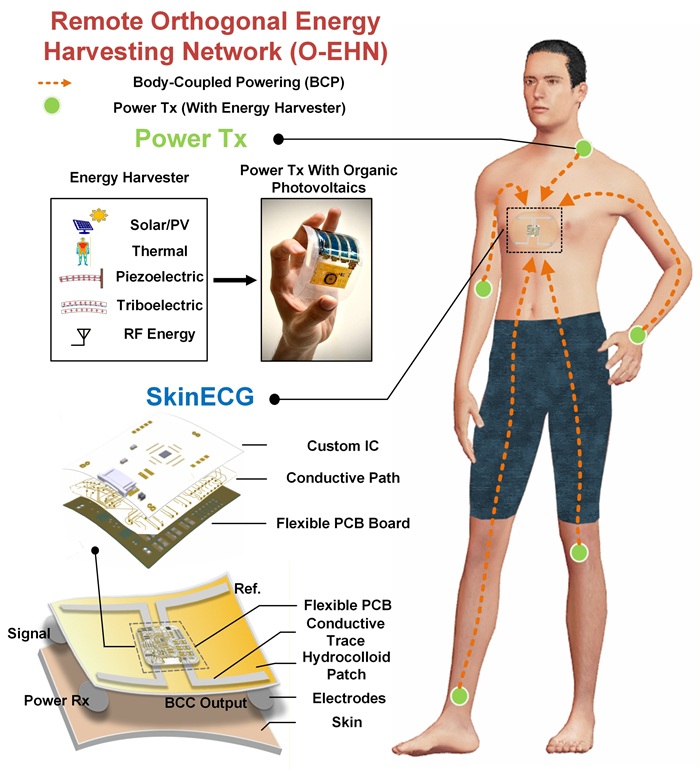
A research team led by Jerald Yoo at Seoul National University has developed a skin-conformal wearable healthcare system, “SkinECG,” that can measure heart signals without using a battery. The findings, published in Science Advances, address a major challenge in wearable technology—reliable power supply.
Overcoming Limitations of Conventional Wearables
Wearable devices, especially Electrocardiography sensors, play a crucial role in monitoring heart activity and detecting conditions such as arrhythmias. However, traditional systems rely on batteries, which increase device size and weight. Moreover, batteries require regular charging or replacement, often interrupting continuous health monitoring.
Tackling the “Location Mismatch” Challenge
Although researchers have explored energy harvesting from sources like light, heat, and motion, a key limitation persists. Typically, the best locations for harvesting energy differ from those for measuring physiological signals. For instance, solar cells work best on exposed areas like arms, while ECG sensors need chest placement.
To address this issue, the team introduced a novel architecture that wirelessly transfers energy from body-worn harvesters to a chest-mounted sensor. They termed this system an Orthogonal Energy Harvesting Network (O-EHN).
Innovative Skin-Based Power Transfer
Instead of relying on conventional electromagnetic radiation, the researchers guided power along the skin using body-coupled transfer. This approach significantly improves efficiency, especially near the human body where signal loss is common.
Additionally, the system assigns different frequency channels to multiple energy sources, minimizing interference and ensuring stable power delivery. Importantly, the design maintains safety by keeping energy exposure at levels comparable to everyday environments.
Toward Next-Generation Healthcare Devices
As reported by medicalxpress, the team successfully demonstrated continuous ECG monitoring powered solely by harvested energy. Furthermore, the technology can extend to other biosignals such as EMG and EEG.
Overall, this innovation paves the way for lighter, battery-free wearable and implantable devices, marking a significant step toward advanced, long-term digital healthcare solutions.
