
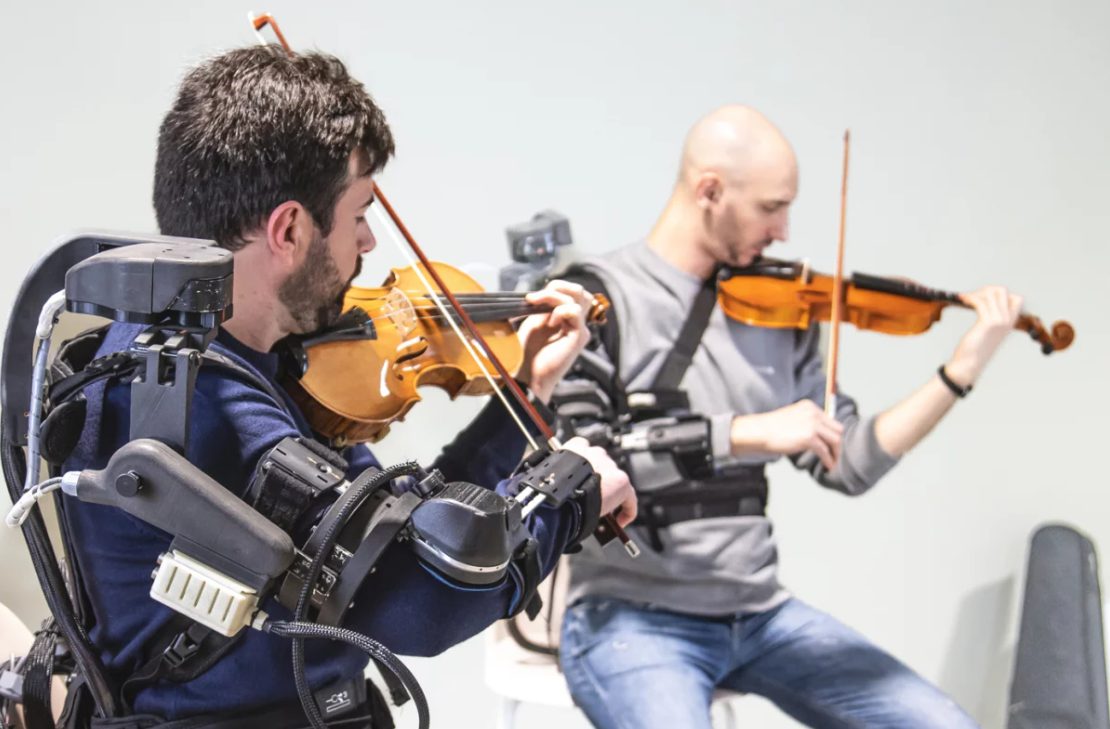
Musicians just gained a sixth sense they never knew they needed. Haptic exoskeletons are creating invisible physical connections between violinists, letting them unconsciously sync their movements like they’re sharing the same nervous system.
The Invisible Connection
Twenty violinist pairs recently performed duets while wearing lightweight exoskeletons, completely unaware that servo motors were subtly adjusting their arm movements based on their partner’s actions. The EU-funded study, published in Science Robotics, tested four conditions:
- Audio only
- Audio plus visual cues
- Audio plus haptic feedback
- The full sensory combo
The results shattered assumptions about how musicians coordinate. “Haptics provides physical, direct information that the human motor system integrates efficiently, even in skilled artists,” explains Francesco Di Tommaso from Rome’s UCBM CREO Lab. Professional violinists benefited most—likely because years of training heightened their touch sensitivity.
Beyond Better Bow Sync
Your muscle memory for riding a bike relies on similar haptic feedback, but this system creates shared physical awareness between separate people. The bidirectional exoskeletons transmitted real-time force data through two-degree-of-freedom arm controls, improving spatiotemporal alignment and bow position synchronization.
Think of it as autocorrect for physical movements, but so subtle that users never noticed the mechanical nudges guiding their technique. The €5 million CONBOTS project represents something bigger than better ensemble playing. These aren’t bulky industrial exoskeletons—they’re designed to preserve musical expressivity while enabling precise skill transmission.
Teaching Through Touch
Physical skills have always required in-person guidance—until now. “Robots mediate physical communication, enhancing coordination, learning, and rehabilitation,” notes Domenic Formica from UCBM’s NeXTlab. The technology opens possibilities for remote teaching across disciplines where muscle memory matters:
- Surgical procedures
- Athletic techniques
- Dance choreography
Future versions could slim down to vibration-based haptic suits, making the technology accessible for everyday skill learning. Arthur C. Clarke’s vision of technology enhancing rather than replacing human connections finds perfect expression here—amplifying the irreplaceable intuitive bonds between teachers and students through cybernetic links.
The unconscious learning aspect represents the real breakthrough. Your brain integrated these physical cues without conscious effort, suggesting haptic feedback could accelerate skill acquisition across any field requiring precise motor coordination.
